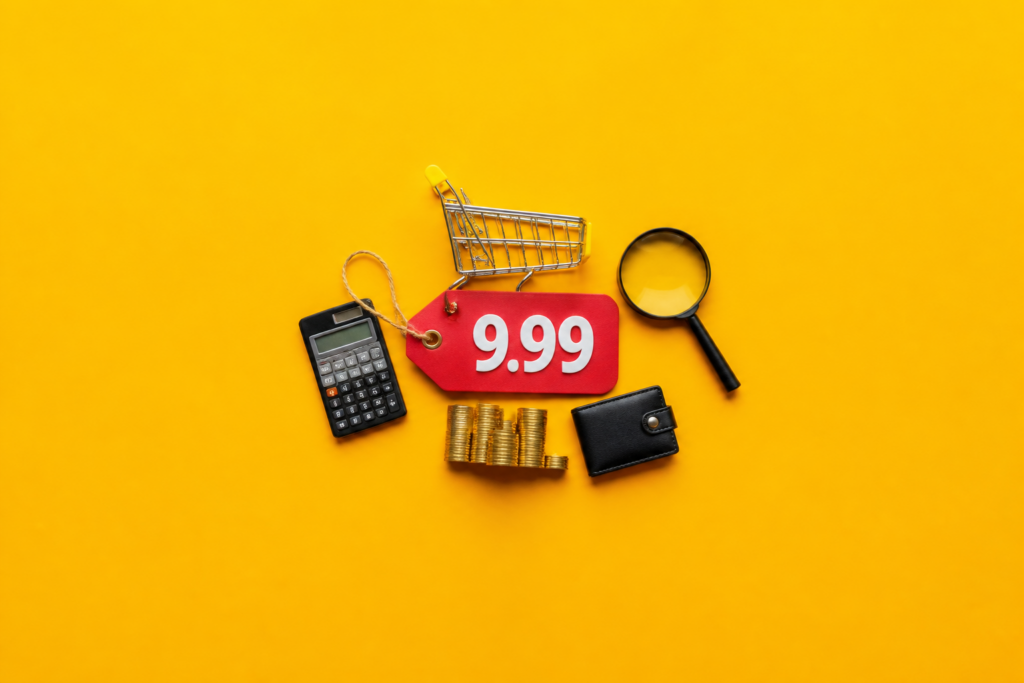

$9.99 works because shoppers read the first digit first, not because they are fooled in a cartoonish way. A price of $9.99 lands in the nine-dollar mental bucket, while $10.00 crosses into the ten-dollar bucket, and that boundary changes perception fast enough to affect sales.
That effect survives consumer awareness because awareness and automatic perception are not the same thing. People know charm pricing exists and still react to the left digit, to discount cues, and to the feeling that a price ending in 9 belongs in the value lane.
It loses force when the product needs prestige instead of value. Premium brands use round numbers to signal confidence, control, and exclusivity, and digital shoppers who compare tabs and totals line by line notice the trick faster than a casual in-store buyer.
What $9.99 pricing does to the buyer’s brain
$9.99 pricing, known as Charm pricing, exploits the Left-digit effect. The shopper anchors on the first digit, so $9.99 feels closer to $9 than to $10 even when the difference is one cent.
The brain does not process price as a perfect spreadsheet. It compresses numbers into categories, and that categorization favors the leftmost digit. A shelf tag that reads $9.99 sits in the same perceived zone as “under ten,” while $10.00 crosses a clean threshold.
That tiny crossing point does the work. A cent does not change product quality, but the label changes the mental frame from bargain-adjacent to fully ten-dollar pricing. The purchase decision often follows the frame, not the arithmetic.
Visible discount cues strengthen the effect. A strikethrough on the old price, a percentage-off badge, or a comparison against a higher reference price gives the 9-ending number a value signal that shoppers recognize instantly.
Psychological mechanisms that keep charm pricing alive
Prices ending in 9 have lifted sales by 20% to 24% versus equivalent round prices in widely cited retail findings tied to Anderson-Simester-style evidence. The lift is strongest when the item is practical, the price is visible, and the shopper is comparing options quickly.
The structure of the number matters as much as the number itself. $19.99 signals a lower tier than $20.00, $49.99 feels below $50, and the same pattern repeats across price points because the left digit keeps shifting the mental category.
Another force works in the background: 9-ending prices are associated with promotions. Years of retail exposure taught shoppers to read them as sale-coded, so the format itself carries a value cue before the product description even enters the picture.
That cue is strongest for utilitarian products. Grocery staples, household goods, low-risk apparel, and everyday software subscriptions benefit because the shopper wants a good deal more than a prestige signal.
| Price | Perceived Value | Purchase Likelihood |
|---|---|---|
| $9.99 | Closer to $9 | Higher |
| $10.00 | Closer to $10 | Lower |
Source: The Psychology of Pricing
Where $9.99 pricing loses ground in premium markets
Luxury pricing uses round numbers because roundness signals deliberateness. A $100 item reads as refined and unforced; a $99.99 item reads as mass-market and promotional, which works against the positioning premium brands sell.
That is the point where Discount calculator thinking becomes more useful than charm pricing. Premium buyers compare price with status, craftsmanship, and brand distance from discount culture, not with the feeling of saving a cent.
Fine jewelry, high-end hospitality, designer apparel, and premium consulting fees rely on clean numbers because the number itself becomes part of the product story. A round tag supports confidence; a 9-ending tag invites bargain logic.
Luxury shoppers also decode the seller’s intent faster. When the item is expensive, the buyer wants proof of quality, not a small psychological nudge that belongs in mass retail.
What consumer awareness changes, and what it does not
Awareness strips away some of the magic, but it does not erase the mechanism. Shoppers who recognize charm pricing still process the left digit, and many still respond to the implied discount even while knowing the tactic is deliberate.
That produces a split market. Informed buyers resist the cue more than casual buyers do, yet the price format keeps working enough to matter because retail decisions are fast, repetitive, and often made under time pressure.
Online shopping has reduced blind spots. Price comparison tabs, review pages, and filtered search results make the difference between $9.99 and $10.00 more visible, so the tactic has to compete with explicit sorting and transparent alternatives.
Public familiarity also creates skepticism. A shopper who has seen charm pricing for years reads it as a sales device, which weakens the emotional lift, but skepticism does not automatically translate into a neutral decision. Many buyers still treat the lower left digit as the cleaner deal.
Digital shopping, subscriptions, and microtransactions
Subscription pricing changed the frame. $9.99 per month does not trigger the same bargain response as a one-time retail tag because the shopper now evaluates recurring cost, cancellation friction, and total yearly spend.
That shift makes the tactic less stable in digital products than in physical retail. Streaming, apps, cloud tools, and memberships all compete on retention, usage, and habit, so the headline price is only one part of the decision.
Microtransactions introduce another layer. A 99-cent add-on or a $9.99 upgrade slot feels small in isolation, yet repeated purchases make the cumulative cost obvious, which weakens the charm effect as the buyer gains more context.
Transparent checkout pages also blunt the impact. When taxes, fees, and bundled charges appear before payment, the clean psychological edge of $9.99 shrinks because the final number, not the shelf number, becomes the real reference point.
When $9.99 pricing works best, and when round numbers win
| Product Category | Effectiveness of $9.99 Pricing | Preferred Pricing Strategy |
|---|---|---|
| Utilitarian Products | High | $9.99 pricing |
| Premium/Luxury Products | Low | Round numbers (e.g., $100) |
| Online Retail | Moderate | $9.99 pricing with caution |
| Subscription Services | Variable | Context-dependent pricing strategies |
Source: Charm Pricing 9.99
Value-focused products get the strongest lift because the buyer wants a bargain signal. Round-number pricing works better when the brand sells trust, prestige, or simplicity rather than savings.
Retailers selling across multiple channels need tighter control. A brick-and-mortar discount strategy that works on end caps and promo signs often fails for a premium landing page, and the same price format does not belong on every channel.
The best fit is determined by price sensitivity, brand position, and the buying context. A low-friction utility product in a promotion benefits from 9-ending pricing; a status product does better when the number looks deliberate and clean.
Pricing rules that still hold in 2026
$9.99 still moves behavior because the human brain still processes left digits first, and retail environments still reward fast decisions. Consumer awareness reduces the size of the effect, but it does not remove the underlying category shift from nine to ten.
The pattern is strongest where shoppers seek value, weakest where they buy status, and least reliable where digital transparency exposes the total cost before checkout. Businesses that match the number format to the product and the audience keep the advantage; businesses that use 9-ending prices everywhere dilute it.
FAQs
Is $9.99 pricing effective for all products?
No, $9.99 pricing works best for utilitarian products and promotions. Premium and luxury items perform better with round numbers that support quality and exclusivity.
How does consumer awareness affect $9.99 pricing?
Awareness reduces the size of the effect because informed shoppers recognize the tactic, especially online. The left-digit effect still operates, so the strategy keeps some influence even with skepticism.
What are alternative pricing strategies to $9.99?
Round pricing fits premium positioning, value-based pricing fits products with strong differentiation, and subscription pricing fits recurring services where the total package matters more than the ending digit.