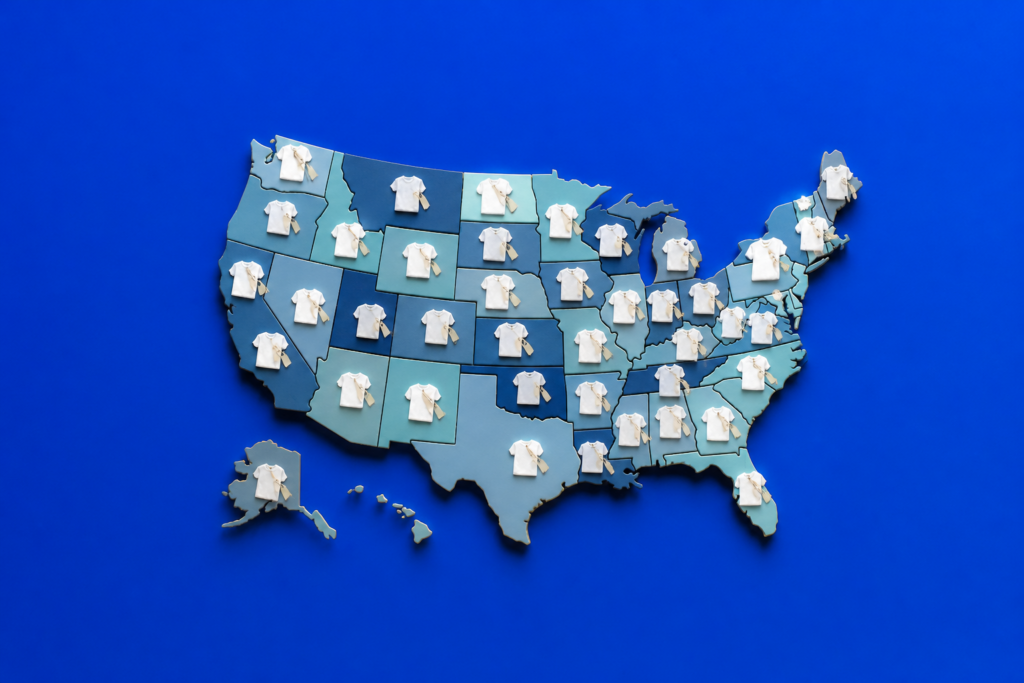

A $20 T-shirt does not stay at $20 once sales tax is added, and the final register total changes again when retailers price the same shirt differently by state. A 5% sales tax turns that shirt into $21. A 10% sales tax pushes it to $22.
State taxes are only one layer. Retail pricing follows local labor costs, rent, freight, and what nearby shoppers will pay, so the same basic cotton tee lands at different totals across the country.
Hawaii and Alaska sit near the top of national price indices, while Arkansas sits below the national average. That pattern lines up with the broader store-price gap shoppers see in clothing, food, and everyday goods. The latest state price data in Mapped: Grocery Prices Across U.S. States shows Hawaii at 131.4 for grocery prices and 183.9 for cost of living, Alaska at 125.0 and 126.7, California at 109.3 and 143.1, and Arkansas at 94.3 and 90.1.
Impact of Sales Taxes on T-Shirt Prices
Sales tax is the fastest way a $20 shirt stops being a $20 shirt. A state with a 5% sales tax adds $1, while a state with a 10% sales tax adds $2, and local sales taxes push the final total even higher in many cities.
That gap looks small on one item and large over a year of shopping. A family buying clothes, shoes, and school basics across multiple purchases pays the tax every time the item is taxable. Clothing tax rules also differ by state, so the sticker price and the receipt total do not always move together.
State and local collections drive the gap. New Hampshire, Oregon, Montana, Delaware, and Alaska do not use a broad state sales tax, while many states layer state and local rates on top of the shelf price. The effect is immediate at checkout: the posted $20 becomes the base, not the total.
Sales tax calculator figures show the receipt total before you buy, and the math is always the same: base price plus tax equals final price.
Cost of Living Differences Across States
Retailers do not price clothing in a vacuum. Higher rents, higher wages, higher shipping costs, and higher operating expenses show up in the price tag, so the same T-shirt carries a different shelf price in a high-cost state than in a low-cost one.
State price indexes make the pattern visible. Hawaii posted a grocery price index of 131.4 and a cost of living index of 183.9 in the latest state table, which signals a steep retail environment across everyday goods. Alaska also ran above the national average with a grocery price index of 125.0 and a cost of living index of 126.7. California sat above average as well at 109.3 and 143.1. Arkansas landed below average at 94.3 and 90.1, which points to lower baseline store costs.
| State | Grocery Price Index 2025 | Cost of Living Index 2025 |
|---|---|---|
| Hawaii | 131.4 | 183.9 |
| Alaska | 125.0 | 126.7 |
| California | 109.3 | 143.1 |
| Arkansas | 94.3 | 90.1 |
Source: Mapped: Grocery Prices Across U.S. States
The same logic reaches apparel. A retailer with expensive storefronts in Honolulu or Anchorage prices to protect margin; a chain with lower overhead in Little Rock or a smaller Midwest market has more room to keep a basic tee close to the national sticker price. Shipping also matters more for remote states, where moving inventory costs more before the shirt even reaches the rack.
Arkansas is the clearest low-cost example in the state table. Grocery prices there sit 5.7% below the national average, which points to a lower-cost retail base across ordinary consumer goods. That does not force a T-shirt price down by the exact same percentage, but it pushes the final number in that direction.
Regional Pricing Strategies by Retailers
Retail chains use state and regional pricing to protect margins and match local demand. A T-shirt in Manhattan stores at a different level than the same shirt in a less expensive market because rent, labor, shrink, and competition differ from one place to another.
Chains also watch what local shoppers accept as normal. Premium basics, licensed graphics, and mall-oriented fashion lines support higher prices in dense metros and tourist-heavy states. Discount basics get priced tighter in value-driven regions, especially where competition from warehouse clubs, off-price chains, and online fulfillment keeps margins thin.
Store format changes the number too. A small tourist shop, a big-box retailer, and an outlet store sell the same cotton tee through different cost structures, so the state you are shopping in and the channel you choose both shape the receipt total. The shirt is the same; the pricing logic is not.
That is why a $20 label is only a reference point. In one state the shirt remains near $20 before tax, in another it lands at $22 or more before the receipt even prints, and in a lower-cost market it may stay close to the original tag. Sales tax, local costs, and retailer strategy work together, so the same basic T-shirt carries different totals from one state line to the next.
FAQs
Why do T-shirt prices vary across US states?
T-shirt prices vary across US states due to differences in state-specific sales taxes, cost of living, and regional pricing strategies by retailers.
How do state sales taxes affect clothing prices?
State sales taxes directly increase the final price of clothing items, including T-shirts, with higher tax rates leading to higher prices for consumers.
Which states have the highest clothing prices?
States with higher costs of living, such as Hawaii and Alaska, often have higher clothing prices due to increased operational costs for retailers.
Can I find cheaper T-shirts in states with lower costs of living?
Yes, states with lower costs of living, like Arkansas, may offer lower clothing prices, including T-shirts, due to reduced operational expenses for retailers.