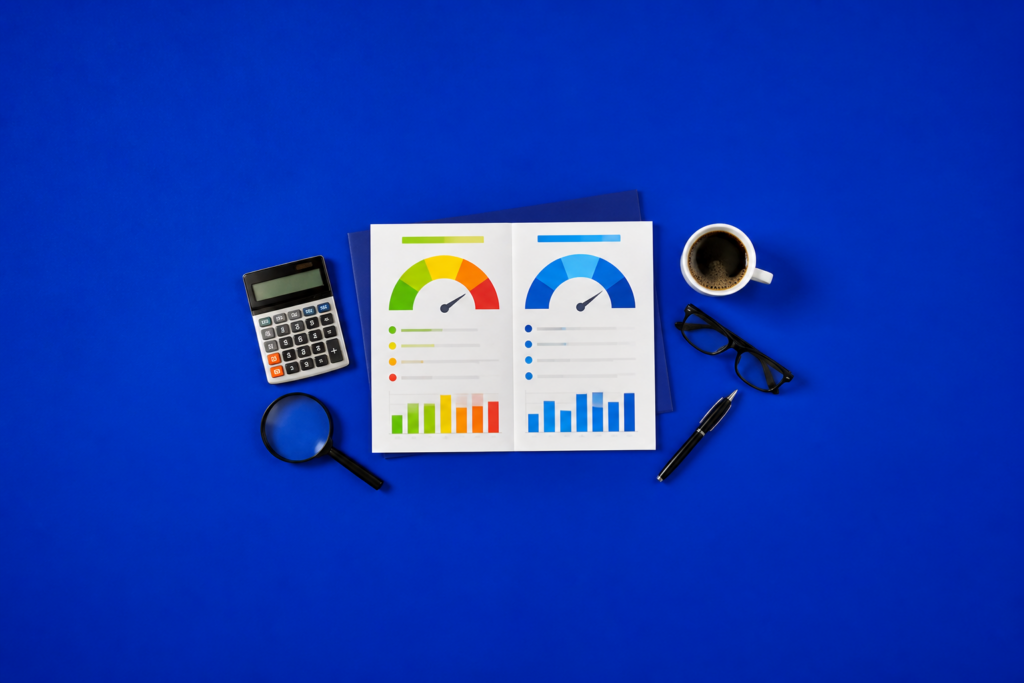

Business credit scores and personal credit scores live in separate systems. Business scores track a company’s payment behavior, public filings, debt load, and trade history; personal scores track an individual’s consumer borrowing and repayment history. The two score types use different bureaus, different data, and different score ranges, so one does not replace the other.
That separation changes lending, supplier terms, liability protection, and how lenders assess new companies. It also changes what happens when a business is young, thinly documented, or tied to an owner’s guarantee.
Introduction to Business and Personal Credit Scores
A business credit score measures how a company handles obligations in its own name. A personal credit score measures how a person handles consumer debt in their own name. The scores answer different questions, which is why a bank, vendor, or landlord may review both and still treat them as separate files.
Consumer scores usually come from the major consumer bureaus and use the familiar 300 to 850 range. Business scores come from Major business bureaus such as Dun & Bradstreet, Experian Business, and Equifax Business, and many business models use a 0 to 100 scale. Those ranges are not interchangeable, and the data behind them is not the same.
Business credit scores
Business credit scores evaluate a company’s ability to pay suppliers, lenders, and other creditors on time. They draw on trade lines, public records, collections, credit utilization, and years in operation. A vendor reviewing a score wants to know whether the company pays its invoices and whether it has a pattern of late payment or default.
Business scores also serve practical screening functions. Suppliers use them to set terms, insurers use them to gauge exposure, and lenders use them to size the risk of extending credit without requiring a large deposit or collateral package.
Personal credit scores
Personal credit scores measure an individual borrower’s repayment history across consumer accounts. Credit cards, mortgages, auto loans, student loans, and installment loans feed those scores. The file follows the person, not the company they own.
A consumer score affects approval odds, interest rates, credit limits, apartment applications, and personal guarantees. It also affects business finance when a lender decides the owner’s individual credit history belongs in the underwriting file.
Separate files, separate uses
The separation is not cosmetic. A company can have a strong business file and an owner with weak consumer credit, or the reverse. That split lets a business build its own reputation with lenders and suppliers instead of borrowing the owner’s reputation forever.
Business credit cards sit right in that gap: many small-business issuers still review the owner’s personal profile when the business lacks its own history, but the account can still feed the company’s business file after approval.
Legal Structures and Their Impact on Credit Separation
Business structure controls how far the company stands apart from its owner. Sole proprietorships and general partnerships have no separate legal identity from the owner or owners, so business obligations and personal obligations often overlap from day one. Corporations and LLCs are separate legal entities, so they create the framework needed for separate business credit profiles.
An EIN helps the company open financial accounts in its own name, but the legal entity does the real work. A sole proprietor can use an EIN and still remain personally liable for the business’s debts. An LLC or corporation creates a distinct legal shell, which is the starting point for separated credit files and limited liability.
Sole proprietorships and general partnerships
These structures tie the owner directly to the business. Creditors look through the business and evaluate the owner because there is no separate entity standing between them. That means a late payment on a business card or vendor account can land in the owner’s personal risk picture, especially if the debt was personally guaranteed.
Borrowing also stays tightly linked. A lender evaluating a sole proprietor does not need to hunt for a separate corporate history because the business and the person are one legal debtor.
LLCs and corporations
LLCs and corporations create the legal separation that supports a distinct business credit profile. The company can sign contracts, hold accounts, borrow funds, and build payment history under its own name. That separation does not erase the owner from underwriting, but it gives the business its own identity.
Formal separation matters most when the company grows. Once trade lines, loans, leases, and vendor accounts sit in the company’s name, the business file becomes a real asset that lenders and suppliers can review without treating every decision as a mirror of the owner’s consumer history.
Major Business Credit Bureaus and Scoring Models
Three bureaus dominate business credit reporting in the United States: Dun & Bradstreet, Experian Business, and Equifax Business. Each collects different information, reaches different coverage levels, and applies its own scoring model. A strong file at one bureau does not automatically mean a strong file at the others.
Dun & Bradstreet is known for the PAYDEX score, which focuses on payment timing. Experian Business uses products such as Intelliscore Plus, which blends payment behavior with business demographics and other risk signals. Equifax Business offers commercial scores that weigh payment history, public records, and account performance. The scoring labels differ, but the purpose stays the same: predict repayment behavior.
| Bureau | Common business score | Typical scale | Main emphasis |
|---|---|---|---|
| Dun & Bradstreet | PAYDEX | 0 to 100 | Payment timing with vendors and suppliers |
| Experian Business | Intelliscore Plus | 0 to 100 | Payment behavior plus broader risk variables |
| Equifax Business | Commercial score models | Varies by product | Payment history, public records, and credit usage |
Source: Do Businesses Have Credit Scores? Here’s How They Work
Consumer bureaus work differently. Experian, Equifax, and TransUnion generate personal scores from consumer credit files and report them on the 300 to 850 scale used in everyday lending. A business owner who checks only a consumer score misses the separate commercial file that suppliers and lenders may be using behind the scenes.
What goes into each score
Business scoring models lean heavily on payment history, credit lines with suppliers, public records, company age, industry risk, and high-balance patterns. Consumer scoring models focus on revolving utilization, installment payment history, length of credit history, recent inquiries, and derogatory marks tied to personal accounts.
The same event can affect both systems differently. A personal credit card charge does not belong in a business credit file unless the account is reported as a business account or mixed in through a personal guarantee. A vendor invoice paid late may affect the business score without touching the owner’s consumer score at all.
How Business and Personal Credit Scores Affect Each Other
The two systems stay separate, but they are not sealed off from each other. New businesses often lack enough commercial history for lenders to price risk confidently, so the owner’s personal file becomes part of the underwriting picture. Some business scoring models also pull consumer data when the company has too little commercial history to evaluate on its own.
Experian’s Intelliscore Plus is one example of a commercial score that incorporates personal credit information in certain files, especially for newer firms. Lenders also demand personal guarantees on many small-business loans, business cards, and equipment leases. That guarantee keeps the owner personally responsible if the company does not pay.
New businesses lean on personal credit
A startup with no trade lines, no vendor accounts, and no payment history has little commercial data to score. Underwriters fill that gap with the owner’s consumer profile, tax history, business plan, bank statements, and industry risk. The company still starts a business file, but the owner’s credit carries more weight until the file matures.
That pattern fades as the business builds its own record. Once suppliers report payment history and lenders see repeated on-time performance, the company’s file starts standing on its own more reliably.
Personal guarantees keep the owner exposed
A personal guarantee puts the owner’s personal assets and consumer credit on the hook for a business obligation. If the company defaults, the creditor can pursue the guarantor personally, and the default can damage the owner’s consumer profile through collections, lawsuits, or other reporting activity tied to the guarantee.
This is the main reason business credit and personal credit still cross paths in real life. The legal entity may be separate, but the contract often is not.
What does not cross over
Routine business operations do not automatically spill into a personal file. A supplier invoice paid by the company does not belong on the owner’s consumer report just because the owner signed the lease or incorporated the business. Separation stays intact when the accounts are opened in the company’s name, the records stay clean, and no personal guarantee is triggered by default.
That separation disappears when finances get mixed. Paying business bills from a personal card, using the business account for household expenses, or failing to document transactions invites confusion in underwriting, taxes, and liability disputes.
Keeping Business and Personal Credit Profiles Separate
Separate bank accounts, separate cards, separate books, and a formal entity create the cleanest divide. The company needs its own EIN, its own checking account, and its own vendor and lender relationships. Those basics give the business file something real to report and protect the owner from needless overlap.
Commingling funds undermines the legal wall that LLCs and corporations are built to create. Courts, lenders, and tax authorities look for patterns that show the owner treated business money as personal money. That behavior weakens liability protection and muddies the credit trail.
- Open business checking and savings accounts in the company’s legal name.
- Use business credit cards and vendor accounts for business expenses only.
- Pay invoices from business accounts, not from personal accounts.
- Keep accounting records current so every transaction has a clear purpose.
- Register with bureaus that report commercial trade lines, not just consumer accounts.
A clean file also improves underwriting speed. Lenders like documents that align: matching entity name, EIN, business address, bank records, and trade references. The fewer inconsistencies they find, the less they need to rely on the owner’s personal profile as a fallback.
Protecting liability protection
LLCs and corporations offer liability protection only when the owner respects the separation. That means distinct accounts, formal contracts in the entity’s name, and accurate bookkeeping. Once the owner treats business and personal money as the same pool, that protection loses force.
Credit separation and liability protection move together. The same discipline that builds a commercial credit profile also helps preserve the legal boundary between the owner’s assets and the company’s debts.
FAQs
What is the difference between business and personal credit scores?
Business credit scores assess a company’s ability to repay debts, while personal credit scores reflect an individual’s creditworthiness. Business scores draw on commercial trade lines, public records, and payment history tied to the company. Personal scores rely on consumer accounts such as credit cards, mortgages, auto loans, and other individual obligations.
How does business structure affect credit separation?
Sole proprietorships and general partnerships do not have a separate legal identity from their owners, so personal and business credit stay closely linked. Corporations and LLCs are separate legal entities, which lets the company build its own credit profile. The legal entity is the foundation for separation, not the EIN by itself.
Do personal credit scores impact business credit scores?
Some business credit scores, including Experian’s Intelliscore Plus, incorporate the owner’s personal credit information when the business lacks enough commercial history. Lenders also review personal credit when they require a personal guarantee. As the company builds its own trade history, the business file carries more of the weight.
Can I separate my business and personal credit?
Yes. Form a separate legal entity such as an LLC or corporation, obtain an EIN, open business bank accounts, and use business trade lines and cards for company spending. Reporting to business bureaus builds a distinct commercial file over time.
Why is it important to maintain separate credit profiles?
Separate credit profiles protect personal assets, keep business records accurate, and preserve the liability shield that LLCs and corporations provide. They also help lenders judge the company on its own performance instead of defaulting to the owner’s consumer history. That separation supports cleaner underwriting and cleaner bookkeeping.
Business and personal credit stay separate for a reason: companies borrow, individuals borrow, and the risk profile is not the same. The strongest setup is a business that builds its own commercial history while the owner keeps personal obligations out of company accounts. That structure gives lenders a clearer file, suppliers a cleaner payment record, and the owner a better shot at keeping personal assets outside business trouble.