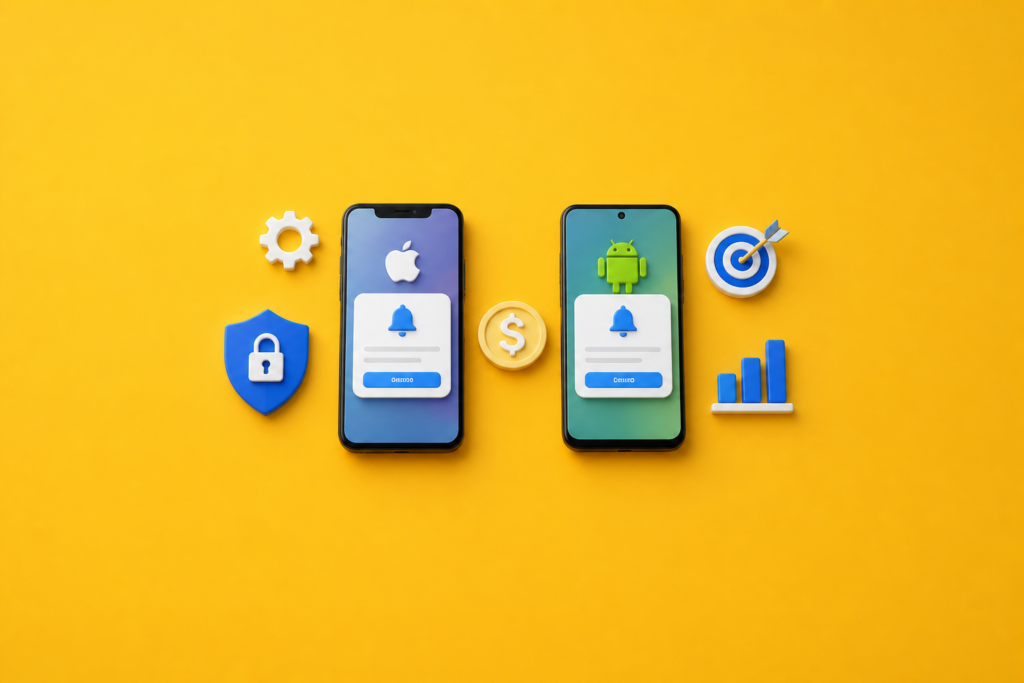

IOS requires explicit permission before a push token becomes useful for marketing, while Android allowed notifications by default on most devices before Android 13 added its own prompt. That difference produced a wide opt-in gap: iOS sits near 51%, Android devices on pre-Android 13 builds sit near 81%, and Android 13 and later dropped to 67% in 2025 after the prompt changed.
The conversion cost is not the permission screen alone. Every declined prompt shrinks your reachable audience, and every accepted prompt still has to earn opens, clicks, and downstream revenue. On the same dataset, average click-through rates were 3.05% on iOS and 3.78% on Android, while reaction rates were 4.9% on iOS and 10.7% on Android. That gap compounds fast when push is part of checkout recovery, reactivation, or subscription conversion.
Platform strategy follows the permission model. IOS demands a pre-permission build-up before the system prompt appears, while Android teams now need to design for an explicit ask on newer devices instead of relying on default delivery. Categories with stronger user intent, such as fintech, still outperform broad consumer segments, and personalized creative beats generic blasts across both operating systems.
IOS push permission versus Android push permission
IOS gates every notification channel behind a system consent prompt, so the app receives permission only after the user taps Allow. Android historically delivered notifications by default on many devices, then moved to an explicit runtime prompt with Android 13. The practical result is a higher initial acceptance rate on older Android builds and a sharper drop once Android 13 entered the mix. The prompt design, not the notification payload, creates the first conversion barrier.
The iOS pattern forces a tighter sequence: earn trust first, request permission second, then monetize the subscriber pool. Android’s earlier default-on model let teams send sooner, but that also masked weak permission strategy because the opt-in ask did not exist on many devices. Once the Android 13 prompt arrived, the difference between cohorts became visible in the numbers instead of being hidden inside delivery defaults.
| Platform | Opt-In Rate | Average Click-Through Rate (CTR) | Average Reaction Rate |
|---|---|---|---|
| IOS | 51% | 3.05% | 4.9% |
| Android (pre-Android 13) | 81% | 3.78% | 10.7% |
| Android (post-Android 13) | 67% | 3.78% | 10.7% |
Source: Push Notifications on iOS vs Android: How They Work in 2026
The 30-point spread between iOS and pre-Android 13 Android means the same install base produces very different message reach. The 14-point decline after Android 13 shows how quickly a permission model change alters the size of a reachable audience. Those numbers align with the broader platform behavior described in the iOS and Android setup guides from IOS push notification opt-in rate and Android push notification opt-in rate.
Real conversion cost from lower opt-in rates
Lower permission rates reduce the top of the funnel before any creative test begins. If only 51% of iOS users accept, then 49 out of every 100 installs never enter the push audience. On Android 13 and later, 33 out of every 100 installs remain outside the channel. That loss shows up as fewer recoverable carts, fewer reactivation touches, and fewer opportunities to move a user from intent to transaction.
The cost rises in a non-linear way because push works best on users already near action. A declined permission does not just remove one send; it removes the reminder loop that catches abandoned carts, subscription renewals, and price-drop triggers. For any app that depends on repeat visits, the permission rate changes the value of each acquisition dollar before the first campaign goes out.
CTR and reaction rate tell the second half of the story. Android’s 3.78% CTR outpaced iOS at 3.05%, and the reaction rate spread was wider still at 10.7% versus 4.9%. The audience that stays subscribed on Android has historically responded more often, but that advantage does not erase the opt-in loss on newer devices. A larger accepted audience with slightly lower response still beats a smaller audience with slightly better response when total conversion volume is the goal.
Industry mix changes the math further. Fintech pull rates sit above retail and media, while action games and news show the widest gap between the two platforms in the sample below.
| Industry | IOS Opt-In Rate | Android Opt-In Rate |
|---|---|---|
| E-commerce & Retail | 52.78% | 75.28% |
| Fintech | 69.64% | 83.85% |
| Action Games | 44.17% | 74.68% |
| Media & Entertainment | 59.93% | 76.68% |
| News | 51.84% | 68.00% |
Source: IOS push notifications guide (2026): How they work, setup, and best practices, Android push notifications explained: Setup, permissions & best practices
Fintech’s 69.64% iOS opt-in and 83.85% Android opt-in show that trust-heavy categories still outperform the average. Action games tell the opposite story: 44.17% on iOS and 74.68% on Android. That spread is the real conversion cost in practice, because the same install volume feeds a much smaller permission pool on iPhone and a changing pool on Android 13-era devices.
Strategies to Optimize Push Notification Engagement
Permission quality rises when the ask follows visible value. Users accept push more readily after a clear product action, a benefit they just saw, or a setting they intentionally enabled. Broad, front-loaded permission requests produce weaker opt-in than contextual asks tied to checkout tracking, price alerts, order updates, or saved preferences.
- Use a pre-permission dialog on iOS before the system prompt. In shopping and games, that sequence lifts opt-in by 15% to 25% because the user sees a reason before the OS request appears.
- Segment by intent and lifecycle stage. A new installer, a cart abandoner, and a dormant subscriber need different copy, frequency, and send timing.
- Use a push notification service such as Push notification services to manage platform-specific prompt timing, audience buckets, and delivery rules across iOS and Android.
- Write personalized messages. Personalized push notifications generate 4x higher open rates than generic ones, so a named product, behavior-based offer, or location-based trigger outperforms a one-size-fits-all blast.
- Add rich media when the format supports it. Rich push notifications with images lift engagement by 56%, which makes visuals useful for product drops, menu items, travel offers, and media promos.
The sequence matters as much as the creative. On iOS, the best-performing flow usually starts with a custom prompt, then moves into the native permission dialog only after the user has already signaled interest. On Android 13 and later, that same discipline prevents the runtime prompt from becoming a dead end, since the OS now asks for consent before delivery begins. The result is a permission ask that behaves like part of the product instead of a detached interruption.
Personalized content closes the gap after opt-in. A generic promo line burns the limited audience you worked to acquire, while behavior-based messaging keeps the channel tied to observed intent. Rich creative then raises the probability that the user taps, and the higher CTR feeds better conversion downstream because the notification is carrying a specific next step instead of a vague announcement.
Platform differences do not disappear in 2026. IOS still demands the cleanest permission strategy, Android still carries the higher legacy opt-in rate on older devices, and Android 13 changed the baseline enough to make the audience split visible in every dashboard. Teams that treat permission as a conversion gate, not a technical checkbox, preserve more of their acquisition spend and get more revenue from the users who stay.
FAQs
How do iOS and Android handle push notification permissions?
IOS requires explicit user consent for push notifications, while Android’s opt-in rate is around 81%, though this has declined to 67% with Android 13’s explicit opt-in requirement.
What impact do push notification permission models have on conversion rates?
The differing permission models on iOS and Android lead to varying conversion rates, with Android’s higher opt-in rate potentially resulting in greater user engagement.
How can I improve push notification opt-in rates on iOS?
Use a pre-permission dialog before the iOS system prompt. In shopping and games, that approach lifts opt-in by 15% to 25% because the request arrives after the user has seen value.
What are the benefits of personalized push notifications?
Personalized push notifications generate 4x higher open rates than generic ones. That lift gives you more opens from the same permission pool, which improves the odds of click-through and downstream conversion.