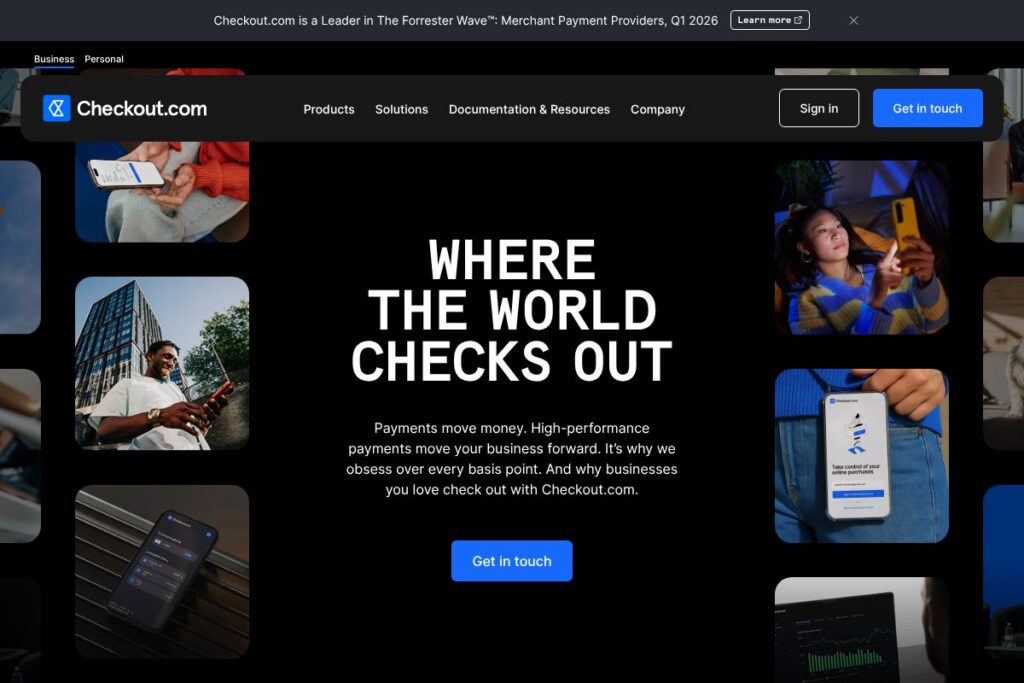

Checkout.com: An Overview
Checkout.com provides end-to-end payment processing for businesses that accept payments online and disburse funds across markets. The platform combines acquiring relationships, processing infrastructure, fraud and risk controls, and payment method coverage into a single provider aimed at improving acceptance rates and simplifying cross-border commerce.
Compared with Stripe, Checkout.com positions itself more heavily toward enterprise negotiations and local acquiring in many markets, offering bespoke routing and local issuing relationships that can improve acceptance in regionally complex payments flows. Against Adyen, Checkout.com has a similar focus on direct acquiring and global scale, while competing with PayPal on consumer-facing payment method coverage but differentiating through direct-card processing and AI-driven optimization.
All of this makes Checkout.com well suited for mid-market and enterprise merchants that need global coverage, higher acceptance through routing and retry logic, and tighter control over fraud and payouts. The platform is particularly useful for companies with multi-currency volumes, regional footprint requirements, or complex payouts to sellers or vendors.
How Checkout.com Works
The platform operates as an integrated payments stack combining payment routing, local acquiring, fraud detection, and settlement tools. Merchants send payment requests via REST APIs or client SDKs; Checkout.com processes those requests, applies risk checks and routing rules, and submits transactions to the best acquiring path based on card scheme, region, and historical performance.
For common implementations merchants use hosted payment pages for quick checkout flows or integrate server-to-server using the API for a fully embedded experience. Intelligent Acceptance uses real-time network data and machine learning to choose authorization routes and retry strategies that maximize successful authorizations while controlling chargeback risk.
Checkout.com also consolidates reporting, reconciliation, and balance management in a single dashboard, giving finance teams visibility over payins, refunds, and multi-currency settlements. Payouts and disbursements can be directed to multiple entities and markets through configurable payout rails and local currency options.
What does Checkout.com do?
Checkout.com combines global acquiring, payment processing, fraud and risk management, developer APIs, and payouts into one payments platform. Recent emphasis has been on Intelligent Acceptance, AI-powered optimization for routing, and expanding local acquiring coverage to improve acceptance in key markets.
Intelligent Acceptance
Intelligent Acceptance uses machine learning to pick the best acquiring route and retry patterns for each transaction. This increases successful authorizations and can raise conversion without manual rule maintenance.
Fraud Detection and Risk Tools
A suite of fraud controls, identity verification, and authentication options lets merchants tune blocking and scoring to their risk tolerance. These tools combine device, behavioral, and network signals to reduce false declines and fraud losses.
Global Acquiring and Local Processing
Local acquiring capabilities reduce cross-border friction, allow local settlement, and avoid some foreign exchange costs. This is particularly important in markets with local scheme preferences or regulatory requirements.
Wide Payment Method Coverage
Support for major card networks, digital wallets, bank transfers, direct debit schemes, and local voucher or bank-based methods helps merchants offer locally preferred payment options. Merchants can present relevant methods by region to improve conversion.
Payouts and Reconciliation
Flexible payout rails enable disbursements to merchants, sellers, or vendors in many currencies and geographies. Built-in reconciliation and reporting tools reduce manual accounting work across settlements and refunds.
Developer APIs and SDKs
Comprehensive REST APIs, client libraries, and webhooks support server, mobile, and frontend integrations. APIs cover authorization, tokenization, payouts, and reporting so engineering teams can build custom workflows.
Hosted Payment Pages
Hosted pages provide a fast integration option that offloads PCI scope and simplifies accepting payments with a configurable checkout experience. This is useful for teams that want a secure, lower-maintenance integration path.
Security and Compliance
The platform includes PCI-compliant processing, support for strong customer authentication, and compliance features tuned for cross-border operations. Security controls and reporting help meet regulatory requirements in multiple jurisdictions.
The biggest benefit of Checkout.com is combining local acquiring and AI-driven routing with developer-friendly APIs, which drives higher acceptance while keeping integrations flexible for engineering teams.
Checkout.com Pricing
Checkout.com uses custom, enterprise-oriented pricing rather than a single public pricing table; charges typically combine processing fees, local acquiring arrangements, and volume- or region-based components. Pricing varies by region, payment method, and merchant volume, and is generally negotiated for mid-market and enterprise customers.
For current pricing options and to request a quote, contact Checkout.com’s team through the Checkout.com website to discuss how fees will be structured for your business and markets.
What is Checkout.com Used For?
Checkout.com is used to accept online payments, optimize authorization success, and manage cross-border settlement for e-commerce retailers, marketplaces, travel platforms, and digital services. Teams use the platform to reduce false declines, expand local payment choices, and centralize settlement reporting across multiple countries.
Product and engineering teams use Checkout.com’s APIs to embed payment flows and build customized checkout experiences, while finance teams rely on its reconciliation and payout capabilities to simplify accounting across currencies and entities. Risk teams use the fraud tools and authentication options to balance acceptance and security.
Pros and Cons of Checkout.com
Pros
- High acceptance and routing control: Checkout.com’s Intelligent Acceptance and local acquiring relationships often improve authorization rates and reduce lost revenue from declines.
- Enterprise-grade global coverage: The platform supports many currencies and local payment methods, with local acquiring in numerous markets to simplify cross-border operations.
- Developer-friendly APIs: Comprehensive APIs, SDKs, and webhooks make it straightforward for engineering teams to integrate customized checkout and payout flows.
- Advanced fraud and identity tools: Flexible fraud scoring and verification options let risk teams tune protection without severely impacting legitimate conversions.
Cons
- Custom pricing model: Negotiated pricing means less transparency for smaller merchants; you need to engage sales to get specific fee structures and may not find published, fixed-rate plans.
- Enterprise orientation: Checkout.com’s focus on larger merchants may mean the onboarding process is more sales-driven and tailored, which can be heavier than plug-and-play providers geared to small businesses.
- Regional availability nuances: While coverage is broad, specific local acquiring capabilities vary by market and may require additional configuration or contracts.
Does Checkout.com Offer a Free Trial?
Checkout.com provides paid services with custom pricing and does not advertise a public free plan or trial. Businesses typically engage with sales to evaluate product fit and arrange sandbox or test environments via the developer documentation to validate integrations before going live. For sales inquiries and to request access to test environments, visit the Checkout.com website.
Checkout.com API and Integrations
Checkout.com publishes developer APIs and SDKs that cover payments, tokenization, payouts, and reporting; the API documentation provides endpoints, sample code, and integration guides for server and client implementations. Webhooks and client libraries in multiple languages support real-time event handling and common platforms.
Key platform integrations include e-commerce platforms and payment plugins for popular stacks, as well as connections to ERP and accounting systems for settlement and reconciliation. Checkout.com also supports custom integrations through its APIs for marketplaces and platforms that require complex payout routing.
10 Checkout.com alternatives
Paid alternatives to Checkout.com
- Stripe — A developer-first payments platform with transparent, published fees and extensive APIs for payments, billing, and issuing. Known for fast onboarding and broad third-party integrations.
- Adyen — Global acquiring and processing platform that provides unified commerce, local acquiring in many markets, and enterprise features for omnichannel merchants.
- PayPal — Consumer-facing payments network with wide wallet adoption and merchant solutions for online checkout, payments, and invoicing.
- Braintree — A PayPal company offering card and alternative payment processing with SDKs for mobile and web, favored for mobile-first merchants.
- Worldpay — Large global acquirer with broad merchant services, in-person and online payment solutions, and enterprise pricing options.
- Authorize.Net — Longstanding US-focused payment gateway for merchants seeking a reliable gateway with developer tools and payment method support.
- Square — Known for point-of-sale and small business tools, with integrated online payments and invoicing for SMBs.
Open source alternatives to Checkout.com
- Kill Bill — Open source billing and payment orchestration platform you can self-host to manage payments, subscriptions, and invoicing logic across multiple gateways.
- Apache OFBiz — An open source enterprise automation suite with commerce and financial modules that can be extended to integrate with payment processors.
- Solidus — An open source e-commerce platform that can be paired with payment gateways and custom processing logic for merchants building full-stack stores.
- Spree Commerce — Modular open source e-commerce platform that supports integration with external payment gateways and custom payment flows.
Frequently asked questions about Checkout.com
How does Checkout.com handle international payments?
Checkout.com supports local acquiring and multi-currency processing. The platform lets merchants accept payments in local currencies and route transactions through local acquirers to reduce cross-border friction and improve acceptance rates.
Does Checkout.com provide developer APIs for payments?
Yes, Checkout.com offers comprehensive developer APIs and SDKs. The API documentation contains endpoints, client libraries, and guides for common integration patterns including tokenization, webhooks, and payouts.
What payment methods can Checkout.com accept?
Checkout.com accepts cards, digital wallets, bank transfers, direct debit schemes, and local payment methods. Merchants can present region-specific methods to customers based on geography and device.
Is Checkout.com PCI compliant and secure?
Yes, Checkout.com maintains PCI-compliant processing and supports secure tokenization and authentication flows. The platform includes security controls and compliance features to help merchants meet regulatory requirements in multiple regions.
How do I get pricing for Checkout.com?
Checkout.com uses custom pricing tailored to merchant size, volume, and markets. Contact the team via the Checkout.com website to discuss pricing and request a tailored quote.
Final Verdict: Checkout.com
Checkout.com is a strong choice for merchants that need enterprise-grade global processing, higher acceptance via Intelligent Acceptance, and control over payouts and settlement across currencies. Its combination of local acquiring relationships and machine learning-based routing helps reduce false declines and lift conversion in complex markets.
Compared to Stripe, which publishes transparent rates such as 2.9% + $0.30 per US transaction and appeals to developers seeking fast self-serve onboarding, Checkout.com takes a more customized pricing approach with deeper local acquiring coverage for enterprise customers. If your priority is transparent, small-business friendly pricing, Stripe may be a better fit; if your priority is improving acceptance and managing multi-country settlement at scale, Checkout.com is worth evaluating.
Overall, Checkout.com is best suited to larger merchants, marketplaces, and platforms that require regional acquiring, advanced fraud controls, and tailored commercial arrangements backed by developer APIs and production-grade infrastructure.