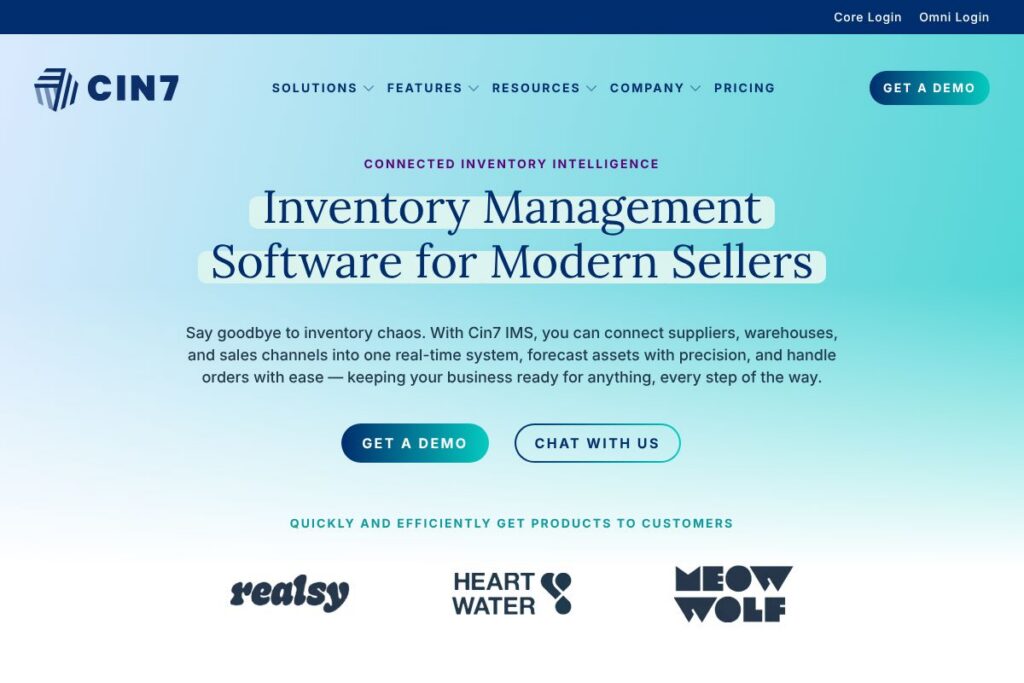

Cin7: An Overview
Cin7 is an inventory-first ERP designed for small and mid-market businesses that sell across multiple channels. It combines real-time inventory tracking, order management, point of sale, manufacturing features, and integrations with accounting systems to reduce manual reconciliation and improve fulfillment accuracy.
Compared with NetSuite, Cin7 targets smaller teams who need faster deployment and multichannel retail capabilities rather than a full enterprise ERP implementation. Against DEAR Systems, Cin7 emphasizes built-in POS and direct retailer/wholesale connectivity, while relative to Fishbowl it offers a broader cloud-native integration layer for marketplaces and e-commerce platforms.
Cin7 does particularly well at giving trading businesses a single source of truth for stock across warehouses and sales channels, while supporting basic production workflows and accounting integration. That makes it a fit for wholesalers, multichannel retailers, and manufacturers that outgrow spreadsheets or separate point solutions but do not need a large-scale ERP project.
How Cin7 Works
Cin7 centralizes inventory and order data from connected sales channels into a single catalog so stock levels, SKU details, and availability are updated in real time across marketplaces, webstores, and retail locations. Orders flow into Cin7 where they are allocated, fulfilled, and synced with shipping and accounting systems, reducing double data entry and stockouts.
For manufacturers, Cin7 links bills of materials and work orders to inventory consumption so components are reserved and finished goods are tracked through production stages. The platform supports automated rules for allocation, reorder suggestions, and transfers between warehouses to keep operations consistent as volume grows.
Integration is a core workflow: Cin7 connects to e-commerce platforms, marketplaces, POS systems, and accounting packages so financial reporting, sales data, and inventory cost layers remain aligned. Teams typically set up channel connectors, import SKU data, configure warehouse locations, and then use automation rules to handle routine fulfillment and replenishment tasks.
Cin7 features
Cin7’s feature set centers on inventory control, order management, production support, and integrations that bridge retail, wholesale, and accounting systems. The platform also includes warehouse and fulfillment capabilities, native POS, and tools for B2B selling and EDI connectivity.
Key functionality includes:
Real-time inventory visibility
Tracks stock levels across warehouses, stores, and third-party logistics providers with location-level quantities and on-hand vs allocated status. This reduces overselling across channels and feeds accurate availability into storefronts and marketplaces.
Order management and POS
Consolidates orders from marketplaces, webstores, wholesale portals, and retail tills into a unified order queue for picking, packing, and shipping. Built-in POS lets retail locations process sales that immediately update inventory and customer records.
Manufacturing and bill of materials
Supports simple assemblies and more complex bill-of-materials workflows, linking component consumption to production orders so inventory and costs are adjusted automatically. This helps manufacturers maintain material planning and reduce production bottlenecks.
Multi-channel selling and marketplace connectors
Provides pre-built connectors for popular e-commerce platforms and marketplaces so listings, pricing, and stock are synchronized. The integrations reduce manual listing management and allow centralized analytics across channels.
Warehouse management and fulfillment
Includes features for warehouse locations, transfer orders, pick-and-pack workflows, and third-party logistics coordination to speed fulfillment and lower shipping errors. It supports barcode scanning and route planning through connected shipping partners.
Reporting and accounting integrations
Delivers inventory valuation reports, sales analytics, and stock movement histories while syncing transactions with accounting systems like Xero and QuickBooks Online to keep financials aligned. That supports accurate cost of goods sold and margin analysis.
Automation and workflow rules
Enables automatic reorder suggestions, allocation rules, and status triggers so routine tasks are handled without manual intervention. Automation reduces clerical work and helps maintain service levels as order volume increases.
B2B portals and EDI
Provides functionality for wholesale ordering, customer-specific catalogs, and electronic data interchange to connect with larger retailers and distributors. This facilitates larger order volumes and supports trading partners that require standardized messaging.
With these capabilities, Cin7 gives growing businesses a central operational layer that reduces manual reconciliation and supports both retail and wholesale channels in a single platform.
Cin7 pricing
Cin7 uses a subscription SaaS pricing model with modular options and enterprise-style custom pricing based on the number of connectors, warehouse locations, and required modules. Because pricing is tailored to business size and selected features, exact plan rates are provided by sales rather than posted as flat public tiers.
For detailed plan options and costs, view Cin7’s pricing and plan details on the official site or contact their sales team to get a quote matched to your inventory volume and integration needs.
What is Cin7 Used For?
Cin7 is used to centralize inventory and order operations for businesses that sell through multiple channels, including e-commerce, marketplaces, retail, and wholesale partners. Teams use it to keep stock accurate across locations, automate order routing, and reduce the manual work involved in reconciling sales and purchases.
It is also used by small manufacturers to coordinate material consumption and production orders so assemblies and finished goods are tracked alongside purchased inventory. Accounting teams use its integrations to ensure inventory movements flow into financial reporting with the correct costing.
Pros and Cons of Cin7
Pros
- Comprehensive multichannel connectivity: Cin7 combines marketplace, webstore, and POS connections in one system, simplifying stock synchronization and sales consolidation.
- Integrated manufacturing support: The platform handles BOMs and production orders so light-to-moderate manufacturing operations can run alongside trading activities without a separate MES.
- Accounting integrations: Native connectors to systems like Xero and QuickBooks Online keep inventory valuation and sales transactions aligned with financial records.
- Warehouse and fulfillment features: Location-level control, pick-and-pack workflows, and third-party logistics coordination reduce shipping errors and fulfillment lead times.
Cons
- Custom pricing and onboarding: Because pricing is tailored, initial cost and implementation scope can be unclear without a sales conversation, requiring planning and budget allocation.
- Learning curve for complex workflows: Feature depth across channels and manufacturing means configuration can be time-consuming for teams migrating from spreadsheets or basic systems.
- Advanced features may require add-ons: Some specialized capabilities such as high-volume EDI, extensive automation, or custom connectors can add to total cost and setup time.
Does Cin7 Offer a Free Trial?
Cin7 offers demo and trial options through its sales team. Prospective customers can request a personalized demonstration and inquire about trial access to evaluate key modules; contact details and request forms are available on Cin7’s site for arranging demos and trial periods.
Cin7 API and Integrations
Cin7 provides API access for developers to extend functionality and build custom integrations; the developer documentation describes endpoints for inventory, orders, customers, and more. Explore the Cin7 integration directory to see pre-built connectors and integration partners.
Key native integrations include accounting platforms like Xero, QuickBooks Online, e-commerce platforms and marketplaces, shipping providers, and POS systems to keep data synchronized across the stack.
10 Cin7 alternatives
Paid alternatives to Cin7
- NetSuite — Enterprise-grade ERP with deep financials, advanced inventory, and global operations support; suited to larger organizations with complex ERP requirements.
- DEAR Systems — Cloud inventory and order management focused on small and medium manufacturers and distributors with built-in accounting connectors and production features.
- Unleashed — Inventory management aimed at manufacturers and distributors, with strong costing and production tracking for discrete manufacturers.
- Fishbowl — Manufacturing and inventory control that integrates with QuickBooks for businesses needing local inventory control and shop floor features.
- Zoho Inventory — Lightweight multichannel inventory and order management integrated into the wider Zoho suite, suited to smaller e-commerce operations.
- SkuVault — Warehouse and inventory management focused on reducing fulfillment errors and improving warehouse workflows for multichannel sellers.
- Ordoro — Shipping-first multichannel order management with automation for dropshipping and inventory syncing across channels.
Open source alternatives to Cin7
- Odoo — Open source ERP with inventory, manufacturing, and sales modules that can be self-hosted or run via Odoo’s managed services for customization and cost control.
- ERPNext — Open source ERP with inventory, manufacturing, and accounting modules designed for small and medium businesses, with strong community support.
- OpenBoxes — Open source inventory and supply chain tool geared toward healthcare and non-profit logistics but adaptable for basic warehouse operations.
- Dolibarr — Modular open source ERP and CRM system that includes inventory and order management modules suitable for small businesses seeking self-hosted options.
Frequently asked questions about Cin7
What is Cin7 used for?
Cin7 is used for multichannel inventory and order management with light manufacturing support. Businesses use it to synchronize stock across stores, webstores, and marketplaces while automating fulfillment and accounting synchronization.
Does Cin7 integrate with Xero and QuickBooks?
Yes, Cin7 integrates with both Xero and QuickBooks Online. These integrations sync sales and stock movements to accounting ledgers to support accurate inventory valuation and financial reporting.
How much does Cin7 cost?
Cin7 uses custom subscription pricing tailored to business needs. Exact costs depend on modules, number of connectors, and deployment scale, so contact Cin7 sales for a quote via their website.
Can Cin7 handle manufacturing and BOMs?
Yes, Cin7 supports bills of materials and production order workflows. It tracks component consumption, work order progress, and finished goods so small manufacturers can manage production alongside trading operations.
Does Cin7 provide an API for developers?
Yes, Cin7 provides API access for integration and automation. The API covers inventory, orders, customers, and other core objects and is documented alongside the platform’s integration resources.
Final Verdict: Cin7
Cin7 excels at bringing inventory, order management, POS, and light manufacturing into a single platform that is well suited for growing wholesalers, multichannel retailers, and manufacturers. Its strength lies in real-time stock synchronization across sales channels and tight accounting integrations that reduce reconciliation work for trading businesses.
Compared with NetSuite, Cin7 usually brings faster time to value and a lower entry cost for multichannel merchants, while NetSuite remains stronger for large enterprises that need deep financial and global ERP capabilities. For organizations prioritizing channel connectivity, built-in POS, and practical manufacturing features without a full enterprise rollout, Cin7 is a compelling operational layer to consider, and you can review specific plan and deployment options through Cin7’s site or sales team.