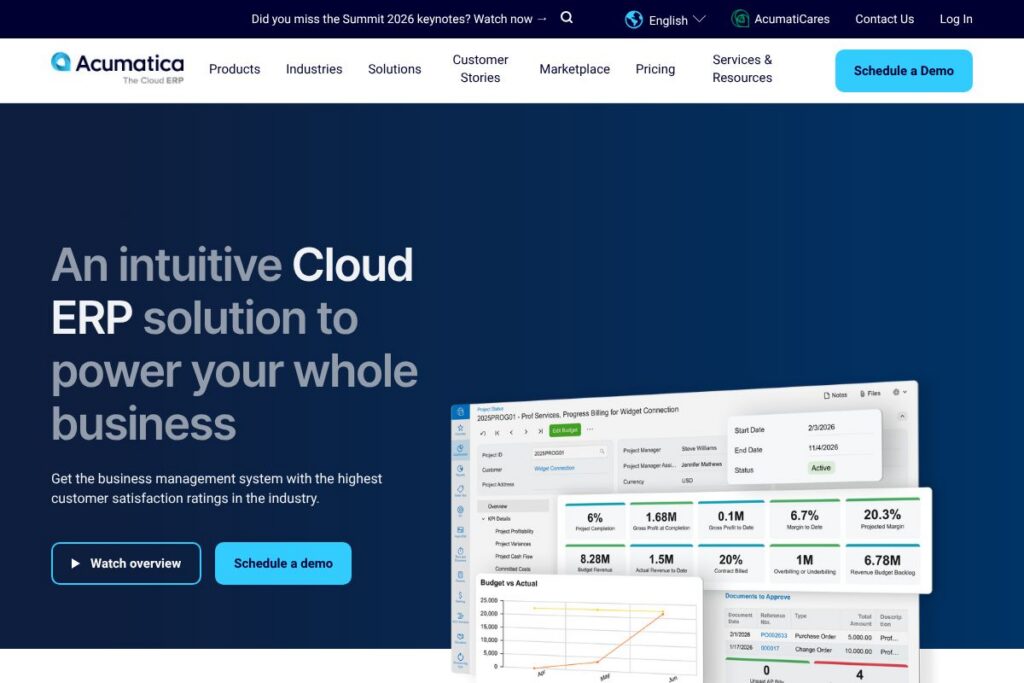

What is Acumatica
Acumatica is a cloud enterprise resource planning platform that centralizes financials, supply chain, manufacturing, project accounting, commerce, and service operations into a unified system. The platform emphasizes an intuitive interface, mobile access, and a customer-centric licensing model that permits unlimited users and flexible deployments.
Compared with competitors, Acumatica prioritizes deployment flexibility and licensing structure. Oracle NetSuite focuses on a subscription model with per-user and module fees and extensive built-in global accounting functionality. Microsoft Dynamics 365 offers deep integration with the Microsoft ecosystem and strong CRM capabilities, while SAP Business ByDesign targets larger midmarket to enterprise customers with a feature-rich but more prescriptive approach.
All of this makes Acumatica well suited to companies that need modular ERP functionality, broad role-based access for many users, and industry-specific editions for manufacturing, construction, distribution, or commerce. Its combination of modularity and unlimited-user licensing is particularly useful for organizations that want to scale without per-seat cost inflation.
How Acumatica Works
Acumatica runs as a multi-tenant cloud application that delivers core ERP functions through a browser or native mobile apps, with real-time dashboards and role-specific workspaces. Data is kept in a single logical database so accounting, inventory, sales, purchasing, and project details remain synchronized across teams.
Implementation typically begins with selecting the industry edition and modules you need, mapping business processes, and configuring workflows and security roles. Integrations and customizations are handled through built-in connectors, the REST-based API, and an extensible platform that supports business logic customization without replacing the core upgrade path.
Day-to-day use centers on transaction entry, approvals, automated document flows, and analytics. Users interact with screens optimized for specific roles, trigger automated workflows for approvals or inventory replenishment, and monitor KPIs on dashboards that update in real time.
Acumatica features
Acumatica groups ERP capabilities into modular, industry-focused suites to cover financials, supply chain, manufacturing, construction, commerce, and service operations. Recent releases emphasize AI-assisted automation, expanded industry functionality, and improvements to reporting and user experience.
Financial Management
A comprehensive accounting suite handles general ledger, accounts payable, accounts receivable, cash management, and multi-entity consolidations. Built-in reporting and audit trails help maintain compliance and provide finance teams with timely close processes and month-end workflows.
Distribution Management
Inventory, order management, purchasing, and demand allocation combine to reduce carrying costs and improve order fulfillment. The module supports multiple warehouses, lot and serial tracing, and automated replenishment rules to keep stock aligned with sales forecasts.
Manufacturing Management
Support for discrete and process manufacturing connects bills of materials, routing, shop floor control, and capacity planning into a single production lifecycle. This integration helps automate quote-to-cash processes and provides visibility into work-in-progress and costs.
Construction Management
Project accounting and job cost control are tailored for construction workflows, with budgeting, change order tracking, progress billing, and contract management. The suite provides job-specific dashboards and mobile field data capture to improve project visibility.
Retail and Commerce Management
Unified commerce features cover point-of-sale, e-commerce connectors, pricing rules, and inventory visibility across channels. The platform supports omnichannel order routing and integration with popular storefronts to keep inventory and sales synchronized.
Professional Services Management
Resource scheduling, project accounting, time and expense capture, and client billing are combined to manage service delivery and profitability. The functionality helps professional services teams monitor utilization and automate revenue recognition.
With these modules, Acumatica’s biggest benefit is the ability to run multiple business functions on a single data model, reducing reconciliation work and enabling faster operational reporting. The platform’s modular nature means organizations can adopt capabilities incrementally as they grow.
Acumatica pricing
Acumatica uses a flexible, enterprise-oriented pricing approach that is tailored to business size, chosen industry edition, deployment model, and support requirements, rather than a fixed per-user subscription. Pricing is typically quoted by partners or directly through sales to reflect the specific combination of modules, customization, and hosting preferences.
For a clear estimate and the best-fit options for your organization, review Acumatica’s deployment and licensing overview on the Acumatica website or contact sales to request personalized enterprise pricing details. Your quote will usually include implementation services, optional partner support packages, and hosting or infrastructure costs when applicable.
What is Acumatica Used For?
Acumatica is used to centralize and automate core business processes across finance, distribution, manufacturing, construction, retail, and services. Teams adopt it to reduce manual reconciliation, standardize workflows, and gain near real-time financial and operational visibility.
Typical users include midmarket businesses and divisions of larger enterprises that need industry-specific functionality with flexible licensing and mobile access. Companies that want unlimited user access for non-seat-limited staff, such as manufacturing floor workers or retail associates, find Acumatica’s licensing model particularly attractive.
Pros and Cons of Acumatica
Pros
- Flexible licensing: The unlimited-user, customer-centric licensing model avoids per-seat cost growth and makes it easier to give broad access across the organization.
- Industry editions: Prebuilt modules for manufacturing, distribution, construction, retail, and services reduce implementation time compared with building vertical functionality from scratch.
- Extensible platform and API: Customization and third-party integrations are supported without breaking core upgrades, enabling tailored workflows and connections to existing systems.
- Mobile-first and usability: A modern browser and mobile interface reduce training needs and let users access ERP functions from anywhere.
Cons
- Partner-driven implementations: Many customers rely on Acumatica partners for deployment and customization, which can introduce variability in cost and timelines depending on the chosen partner.
- Enterprise-level focus: Smaller businesses with simple accounting needs may find the scope and implementation effort greater than required, compared with lightweight accounting or bookkeeping tools.
- No public fixed pricing: The absence of straightforward published price tiers means procurement requires direct contact and a proposal, which can slow initial evaluation.
Does Acumatica Offer a Free Trial?
Acumatica is a paid platform but offers demos and trial environments through partners and sales channels. Prospective customers can request a hands-on trial or a live demo to evaluate specific industry editions and workflows; use the request demo and contact options to schedule access or a guided walkthrough.
Acumatica API and Integrations
Acumatica provides a REST-based API and developer resources to build integrations, automate processes, and extend functionality. The API documentation and developer portal describe endpoints for CRUD operations, business events, and automation scenarios.
The platform also supports prebuilt connectors and partner integrations with CRM, ecommerce, tax engines, payroll, and BI tools; common integrations include Salesforce, Shopify, Avalara, and Microsoft Power BI through certified connectors and middleware. See Acumatica’s integration resources for connector options and partner listings on the integration partners pages.
10 Acumatica alternatives
Paid alternatives to Acumatica
- Oracle NetSuite — A cloud ERP with broad global financials, native CRM, and a large partner ecosystem suited for fast-growing and multinational companies.
- Microsoft Dynamics 365 — A modular suite combining ERP and CRM, with close integration into Microsoft 365, Azure, and Power Platform for automation and analytics.
- SAP Business ByDesign — A midmarket cloud ERP from SAP offering end-to-end business processes and strong multi-subsidiary capabilities.
- Infor CloudSuite — Industry-focused ERP suites for manufacturing, distribution, and services with embedded analytics and industry templates.
- Sage Intacct — A financial-management-focused cloud solution with strong core accounting, multi-entity consolidation, and native cloud reporting.
- Epicor — ERP targeted at manufacturing and distribution with deep shop-floor and production management functionality.
- Plex — A cloud manufacturing ERP focused on plant floor operations, quality, and traceability for discrete manufacturers.
- Workday — Primarily for larger enterprises, Workday combines financials and human capital management with strong reporting capabilities.
- Acumatica Cloud ERP (other editions) — Consider different Acumatica industry editions if you want to compare functionality within the same platform.
- IFS Cloud — Enterprise ERP for service management, manufacturing, and asset-heavy industries with strong field-service capabilities.
Open source alternatives to Acumatica
- Odoo — A modular open source ERP with apps for accounting, inventory, manufacturing, and commerce that can be self-hosted or used as a managed service.
- ERPNext — A full-featured open source ERP built on a modern web stack, including accounting, CRM, manufacturing, and projects, well suited to small and midmarket organizations.
- Dolibarr — Lightweight ERP and CRM focused on small businesses and nonprofits, offering invoicing, inventory, and project modules.
- Tryton — A modular, Python-based open source ERP with flexible accounting and inventory models for businesses that prefer self-hosted customization.
Frequently asked questions about Acumatica
What is Acumatica used for?
Acumatica is used to manage enterprise operations across finance, distribution, manufacturing, construction, retail, and services. Organizations use it to centralize transactions, automate workflows, and produce real-time operational and financial reports.
Does Acumatica have an API?
Yes, Acumatica provides a REST-based API and developer resources. The API supports data access, business logic automation, and integration with external systems; see the API documentation for details.
How does Acumatica pricing work?
Acumatica uses a flexible, quote-based pricing model tailored to modules, deployment, and services. Pricing is provided through partners or sales and typically reflects chosen industry editions, hosting, and implementation scope.
Can Acumatica support multiple locations or companies?
Yes, Acumatica supports multi-entity and multi-site operations. Built-in consolidation, multi-currency, and intercompany transaction features help manage operations across subsidiaries and geographies.
Is Acumatica suitable for manufacturing companies?
Yes, Acumatica offers manufacturing management capabilities for discrete and process manufacturers. Features include bills of materials, routing, capacity planning, shop-floor integration, and production costing.
Final verdict: Acumatica
Acumatica stands out for its modular, industry-focused ERP suites and a customer-centric licensing model that avoids per-user fees, which can lower the marginal cost of adding users across operations. Its combination of real-time dashboards, mobile access, and extensible APIs makes it a practical choice for midmarket companies that need breadth across finance, supply chain, and industry-specific needs.
Compared with Oracle NetSuite, Acumatica offers more flexibility around unlimited-user access and partner-driven deployment options, while NetSuite provides a more prescriptive all-in-one cloud ERP with a large global footprint. If you need unlimited user access and industry-tailored modules, Acumatica is worth evaluating; for organizations that prioritize a single vendor with wide global implementation resources, NetSuite may be the better fit.
For product details, platform documentation, and to arrange a guided evaluation, visit the Acumatica cloud ERP platform and use the request demo option to see core modules in action.