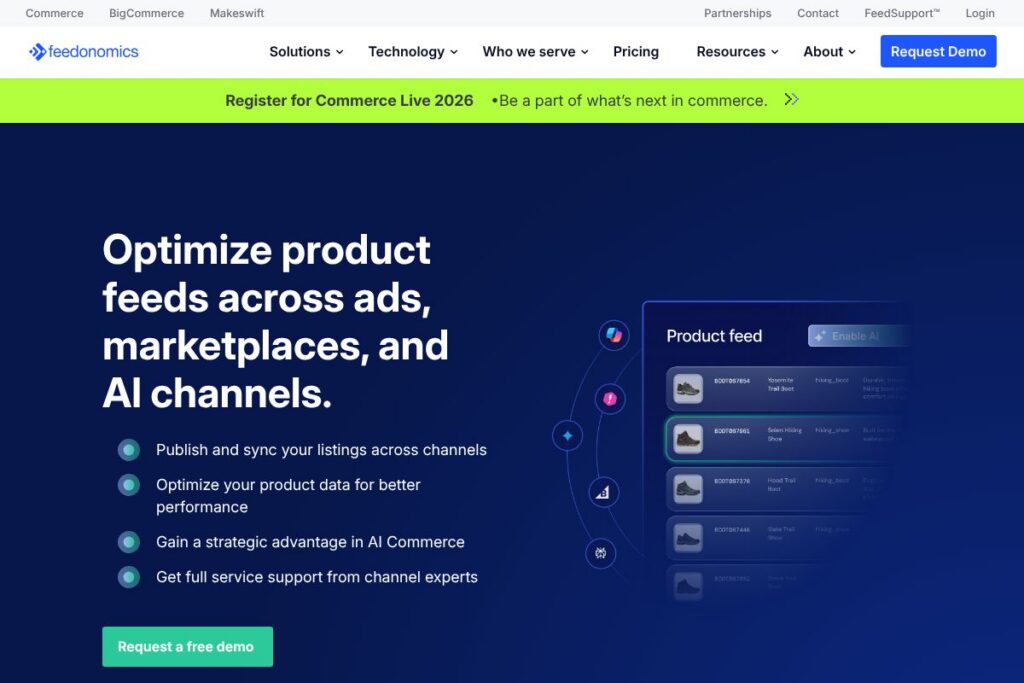

Feedonomics: An Overview
Feedonomics is a full-service product feed management platform that centralizes ingestion, normalization, optimization, and syndication of product data to shopping channels, marketplaces, and AI-driven commerce endpoints. The platform combines a flexible feed engine with ongoing managed services from a global team of feed specialists to support complex catalogs and high-volume publishing.
Compared with ChannelAdvisor, which focuses on marketplace connectivity and retail operations, Feedonomics places heavier emphasis on full-service feed optimization and 24/7 expert support. Against Productsup and DataFeedWatch, Feedonomics is positioned to handle very large SKU counts and complex enterprise integrations while providing hands-on management from channel experts.
All of this makes Feedonomics especially well suited to enterprise retailers, multi-brand merchants, and agencies that need both automation and human-led feed management. It is a practical solution when you must publish consistent, channel-ready listings across dozens or hundreds of endpoints and when catalog errors or channel rejections would meaningfully impact sales and operations.
How Feedonomics Works
Feedonomics ingests product data from native ecommerce platforms, PIM systems, spreadsheets, and custom sources, then applies normalization rules and transformations to create channel-specific feeds. The platform enforces required attributes, maps categories, and enriches listings with channel-appropriate titles, descriptions, and images so feeds meet each channel’s technical and policy requirements.
On the managed services side, Feedonomics pairs customers with feed specialists who monitor feed health, troubleshoot delivery issues, and apply ongoing optimizations. Typical workflows include automated import schedules, rule-based attribute transformations, split testing of product titles, and performance-driven attribute adjustments to improve placement and click-through rates.
What does Feedonomics do?
Feedonomics organizes around feed ingestion, transformation, channel-specific optimization, and syndication at scale. Core capabilities include automated data normalization, channel mapping, scheduled publishing, performance analytics, and managed support from feed experts. Recent platform emphasis includes AI-assisted enrichment and integrations designed for marketplace and AI commerce channels.
Feed ingestion and normalization
The platform accepts data from multiple sources including Shopify, BigCommerce, Magento, PIMs, CSV/XML files, and custom endpoints, and normalizes disparate schemas into a unified catalog model. This reduces manual data cleanup and creates a consistent baseline for downstream channel transformations.
Channel-specific optimization
Feedonomics creates and enforces channel-specific rules for Google Shopping, Amazon, Facebook, and hundreds of global marketplaces, adjusting attributes, categories, and formatting so listings comply with each channel. This decreases rejection rates and speeds time to live for new or updated SKUs.
Full-service feed management
Assigned feed specialists handle onboarding, ongoing troubleshooting, and continuous optimization, taking responsibility for feed health and channel delivery while providing strategic recommendations. This managed model reduces the internal staffing burden for complex catalog operations.
AI-driven enrichment and analytics
The platform uses AI to suggest title and description improvements, identify missing attribute values, and surface opportunities to improve CTR and conversion. Analytics track performance by attribute, channel, and SKU so teams can prioritize high-impact changes.
Multi-platform publishing and synchronization
Feedonomics supports scheduled and real-time synchronization across ad networks, marketplaces, social commerce channels, and proprietary endpoints to keep inventory, pricing, and content consistent. This is important for sellers managing many marketplace seller accounts or varied channel rules.
Order and integration support
Beyond feed delivery, Feedonomics integrates with order management and fulfillment systems to help align listings with inventory and shipping logic when required by the channel. These integrations reduce oversells and simplify reconciliation across marketplaces.
Reporting, diagnostics, and error handling
Built-in diagnostics pinpoint schema mismatches, policy violations, and feed delivery failures, with reporting that teams and agencies can use for root-cause analysis and SLA reporting. Alerts and automated remediation reduce downtime for high-volume catalogs.
With these capabilities, the biggest benefit of Feedonomics is combining a scalable feed engine with continuous, human-led management so large or complex merchants can reliably publish accurate, optimized listings across many channels. Explore their platform integrations for more on supported endpoints.
Feedonomics pricing
Feedonomics uses a custom enterprise pricing model tailored to SKU count, number of channels, and the level of full-service support required. Pricing is not posted as fixed plans because costs scale with catalog complexity, channel coverage, and managed services commitments.
Enterprise pricing
Feedonomics offers flexible pricing that is scoped per customer based on SKUs, channels, and service level; quotes are provided following an evaluation of catalog structure and business objectives. For detailed, customized proposals and to discuss implementation needs, contact Feedonomics via their contact page or request a consultation through the sales and solutions pages.
What is Feedonomics Used For?
Feedonomics is commonly used to centralize and automate the distribution of product listings to Google Shopping, Amazon, Walmart, Facebook, TikTok, and hundreds of global marketplaces. Merchants use it to improve feed quality, reduce channel rejections, and speed time to market for new SKUs.
The platform is also used outside retail, for example to aggregate and normalize listing data for classifieds, automotive, real estate, job boards, delivery apps, and rewards marketplaces. Agencies use Feedonomics to manage feeds centrally for multiple ecommerce clients via the Certified Partner Program.
Pros and Cons of Feedonomics
Pros
- Comprehensive channel coverage: The platform supports hundreds of shopping channels and 300+ global marketplaces, which reduces the need for multiple connectors and simplifies multi-market expansion. This breadth is useful for brands targeting many geographies and niche marketplaces.
- Full-service support model: Dedicated feed specialists handle onboarding and ongoing optimizations, which helps teams without deep feed expertise maintain healthy, high-performing feeds. Ongoing support is available around the clock for many customers.
- Scalability for large catalogs: Designed for enterprise SKU volumes, the platform can process large catalogs, automate transformations, and maintain synchronized listings across many seller accounts. Automation reduces manual workload and error rates.
Cons
- Custom pricing model: Pricing is tailored to each customer and not publicly listed, which can make initial budget planning harder for small businesses seeking fixed-rate options. Prospective customers must request a quote to understand total cost.
- Enterprise focus may be heavy for SMBs: The platform and managed services are optimized for complex or high-volume catalogs, which may exceed the needs or budgets of smaller merchants looking for a self-service, low-cost feed tool.
- Learning curve for integrations: Integrating custom data sources or complex PIM structures can require technical setup and coordination with Feedonomics’ team, which may extend time to first feed publish for very bespoke implementations.
Does Feedonomics Offer a Free Trial?
Feedonomics provides custom paid plans with managed support and does not advertise a public free plan or standardized trial. Prospective customers can request a tailored demo and pilot engagement by contacting the team through the Feedonomics contact page, where you can discuss a scoped trial or pilot as part of a commercial proposal.
Feedonomics API and Integrations
Feedonomics provides connectors and APIs to ingest catalog data, plus integrations with major ecommerce platforms such as Shopify, BigCommerce, and Magento. The platform integrations page lists many prebuilt connectors and the typical integration patterns for PIMs and storefronts.
For developer access, Feedonomics offers API endpoints and integration guides to automate feed submission, status checks, and data pulls; teams should consult the developer and integration resources or contact support to access technical documentation and implementation assistance.
10 Feedonomics alternatives
Paid alternatives to Feedonomics
- ChannelAdvisor — Enterprise marketplace management and channel connectivity with a strong focus on retail operations and inventory distribution.
- Productsup — A feed management and product experience platform that emphasizes data syndication and experience optimization across digital touchpoints.
- DataFeedWatch — A feed optimization and management tool that offers channel-specific templates and a more self-service approach for mid-market merchants.
- GoDataFeed — Channel feed management and listing automation targeted at ecommerce sellers with multiple marketplace channels.
- Salsify — A product experience management (PXM) platform combining PIM features with syndication and digital shelf analytics.
- CommerceHub — Marketplace and drop-ship management with integrations to large retail networks and fulfillment workflows.
- Lengow — Catalog distribution and marketplace connectivity with a focus on European marketplaces and global expansion.
Open source alternatives to Feedonomics
- Akeneo — Open source PIM for product data centralization; requires custom connectors and development to serve as a feed syndication layer. Useful for teams willing to build integrations.
- Pimcore — Open source data and experience management platform that can act as a central catalog and be extended with custom feed exporters for marketplaces.
- Magento Open Source — An ecommerce platform that can be extended with community extensions and custom scripts to generate and export product feeds to channels.
- OroCommerce — Open source B2B ecommerce and product management platform that can be adapted to feed generation with development effort.
Frequently asked questions about Feedonomics
What is Feedonomics used for?
Feedonomics is used to ingest, normalize, optimize, and syndicate product and listing data across advertising channels, marketplaces, and AI commerce endpoints. Teams use it to reduce feed errors, improve channel compliance, and scale catalog distribution.
Does Feedonomics integrate with Shopify and Magento?
Yes, Feedonomics integrates with Shopify, BigCommerce, Magento, and many PIMs and storefronts. Prebuilt connectors simplify ingestion and synchronization for common ecommerce platforms.
How does Feedonomics price its service?
Feedonomics uses custom pricing based on SKU count, number of channels, and the level of managed support required. Prospective customers request a proposal so pricing can be scoped to catalog complexity and channel coverage.
Does Feedonomics provide an API for automation?
Yes, Feedonomics offers API access and developer resources to automate feed submission, monitoring, and data transformations. Teams can combine API usage with the platform’s connectors for automated workflows.
Can Feedonomics manage Amazon and Google Shopping feeds?
Yes, Feedonomics supports Google Shopping, Amazon, and hundreds of global marketplaces and ad channels. The platform handles channel-specific mapping and compliance to reduce rejection rates and improve listing quality.
Final Verdict: Feedonomics
Feedonomics stands out for combining a scalable feed engine with a full-service management model that assigns experienced feed specialists to customers. That combination is valuable for enterprise merchants, agencies, and complex catalogs where channel compliance, continuous optimization, and rapid issue resolution matter.
Compared with ChannelAdvisor, which also targets large retailers and marketplaces, Feedonomics places more emphasis on hands-on feed optimization and 24/7 specialist support while both vendors use custom pricing models. If your priority is a managed feed solution that minimizes internal overhead for syndication and troubleshooting, Feedonomics is a strong fit; if you need an all-in-one commerce operations platform, evaluate both vendors against your specific channel and fulfillment requirements.