
ADP: An Overview
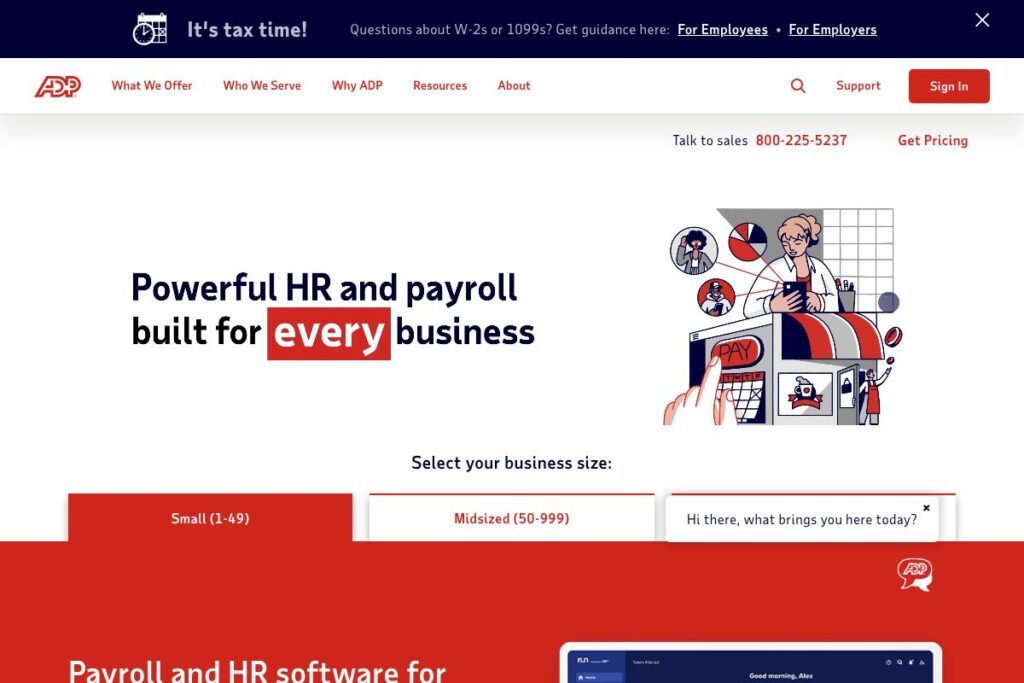
ADP is a long-established provider of payroll, human capital management, tax filing, and benefits administration services for businesses of all sizes. Its product set ranges from standalone payroll services to full-service HR suites and PEO offerings, with additional support for global payroll and compliance across multiple jurisdictions.
ADP competes with providers such as Gusto, Paychex, and Paylocity. Compared with Gusto, which targets small businesses with transparent per-month pricing and simple payroll-first workflows, ADP offers deeper enterprise functionality, broader global payroll coverage, and a wider set of compliance services. Against Paychex, ADP matches in scale and back-office tax services but provides a larger partner ecosystem and more modular product options; compared with Paylocity, ADP has a longer history of large-enterprise payroll processing and stronger multi-country payroll capabilities.
All of this makes ADP well suited to organizations that need robust payroll accuracy, centralized tax and compliance handling, and optional outsourced HR services. It is particularly useful for multi-state or multinational employers, companies with complex tax needs, and businesses that plan to scale or consolidate HR and payroll on a single vendor platform.
How ADP Works
ADP processes payroll through a cloud-based platform that centralizes employee data, tax calculations, and pay runs, then handles tax filing and remittances on behalf of clients when selected. Employers upload employee hours via time clocks or timekeeping integrations, configure pay items and deductions, and schedule recurring or off-cycle payroll runs.
HR and benefits functions are connected to payroll so changes to employee status, withholdings, or benefits enrollment flow into pay calculations automatically. For teams that want a hands-off approach, ADP can manage tax filing, year-end forms, and regulatory reporting as part of a full-service arrangement, while companies that prefer more control can use self-service payroll modules and integrated compliance alerts.
ADP features
ADP’s platform is organized around payroll accuracy, tax compliance, HR administration, time and attendance, and benefits management. Core capabilities include automated payroll processing, multi-jurisdiction tax filing, HR case management, time capture, reporting and analytics, and a developer-friendly integration ecosystem through its API and marketplace.
Payroll processing
ADP handles gross-to-net payroll calculations, multiple pay schedules, off-cycle checks, and direct deposits. The platform corrects common payroll errors before pay runs, supports multiple pay types and garnishments, and offers flexible payroll inputs to match complex compensation models.
Tax filing and compliance
ADP prepares and files federal, state, and local payroll taxes, manages tax deposits, and issues year-end tax forms. For clients that opt into full-service payroll, ADP assumes responsibility for filing accuracy and remittance schedules, reducing internal administrative burden.
HR management
ADP provides employee records, onboarding workflows, performance tracking, and HR policy tools. The HR modules centralize documents, track certifications, and provide case management to coordinate employee inquiries and HR tasks.
Time and attendance
ADP supports time clocks, mobile time capture, and integrations with popular time-tracking hardware and software. Time entries feed directly into payroll calculations, and the system enforces overtime and break rules by location to help maintain compliance.
Benefits administration
ADP manages benefits enrollment, eligibility, carrier connections, and premium reconciliation. The platform supports medical, dental, vision, 401(k), and other benefit types, and synchronizes deductions to payroll automatically.
Global payroll and multi-country support
ADP offers multi-country payroll solutions and local expertise for companies with international employees. This includes localized payroll calculations, statutory reporting, and cross-border compliance management to centralize global payroll administration.
Reporting and analytics
ADP includes configurable reports and dashboards for payroll, headcount, labor costs, and benefits trends. Analytics help HR and finance teams spot cost drivers, monitor overtime, and export data for further analysis.
Integrations and API access
ADP connects with major accounting, HR, and timekeeping systems and exposes APIs for custom integrations. The integration options allow data to flow between HRIS, ERP, benefits carriers, and third-party apps for unified recordkeeping.
Mobile and employee self-service
Employees can access pay stubs, tax forms, and benefits information through mobile apps and self-service portals. Managers can approve time off, view schedules, and run basic reports from mobile devices.
With these capabilities, ADP’s biggest benefit is its breadth: payroll, tax, HR, benefits, and global services are tightly integrated so payroll accuracy and compliance are handled alongside core HR functions.
ADP pricing
ADP uses a custom pricing model that is tailored to company size, selected products, and service level rather than a single public price list. Pricing factors commonly include number of employees, payroll frequency, choice of full-service payroll or self-service, add-on modules such as time and attendance or benefits administration, and any international payroll needs.
For a quote and to discuss plan options, contact ADP through ADP’s contact page (https://www.adp.com) or request a tailored demo via ADP’s solutions overview (https://www.adp.com/what-we-offer.aspx). Sales teams will provide pricing details and contract terms based on your specific configuration and service requirements.
What is ADP Used For?
ADP is used to process payroll, file and remit payroll taxes, and manage employee pay and benefits for businesses ranging from small employers to large multinational companies. Organizations use ADP to centralize HR records, automate benefits enrollment, and maintain compliance with local, state, and national labor and tax laws.
Companies also use ADP for outsourcing HR tasks entirely through PEO or HRO engagements, for consolidating multiple payroll providers into a single platform, and for integrating payroll with accounting and time systems to reduce manual data entry and reconciliation work.
Pros and cons of ADP
Pros
- Comprehensive compliance support: ADP handles federal, state, and local tax filings and remittances, reducing risk and administrative overhead for employers.
- Scalable product range: ADP offers solutions for small businesses through large enterprises, including PEO and global payroll options that support growth and multi-country operations.
- Robust integrations: ADP integrates with common HR, accounting, and timekeeping tools, and provides APIs and an app marketplace for custom workflows.
- Full-service option: Employers can choose full-service payroll and tax filing so ADP assumes responsibility for many back-office tasks.
Cons
- Pricing is enterprise-oriented: ADP’s custom pricing model can be more expensive for small businesses seeking simple, low-cost payroll; smaller employers may find transparent low-cost competitors more attractive.
- Platform complexity: The breadth of features and product variations can create a steeper learning curve for administrators who only need basic payroll functions.
- Implementation and configuration time: Larger deployments and multi-country setups can require extended implementation timelines and professional services.
Does ADP Offer a Free Trial?
ADP does not offer a standard free plan, but provides product demos and tailored trials or pilot programs on request. Prospective customers can schedule a self-guided product tour or request a demo to evaluate payroll, HR, and benefits workflows before committing; contact options are available on ADP’s contact page (https://www.adp.com).
ADP API and Integrations
ADP provides developer APIs and an app ecosystem that enable integrations with HRIS, accounting, timekeeping, and benefits vendor systems. The ADP developer portal contains API documentation, SDKs, and onboarding guides for common integration scenarios.
Key native integrations include accounting systems, applicant tracking systems, major time and attendance vendors, and benefits carriers via ADP’s partner network and the ADP Marketplace (https://apps.adp.com). For custom integrations, ADP’s API endpoints provide secure access to payroll results, employee data, and benefits information.
10 ADP alternatives
Paid alternatives to ADP
- Gusto — Suited for small businesses, combines payroll, benefits, and HR tools with transparent per-month pricing and simple setup.
- Paychex — Offers payroll and HR services with a focus on small to mid-sized businesses and scalable service bundles.
- Paylocity — Cloud HR and payroll platform with strong talent management and workforce management features.
- Rippling — Combines HRIS and IT provisioning alongside payroll, with a modern API-first approach.
- SurePayroll — Aimed at very small businesses and accountants, providing straightforward online payroll services.
- Intuit QuickBooks Payroll — Integrates tightly with QuickBooks accounting software for small to mid-sized businesses needing combined accounting and payroll.
- Ceridian Dayforce — Enterprise-focused single application for payroll, HR, workforce management, and benefits with real-time calculations.
Open source alternatives to ADP
- ERPNext — Open-source ERP with HR and payroll modules suitable for companies that can self-host and customize payroll workflows.
- Odoo — Open-source ERP platform offering HR and payroll apps; payroll availability and localization vary by region and community modules.
- Sentrifugo — Open-source HRMS with core HR features and extensibility for custom payroll integrations and reporting.
Frequently asked questions about ADP
What is ADP used for?
ADP is used for payroll processing, tax filing, HR administration, and benefits management. Businesses use ADP to centralize pay calculations, manage compliance, and automate HR tasks across locations and countries.
Does ADP offer an API for integrations?
Yes, ADP provides developer APIs and marketplace integrations. The ADP developer portal hosts documentation and tools for building secure integrations with payroll and HR data.
How much does ADP cost?
ADP uses custom pricing tailored to each business. Costs depend on the number of employees, selected services, payroll frequency, and whether you choose full-service payroll or add-on modules; contact ADP sales via ADP’s contact page (https://www.adp.com) for a quote.
Can ADP handle multi-state and international payroll?
Yes, ADP supports multi-state payroll and multi-country payroll solutions. The platform includes local tax handling, statutory reporting, and global payroll expertise for employers with employees across jurisdictions.
Does ADP provide benefits administration?
Yes, ADP offers benefits enrollment, carrier connections, and premium reconciliation features. Benefits administration is integrated with payroll to ensure deductions and employer contributions flow correctly to pay runs.
Final verdict: ADP
ADP stands out for its comprehensive approach to payroll, tax, and HR services, particularly for organizations that need reliable tax filing, multi-jurisdiction support, or an option to outsource payroll and HR operations. Its scale and product breadth make it a strong fit for mid-market and enterprise employers, or growing companies that anticipate complex compliance needs.
Compared with Gusto, which offers transparent small-business pricing starting at $40/month plus $6/month per employee, ADP relies on custom pricing but delivers broader enterprise features, stronger multi-country payroll capabilities, and full-service tax filing for larger or more complex workforces. For small employers focused on simple payroll at predictable costs, Gusto may be more cost-effective; for organizations needing deep compliance, global reach, or outsourced services, ADP provides the functionality and support to meet those needs.