
Meet Infor
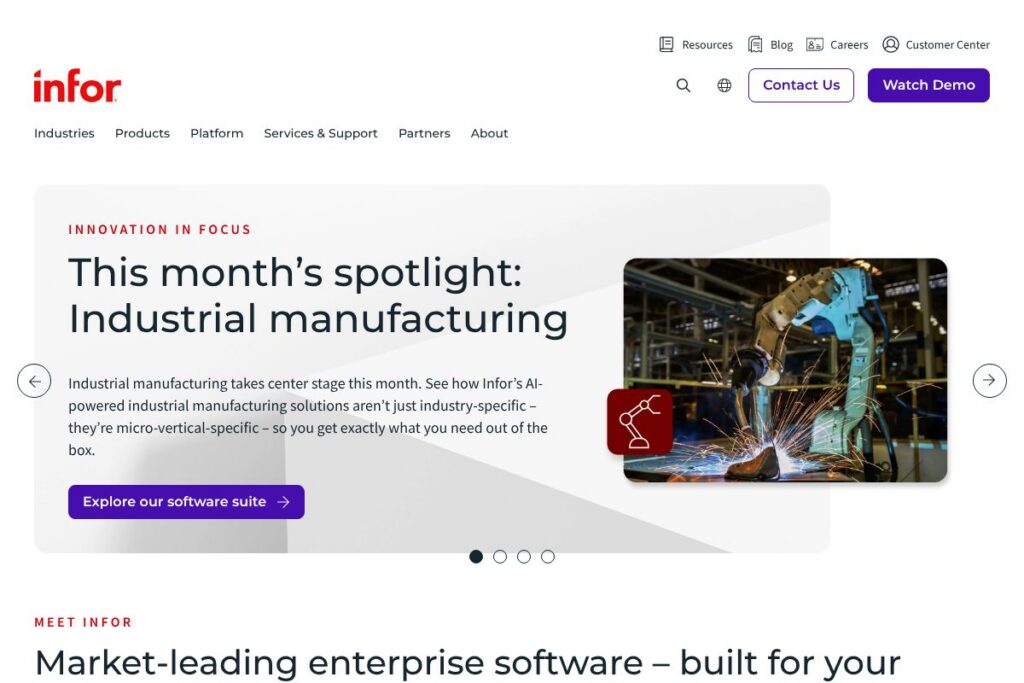
Infor is a global provider of cloud-based, industry-specific enterprise software that combines packaged vertical functionality with cloud infrastructure. The company delivers ERP, supply chain, finance, human capital management, and analytics solutions packaged as industry CloudSuites so businesses get preconfigured workflows and data models tailored to sectors like manufacturing, healthcare, retail, and distribution.
Compared with broad horizontal suites such as SAP S/4HANA, Oracle Cloud ERP, and Microsoft Dynamics 365, Infor differentiates by focusing on deep industry templates and faster prebuilt workflows. Where SAP and Oracle target large enterprises with extensive customization, Infor often positions CloudSuite for organizations that require industry-specific processes out of the box while still supporting enterprise governance and integrations.
Infor does particularly well at reducing implementation scope for industry workflows and providing modular suites that can be adopted incrementally. This makes the platform useful for companies that need ERP and operations software tuned to regulated industries or specialized processes, combined with cloud deployment and third-party integrations.
How Infor Works
Infor delivers its functionality through industry CloudSuites built on a common platform that combines application services, integration components, and an experience layer. Core systems such as ERP and SCM are packaged with industry-specific data models and preconfigured processes to shorten time to value, while the underlying platform standardizes authentication, security, and integrations.
The platform architecture centers on Infor OS, which provides collaboration, integration, and data services, and can host AI capabilities such as Coleman for process automation and predictive analytics. Implementations typically involve selecting a CloudSuite for the target industry, configuring business rules and roles, connecting to existing systems through connectors or APIs, and running pilot workflows before broad rollout.
Operational workflows are supported by role-based interfaces, mobile access for field and shop-floor users, and analytics that draw on a unified data layer. Teams use Infor to manage procure-to-pay, order-to-cash, production planning, and workforce processes while using the platform’s integration services to synchronize data with CRM, payroll, or third-party logistics systems.
Infor features
Infor’s product set emphasizes industry CloudSuites alongside a shared platform layer. Core capabilities include vertically preconfigured ERP, supply chain and manufacturing modules, role-based experience with collaboration, embedded analytics, and platform services such as integration, security, and low-code tooling. Recent platform iterations have expanded AI-assisted automation and cloud-native deployment options.
Industry CloudSuites
CloudSuites are packaged sets of modules and prebuilt processes for specific sectors, reducing the amount of custom configuration required. They include role-specific workflows, regulatory checks, and best-practice templates that shorten implementation timelines for manufacturing, healthcare, retail, and distribution teams.
Infor OS (Platform Services)
Infor OS supplies a shared services layer for identity, data orchestration, workflow, and user experience. It centralizes integration and simplifies cross-application reporting while providing a single place to manage connections, security, and collaboration across the suite. Explore the Infor OS platform overview for implementation details.
Coleman AI and Embedded Automation
Coleman AI offers capabilities for predictive maintenance, demand forecasting, and process automation using machine learning models tailored to industry data patterns. Teams use these tools to automate routine decision steps, flag exceptions, and feed forecasts into planning systems to reduce manual rework.
Supply Chain and Manufacturing
Supply chain modules cover inventory, planning, warehouse management, and execution with features for finite scheduling, advanced planning, and shop-floor control. These modules integrate with production execution to provide end-to-end visibility from demand signals to fulfillment.
Financial Management and Compliance
Financial modules support core accounting, multi-entity consolidation, revenue recognition, and industry-specific compliance requirements. Built-in controls and audit trails help finance teams meet reporting standards while integrating transactional data from operational modules.
Human Capital Management (HCM)
Infor’s HCM offerings include talent management, payroll integrations, workforce scheduling, and role-based employee experiences. These features help operational teams manage labor planning, certifications, and shift-based scheduling in regulated environments.
Analytics and Business Intelligence
Embedded analytics provide operational dashboards, KPI tracking, and ad hoc reporting connected to the platform’s unified data model. Users can combine operational and financial views to monitor performance and support decision-making without extensive ETL projects.
With these capabilities, Infor aims to deliver industry-tailored functionality that reduces customization while supporting enterprise integration and analytics as the central benefit to business users and IT teams alike.
Infor pricing
Infor uses enterprise subscription and licensing models with custom pricing tailored to industry requirements and deployment choices. Pricing depends on factors such as chosen CloudSuite modules, number of users, cloud versus on-premises deployment, required SLAs, and integration or support needs.
Because pricing is customized for each deployment, organizations typically request a quote or engage with Infor sales to receive a proposal aligned to their scope and timeline. For details on licensing options or to request a tailored estimate, visit Infor’s contact and sales page or review the CloudSuite product pages for descriptions of included modules and services.
What is Infor Used For?
Infor is used to run industry-specific core business processes such as ERP for manufacturing, supply chain planning for distribution, clinical and operational workflows for healthcare providers, and merchandising for retail. Its CloudSuites provide prebuilt process flows and data models that make these scenarios easier to adopt than generic ERP systems.
Organizations also use Infor for finance consolidation, regulatory compliance, workforce scheduling, and embedded analytics that tie operational metrics to financial outcomes. IT teams use the platform’s integration and platform services to connect Infor to CRM, e-commerce, payroll, and logistics systems for end-to-end business processes.
Pros and cons of Infor
Pros
- Industry-specific depth: Infor offers packaged workflows and data models that reduce customization for regulated or vertical workflows, speeding implementations and reducing project scope.
- Modular CloudSuites: Customers can adopt modules incrementally, allowing teams to prioritize ERP, supply chain, or HCM as needed while keeping the same platform backbone.
- Platform services and integrations: A common platform for identity, integration, and analytics simplifies cross-application data flows and reduces the need for separate middleware.
Cons
- Enterprise licensing complexity: Custom pricing and modular licensing can be complex to evaluate, typically requiring close engagement with sales and technical teams to estimate total cost of ownership.
- Implementation and change management: Despite prebuilt industry templates, larger deployments still require significant configuration, testing, and user training, especially when integrating legacy systems.
- Variability across modules: Depth and maturity of features can vary between product lines, so organizations should validate specific module capabilities against industry needs during procurement.
Does Infor Offer a Free Trial?
Infor offers custom demos and pilot evaluations rather than a public free plan. Prospective customers can request product demonstrations, pilot environments, or time-limited evaluations as part of the sales process; these are arranged through Infor sales or authorized implementation partners and are tailored to the chosen CloudSuite and use cases.
Infor API and Integrations
Infor provides integration services and APIs through its platform layer to connect CloudSuite modules with third-party systems and custom applications. Information on integration capabilities and developer resources is available on the Infor OS integration pages and through partner documentation.
Key integrations commonly implemented with Infor include CRM systems, payroll providers, e-commerce platforms, and cloud infrastructure on providers such as AWS, Microsoft Azure, and other enterprise services. Implementation partners and the Infor community often supply connectors for popular platforms to accelerate integration work.
10 Infor alternatives
Paid alternatives to Infor
- SAP S/4HANA: An enterprise-grade ERP platform with deep global scale and integration, widely used in large multinational organizations.
- Oracle Cloud ERP: Comprehensive cloud ERP with strong financials and global regulatory support, suited to large enterprises with complex accounting needs.
- Microsoft Dynamics 365: A modular suite that combines CRM and ERP capabilities with tight integration into Microsoft 365 and Azure services.
- NetSuite (Oracle NetSuite): Popular cloud ERP for midmarket companies, offering unified financials, CRM, and ecommerce capabilities.
- IFS Applications: Industry-focused ERP with strengths in service management, field service, and asset-intensive industries.
- Epicor: ERP focused on manufacturing and distribution with on-premises and cloud options for midmarket manufacturers.
- Workday: Cloud-native HCM and financial management platform aimed at large enterprises for HR and finance transformation.
Open source alternatives to Infor
- ERPNext: Open source ERP that covers accounting, manufacturing, inventory, and HR, suitable for small and midmarket deployments.
- Odoo Community: Modular open source suite with apps for invoicing, inventory, manufacturing, and CRM; community edition requires more configuration for scale.
- Dolibarr: Lightweight ERP/CRM for small businesses that is extendable through modules and community add-ons.
- Tryton: A general-purpose business application platform that offers modular ERP capabilities for accounting, sales, and inventory.
Frequently asked questions about Infor
What industries does Infor support with its CloudSuites?
Infor supports manufacturing, healthcare, retail, distribution, hospitality, and other regulated industries. CloudSuites are built with industry-specific data models and workflows to address vertical requirements and compliance needs.
Does Infor provide cloud hosting for its software?
Yes, Infor offers cloud-hosted deployments through Infor CloudSuite and managed options. Customers can choose Infor-hosted cloud environments or deploy in private cloud arrangements depending on compliance and architecture needs.
Can Infor integrate with existing ERP or CRM systems?
Yes, Infor provides integration services and APIs to connect with third-party systems. The platform includes integration middleware and partner-supplied connectors to synchronize data with CRM, payroll, logistics, and other enterprise systems.
How is Infor licensed and priced for enterprise customers?
Infor uses custom enterprise licensing and subscription models tailored to module selection and deployment choices. Pricing depends on the CloudSuite modules, number of users, support levels, and any required integration or implementation services.
Does Infor offer AI or machine learning features?
Yes, Infor incorporates AI and machine learning capabilities such as Coleman for predictive analytics and automation. These features are embedded in areas like demand forecasting, maintenance prediction, and process automation to reduce manual effort.
Final verdict: Infor
Infor is a practical choice for organizations that need industry-tailored ERP and operational applications packaged with a common cloud platform. Its strength lies in preconfigured CloudSuites and platform services that reduce custom development for vertical processes while providing integration and analytics capabilities.
Compared with SAP S/4HANA, which also uses enterprise licensing and custom pricing, Infor tends to emphasize quicker industry-specific deployments and modular adoption for midmarket to large organizations, while SAP targets very large global consolidation scenarios. For companies seeking packaged vertical functionality with enterprise-grade integration, Infor is a strong candidate to evaluate; contact Infor or an authorized partner to arrange a demo or pilot aligned to your industry needs.