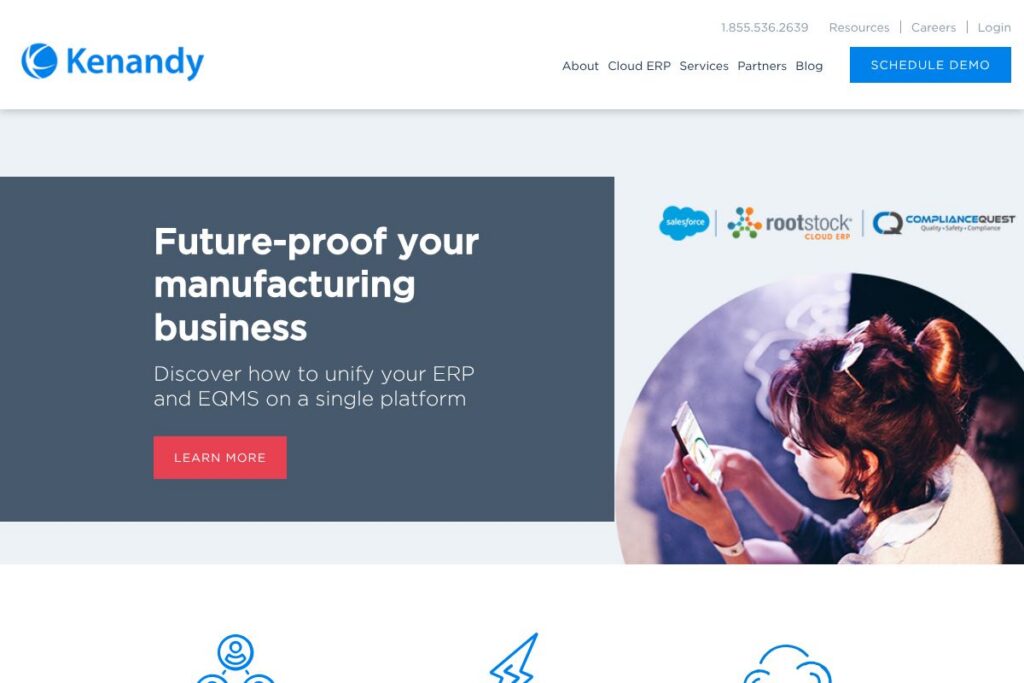

Kenandy: An Overview
Kenandy is a cloud ERP solution designed specifically for manufacturers and distributors, running natively on the Salesforce platform. It organizes core enterprise processes into a set of business-ready objects and preconfigured workflows so companies can map the application to how they actually work rather than forcing processes to fit a legacy data model.
Because Kenandy is built on Salesforce it inherits the platform’s security, identity, reporting, and ecosystem integration capabilities, which reduces the need for separate middleware and custom integrations. The product now operates under the Rootstock Software company, which positions Kenandy alongside other manufacturing ERP offerings and services; see Rootstock’s company information at the Rootstock site.
Kenandy compares with larger, generalist cloud ERP suites such as Oracle NetSuite and SAP S/4HANA Cloud, and with specialist manufacturing-focused products like Infor CloudSuite Industrial. Compared with those, Kenandy stands out for its Salesforce-native architecture and a smaller set of purpose-built business objects that speed deployment and make it easier to extend using Salesforce tools. All of this makes Kenandy a strong choice for manufacturing and distribution organizations that already use Salesforce or want a cloud ERP tightly integrated with CRM and platform-level automation.
How Kenandy Works
Kenandy runs as an application on the Salesforce platform, using Salesforce objects, declarative automation, and platform security to deliver ERP functionality. The product models core processes with what Kenandy describes as Business Ready Objects, which capture orders, inventory movements, production runs, and financial transactions in a structure that aligns with common manufacturing workflows.
Administrators configure workflows, approvals, and custom fields using Salesforce setup tools, while business users interact with role-tailored pages and dashboards. Typical implementations start with mapping existing processes to Kenandy’s objects, configuring master data and item structures, then enabling modules such as order-to-cash, manufacturing, and procurement before connecting external systems like PLM, MES, or shipping carriers.
Kenandy features
Kenandy groups ERP capabilities into end-to-end modules that cover sales, manufacturing, procurement, inventory, distribution, and financials. Core design priorities include flexible configuration, Salesforce-native integration, and a reduced object model that trades thousands of database tables for a more accessible set of business objects. The platform also supports real-time visibility and reporting through Salesforce reporting and dashboards.
Flexible Design
Kenandy uses a configurable object and workflow model so organizations can adapt the system as product lines, processes, or channels change. Configuration focuses on business rules and page layouts rather than low-level table design, making it faster for admins to reflect process updates and for IT teams to maintain the system during growth.
Built on Salesforce
Being Salesforce-native means Kenandy leverages platform services such as single sign-on, role-based access control, audit trails, and built-in reporting. That alignment enables close integration with Salesforce CRM and the broader AppExchange ecosystem; learn more about the underlying platform at the Salesforce platform pages.
Business Ready Objects
Kenandy models end-to-end processes using a reduced set of prebuilt objects that represent orders, receipts, work orders, and financial entries, rather than exposing thousands of raw tables. This approach simplifies data navigation, reduces implementation time, and makes it easier to create reports and automation using standard Salesforce tools.
Order-to-Cash
The order-to-cash module centralizes quotes, pricing, orders, fulfillment, and invoicing to help sales and operations act from a single source of truth. It supports pricing rules, configurable order flows, and automated handoffs to fulfillment and billing, which helps reduce order errors and accelerate revenue recognition.
Manufacturing
Manufacturing features cover bills of materials, work orders, routings, and production scheduling to coordinate shop floor activities and inventory consumption. Integration with inventory and procurement ensures materials are available for builds, and production transactions feed downstream financial posting automatically.
Supply Chain
Procurement and materials management automate purchase requisitions, purchase orders, receipts, and supplier interactions to reduce manual processing and inventory waste. The module supports multi-site procurement, landed cost calculations, and automated matching between purchase orders, receipts, and invoices.
Global Financials
Financial capabilities provide multi-currency accounting, general ledger posting, tax handling, and period close tools that aggregate transactions across operational modules. Real-time transaction posting and integrated subledgers improve month-end close times and visibility for finance teams.
Distribution
Warehouse and distribution features include inventory tracking, warehouse transaction workflows, shipping integration, and order allocation logic to improve fulfillment accuracy and speed. Real-time inventory visibility across locations supports better replenishment and reduced stockouts.
With these capabilities combined, Kenandy provides a single application footprint for manufacturing and distribution ERP needs, with the main benefit being rapid alignment to business processes and straightforward extension through Salesforce declarative tools and AppExchange integrations.
Kenandy pricing
Kenandy uses enterprise subscription pricing tailored to manufacturing and distribution deployments rather than a fixed public price list; licensing and implementation costs are determined by company size, module set, user roles, and deployment scope. For specific pricing, deployment options, and licensing models contact Kenandy through their official site at the Kenandy product pages to request a quote or discuss a proof of concept.
Kenandy Use Cases
Kenandy is commonly used to replace legacy on-premises ERP systems in small to mid-market manufacturers and distributors that need modern cloud workflows and tighter CRM-ERP integration. Typical adopters include discrete manufacturers, equipment builders, and component suppliers that require shop floor control, multi-site inventory, and integrated financials.
Other common uses include streamlining order-to-cash for companies with complex pricing and configuration, automating procurement for multi-location operations, and consolidating financial reporting across subsidiaries. Organizations that already use Salesforce CRM often adopt Kenandy to reduce integration work and maintain a single platform for customer and operational data.
Pros and Cons of Kenandy
Pros
- Salesforce-native architecture: Runs on Salesforce which gives access to platform services, built-in security, and a large ecosystem of integrations and tools.
- Process-focused object model: Business Ready Objects reduce complexity and accelerate implementation by modeling common manufacturing workflows directly.
- Integrated end-to-end modules: Order-to-cash, manufacturing, supply chain, and financials are designed to work together, reducing the need for custom interfaces and reconciliation work.
- Real-time visibility for operations and finance: Built-in reporting and dashboards provide timely insights that help teams manage production, inventory, and financial metrics.
Cons
- Enterprise sales approach: Pricing and deployment are tailored and typically require engagement with sales and partners, which can extend evaluation timelines for smaller buyers.
- Customization limits relative to code-first ERPs: Extensive low-level data model changes are constrained by the Salesforce platform model, so highly bespoke ERP designs may require careful architecture work.
- Partner-dependent implementations: Larger deployments often rely on implementation partners for configuration and data migration, adding to total project cost and planning needs.
Does Kenandy Offer a Free Trial?
Kenandy does not publish a free public plan; it offers demos, pilot programs, and guided proofs of concept that help evaluate fit for manufacturing and distribution customers. To arrange a demonstration or pilot contact the team via the Kenandy product pages.
Kenandy API and Integrations
Kenandy exposes integration options consistent with Salesforce applications and can be extended using Salesforce APIs, platform events, and middleware solutions; for developer details see the Salesforce APIs documentation. Integrations typically include CRM synchronization, PLM and MES connectors, shipping and logistics carriers, and third-party financial systems to create a connected operational stack.
Implementations often use AppExchange apps and integration platforms to connect e-commerce, EDI, analytics, and warehouse systems, which reduces the need for custom point-to-point integrations and leverages existing connectors in the Salesforce ecosystem.
10 Kenandy alternatives
Paid alternatives to Kenandy
- Rootstock — A cloud manufacturing ERP also built on Salesforce that focuses on complex discrete and mixed-mode manufacturing processes and multi-site operations.
- Oracle NetSuite — A broad cloud ERP with strong financials and SuiteCommerce capabilities, often chosen for fast-growing companies that need a unified system across accounting and commerce.
- SAP S/4HANA Cloud — An enterprise-grade ERP for large manufacturers and global operations that require deep industry functionality and global scalability.
- Microsoft Dynamics 365 — A modular ERP and CRM suite with finance, supply chain, and manufacturing modules that integrate closely with Microsoft cloud services.
- Infor CloudSuite Industrial — A manufacturing-focused ERP with built-in industry processes and shop floor management capabilities.
- Acumatica — A cloud ERP aimed at mid-market firms with flexible licensing and strong distribution and manufacturing modules.
- Epicor ERP — A feature-rich manufacturing ERP that supports discrete and mixed-mode production with extensive shop floor control.
Open source alternatives to Kenandy
- Odoo — A modular open source ERP with manufacturing, inventory, and accounting modules that can be extended through community and commercial apps.
- ERPNext — An open source ERP suited for small and mid-sized manufacturers with built-in manufacturing, inventory, and accounting functionality.
- Dolibarr — An open source suite for ERP and CRM that can handle basic inventory and order workflows with modular extensions.
- Metasfresh — An open source ERP focused on distribution and manufacturing workflows with a developer-friendly architecture.
Frequently asked questions about Kenandy
What is Kenandy used for?
Kenandy is used for manufacturing and distribution ERP functions including order management, production, procurement, inventory, warehouse operations, and financials, all accessible within a Salesforce-native application.
Does Kenandy run on Salesforce?
Yes, Kenandy is built natively on the Salesforce platform. That means it uses Salesforce data, security, and automation features and integrates closely with Salesforce CRM and AppExchange apps.
Can Kenandy integrate with existing PLM or MES systems?
Yes, Kenandy can integrate with PLM and MES systems through middleware, AppExchange connectors, and Salesforce APIs. Typical integrations synchronize engineering data, production orders, and shop floor transactions.
How is Kenandy priced for businesses?
Kenandy uses enterprise subscription pricing tailored to deployment scope, modules, and user roles. For a tailored quote and licensing options contact the Kenandy team via their official site at the Kenandy product pages.
Is Kenandy suitable for multi-site global operations?
Yes, Kenandy supports multi-site inventory, multi-currency accounting, and consolidated financial visibility. Its global financials and distribution capabilities help companies manage cross-border procurement and compliance.
Final Verdict: Kenandy
Kenandy is a focused ERP for manufacturing and distribution teams that want a Salesforce-native solution, prebuilt business objects, and end-to-end operational coverage from order to financial close. Its main strengths are the reduced object model that speeds implementation, the ease of extending functionality through Salesforce declarative tools, and real-time visibility across operations and finance.
Compared with a competitor like Oracle NetSuite, Kenandy emphasizes closer CRM-ERP alignment and a manufacturing-centric object model, while NetSuite offers a broader out-of-the-box financial and commerce footprint across many industries. Pricing for both solutions is typically subscription-based and tailored to company size and modules; Kenandy tends to present enterprise quotes that reflect deployment scale and integration needs, so evaluate total cost of ownership including implementation and partner services when comparing options.
For manufacturers that already use Salesforce or prefer a platform approach that simplifies integration with CRM and AppExchange apps, Kenandy is a practical option. For organizations that need a very broad suite of commerce or industry-specific modules, consider comparing Kenandy’s capabilities with larger ERP suites to determine the right balance of fit, cost, and deployment timeline.