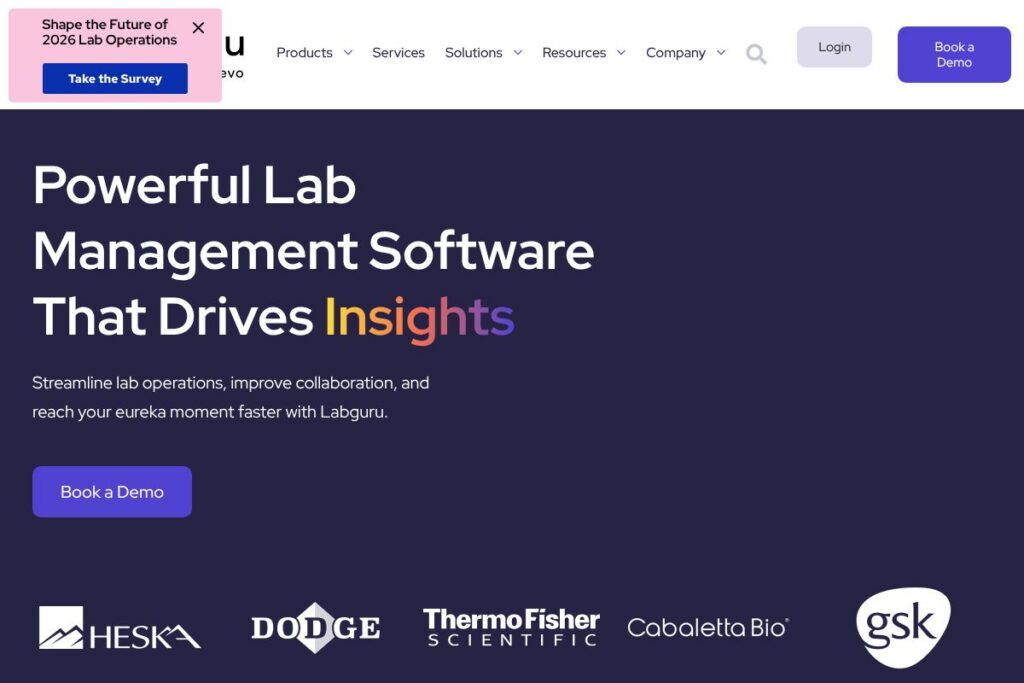

Labguru: An Overview
Labguru is a cloud-based lab management platform designed for R&D teams in biotech, pharma, academic labs and contract research organizations. It merges an electronic lab notebook, laboratory information management features, inventory control, automation tools and analytics into a single environment so teams can plan experiments, track samples and retain full data ownership.
Compared with other life-sciences platforms, Labguru sits between full-featured enterprise LIMS vendors and lighter ELN-only products. For example, Benchling focuses strongly on sequence and molecular biology workflows with extensive developer integrations, LabWare targets large regulated labs with heavy customization and enterprise deployments, and Quartzy emphasizes simple inventory and order management for smaller labs. Labguru differentiates itself by combining ELN and LIMS core capabilities with integrated inventory, customizable automation and a validated cloud option suitable for regulated environments.
All of this makes Labguru well suited for teams that need a single, searchable system to store experimental records, track samples and automate routine lab processes. It performs particularly well for mid-size labs and CROs that need more than an ELN but prefer a more turnkey option than a fully bespoke LIMS implementation.
How Labguru Works
Labguru centralizes laboratory data in structured records that connect experiments, samples, inventory items and equipment. Users create projects and protocols in the ELN, link reagents and samples from inventory, schedule equipment, and capture step-by-step experimental results that are searchable across the platform.
Automation is implemented with configurable workflows and triggers that reduce manual steps; these can invoke predefined protocol steps or custom scripts with the Lab Scripter to automate calculations and data processing. Teams access the platform through a browser, use role-based permissions for collaboration and audit trails for regulatory compliance.
Onboarding typically includes migrating existing notebooks and inventories into Labguru, configuring templates and validating workflows when required. Professional services support is available for integrations, custom workflows and the Labguru Validated Cloud deployment.
Labguru features
Labguru combines ELN, LIMS, inventory and automation features into a single platform, with modules that address experiment design, sample tracking, inventory control and regulatory compliance. Recent platform additions emphasize automation and validated cloud hosting for regulated labs.
Electronic Lab Notebook (ELN)
The ELN lets teams plan experiments, record procedures, attach files and images, and link results to inventory and samples. Entries include versioning, timestamps and access controls so labs can standardize methods and maintain reproducible records.
Laboratory Information Management System (LIMS)
LIMS capabilities cover sample lifecycle management, storage location mapping, chain-of-custody auditing and customizable workflows for processing samples. Built-in reporting and certification flows help labs generate visualized reports and maintain data integrity across studies.
Integrated Inventory Management
Inventory centralizes ordering, tracks stock levels and maps storage locations to reduce duplicate purchases and lost supplies. Notifications for low inventory and detailed records for living specimens, reagents and consumables help control costs and support large sample collections.
Automation and Lab Scripter
Automation tools let teams assemble step-by-step workflows, define triggers and automate data processing or routine lab tasks. The Lab Scripter supports adding code snippets to process results, perform calculations and integrate with external systems for data transfer.
Equipment and Instrument Management
Equipment scheduling, maintenance logs and calibration records are managed alongside experiments so teams can reserve instruments, track usage and attach maintenance history to experimental records. This reduces scheduling conflicts and helps with compliance audits.
Dashboards and Analytics
Dashboards surface experiment progress, inventory status and key performance metrics so lab managers can monitor operations at a glance. Customizable widgets allow different groups to focus on the KPIs that matter for their workflows.
Security, Compliance and Validated Cloud
Labguru supports SOC-compliant cloud hosting and features designed to help meet regulatory requirements including audit trails, electronic signatures and FDA CFR 21 part 11 controls. The Labguru Validated Cloud option and professional validation support are offered for regulated environments.
With these modules combined, Labguru helps labs reduce manual effort, keep data connected across activities and enforce reproducible methods across teams.
Labguru pricing
Labguru uses a SaaS enterprise pricing model with tailored plans rather than publicly listed fixed-price tiers. Pricing is typically customized based on organization size, required modules, deployment options and validation or professional services.
Because Labguru offers custom quotes, organizations should contact sales for a proposal that matches their needs; view Labguru’s homepage for contact options and to request a tailored quote. Common pricing factors include number of users, modules selected (ELN, LIMS, automation), validated deployment needs and onboarding services.
What is Labguru Used For?
Labguru is used to document experiments, track samples and manage reagents and equipment in a single searchable system. Teams use it to replace paper notebooks and fragmented spreadsheets while keeping experimental records linked to inventory and workflows.
Typical use cases include regulated assay development, sample management for sequencing or NGS workflows, inventory control for multi-site labs, protocol standardization, and automating repetitive data processing tasks. It is suitable for biotech and pharma R&D, academic research groups and service labs that need audit-ready records.
Labguru’s Benefits and Limitations
Pros
- Unified platform: Combines ELN, LIMS, inventory and automation so labs keep experimental records, samples and materials connected rather than scattered across multiple tools.
- Regulatory-ready features: Electronic signatures, audit trails and the Labguru Validated Cloud help teams meet FDA CFR 21 part 11 requirements and other compliance needs.
- Automation capabilities: Custom workflows and the Lab Scripter reduce repetitive manual steps and help enforce standardized protocols across teams.
- Professional onboarding and support: PhD-level application scientists and validation services are available to accelerate deployment and ensure correct configuration.
Cons
- Enterprise-oriented pricing: Custom pricing and modular licensing can be less transparent for small labs seeking predictable per-user pricing.
- Configuration effort for complex sites: Highly customized workflows or integrations may require professional services and implementation time to align the system with existing processes.
Does Labguru Offer a Free Trial?
Labguru offers product demos and free trial options so prospective customers can evaluate the platform before committing; trials and demos are typically arranged through the vendor and include access to core ELN, inventory and LIMS functionality. Request a demo or trial through Labguru’s homepage to arrange access and onboarding assistance.
Labguru API and Integrations
Labguru provides API access and integration options so teams can connect the platform to instrument data pipelines, single sign-on providers and common collaboration tools. The API documentation and developer resources outline endpoints for creating and reading records, managing inventory, and automating workflows; see the API documentation for integration details.
Out-of-the-box connectors and common integrations include SSO providers, LIMS-to-instrument interfaces, file storage connectors and the ability to push or pull data to downstream analytics tools and ELN workflows for a more connected lab environment.
10 Labguru alternatives
Paid alternatives to Labguru
- Benchling — A unified R&D platform with strong molecular biology, sequence and registry features aimed at biotech teams and enterprise customers.
- LabWare — An enterprise-grade LIMS with deep customization, strong lab automation integrations and support for complex regulated workflows.
- LabArchives — An electronic lab notebook and data management system often used in academia and research institutions for compliance and collaboration.
- Quartzy — Inventory and order management focused on procurement workflows and simplifying supplies for small to mid-size labs.
- Dotmatics — Informatics platform combining ELN, data visualization and cheminformatics capabilities for discovery science.
- RSpace — ELN and data management system designed for collaborative research with publication and data export features.
- Thermo Fisher SampleManager — A comprehensive LIMS with strong instrument and enterprise integration capabilities for large labs.
Open source alternatives to Labguru
- OpenSpecimen — A biospecimen management platform for tracking specimens, collections and associated clinical metadata in biobanks.
- Bika LIMS — An open-source LIMS with sample tracking, analysis workflows and reporting suitable for labs that can self-host and customize.
- LabKey Server — An open-source data integration platform focused on complex biological data, collaboration and secure data sharing.
- openBIS — A data management system for biological experiments that supports instrument data capture, metadata and structured project organization.
Frequently asked questions about Labguru
What is Labguru used for?
Labguru is used to manage experiments, samples and inventory in a single platform. Teams use it to document protocols, link results to reagents and maintain searchable records for R&D projects.
Does Labguru support FDA CFR 21 part 11 compliance?
Yes, Labguru includes features to support regulatory compliance such as electronic signatures, audit trails and validated cloud hosting. These features help regulated labs meet documentation and traceability requirements.
How much does Labguru cost per user?
Labguru uses custom enterprise pricing rather than fixed public per-user rates. Costs depend on modules selected, number of users, validation and onboarding needs; contact sales via Labguru’s homepage for a tailored quote.
Can Labguru integrate with lab instruments and external tools?
Yes, Labguru offers API access and integrations for instruments, SSO and common collaboration tools. The API documentation describes endpoints to automate data exchange and extend workflows.
Is Labguru suitable for small academic labs?
Yes, Labguru can be configured for small academic labs as well as larger enterprise sites. Its modular approach allows teams to select only the ELN, inventory or LIMS capabilities they need and scale as projects grow.
Final verdict: Labguru
Labguru is a robust option for labs that need combined ELN and LIMS functionality with integrated inventory, automation and compliance-oriented hosting. It excels at connecting experimental records to samples and materials, providing audit-ready trails and offering automation tools that reduce repetitive work for R&D teams.
Compared with Benchling, which also targets biotech R&D with strong sequence and registry features, Labguru tends to emphasize inventory control, equipment management and validated cloud deployments. Both vendors use custom enterprise pricing; Labguru’s professional services and validated hosting can make it a cost-effective choice for regulated mid-size labs that require hands-on onboarding and validation support.
Overall, Labguru is a practical tool for research groups that want a single system to manage experiments, samples and lab operations while keeping data centralized and compliant. For pricing, demos and to explore how its modules match your workflows, visit Labguru’s homepage.