
What is FinQuery
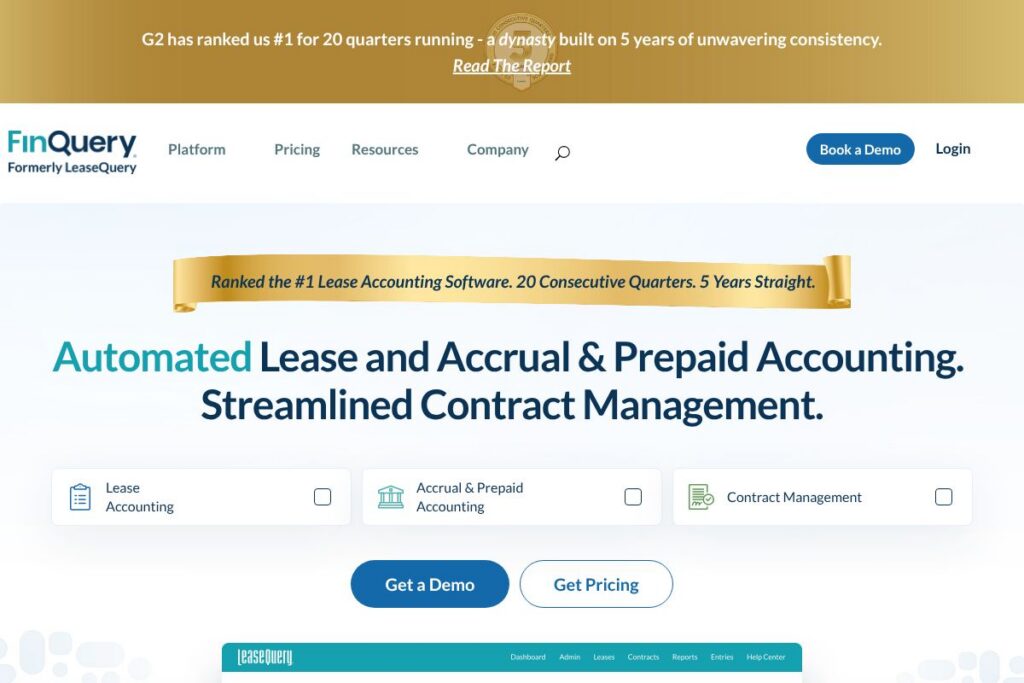
FinQuery is accounting software focused on lease accounting, contract management, accruals and prepaids, and related journal automation for finance teams. It centralizes source documents, produces compliant lease schedules for ASC 842 and IFRS 16, automates recurring accruals and prepayments, and generates disclosure-ready reports for auditors and stakeholders.
Compared with peers, FinQuery targets midsize and enterprise accounting teams that need robust lease and contract controls. For example, LeaseQuery focuses primarily on lease accounting for smaller teams and publishes more self-serve pricing, while Nakisa is often chosen by large enterprises for global lease transformations tied to complex ERP landscapes. Workiva competes on reporting and disclosure automation, but FinQuery emphasizes lease and accrual mechanics and source-to-ledger workflows.
All of this makes FinQuery particularly well suited to corporate accounting groups and finance departments that manage large portfolios of leases and long-term contracts and need consistent accounting, audit trails, and integration into the general ledger.
How FinQuery Works
FinQuery ingests contracts and lease documents through manual upload, bulk import, and optical character recognition to extract key terms such as lease dates, payment amounts, renewal options, and escalation clauses. Extracted data is mapped to configurable accounting rules to calculate right-of-use assets, lease liabilities, amortization schedules, and periodic accruals.
Once accounting rules are applied, FinQuery produces automated journal entries and posting files that integrate with a companys general ledger. Users can review and approve adjustments in a controlled workflow, attach source documents for auditability, and export compliant disclosure reports for ASC 842 and IFRS 16 reporting.
Typical implementations establish a source-to-ledger pipeline: ingest contracts, validate extracted terms, configure accounting policies, generate journal templates, and deliver export files to ERP systems. Finance teams commonly run parallel reconciliations during adoption projects and use FinQuery dashboards to monitor accounting impacts and disclosure-ready outputs.
FinQuery features
FinQuery organizes functionality around lease accounting, accrual and prepaid management, contract lifecycle control, and integration to ERP systems. Core capabilities include lease extraction and modeling, automated journal entry generation, configurable accruals, audit trails, and reporting for financial statements. The platform emphasizes compliance workflows and end-to-end traceability for accounting teams.
Lets talk FinQuery’s Features
Lease accounting (ASC 842 / IFRS 16)
The system supports lease classification, right-of-use asset calculation, and liability measurement in line with ASC 842 and IFRS 16, including initial recognition, subsequent measurement, modifications, and remeasurements. Built-in templates simplify the transition and disclosure processes and produce schedules suitable for external reporting and audit review.
Contract lifecycle and central repository
Contracts and lease documents are stored in a centralized repository with version control and searchable metadata, making it easier to track obligations, renewal windows, and contractual clauses that affect accounting. That centralization reduces missed renewals and ensures consistent application of contract terms to accounting models.
Accruals and prepaids management
FinQuery automates recurring accruals and prepaid amortizations, allowing teams to set schedules, allocation rules, and reversal logic that feed recurring journal generation. This reduces manual spreadsheets and helps maintain consistent month-end close processes for non-lease accruals as well as prepayments.
Automated journal entry generation
Calculated balances and schedules convert directly into formatted journal entries or posting batches that can be exported to ERPs, minimizing manual data entry. Approval workflows ensure entries are reviewed before export, supporting internal controls and SOX requirements.
Reporting and disclosure outputs
The platform produces disclosure-ready schedules and standardized reports for financial statement notes, including rollforwards, lease expense breakdowns, and maturity analyses. Custom report templates and export options help accounting teams adapt outputs to audit and regulatory needs.
Audit trail and controls
Every data change, approval, and journal export is tracked with user-level audit trails and attachment links to source documents, supporting auditor inquiries and internal controls. Role-based permissions let finance leaders control who can alter accounting models or post entries.
ERP and general ledger integrations
FinQuery provides connectors and export formats for common ERPs and GL systems, enabling direct posting or staged uploads to systems like Oracle NetSuite, SAP, and Microsoft Dynamics. Integrations reduce reconciliation work and keep accounting entries aligned with source schedules.
With these capabilities, the biggest benefit is a controlled, auditable accounting workflow from contract ingestion to ledger posting, which reduces manual effort and strengthens month-end accuracy.
FinQuery pricing
FinQuery uses a custom enterprise pricing model designed for accounting and finance teams, rather than fixed self-serve subscription tiers. Pricing typically depends on factors such as number of leases and contracts, integration complexity, deployment model, and support needs.
For detailed pricing and to discuss deployment options, contact FinQuery sales or request a demonstration via the FinQuery homepage. Enterprise customers can also request tailored implementation and support packages aligned to their accounting and audit requirements.
What is FinQuery Used For?
FinQuery is commonly used for lease accounting compliance, converting contract terms into accounting entries that satisfy ASC 842 and IFRS 16 disclosure requirements. Finance teams use it to run remeasurements, manage transition projects, and produce audit-ready schedules.
Beyond leases, accounting teams apply FinQuery to recurring accruals and prepaid amortizations, centralizing controls for month-end adjustments and enabling consistent posting across multiple entities. The platform is also used to manage contract obligations that affect financial statements, such as service contracts and lease-like arrangements.
Pros and cons of FinQuery
Pros
- Strong lease accounting coverage: Built-in support for ASC 842 and IFRS 16 simplifies classification, measurement, and disclosure workflows for lease portfolios.
- Source-to-ledger automation: Automated journal generation and ERP export reduce manual posting errors and speed up month-end close processes.
- Centralized contract repository: Storing documents and extracted metadata in one place improves traceability and reduces missed contractual obligations.
- Audit and control features: Detailed audit trails, approval workflows, and role-based permissions support SOX and audit readiness.
- Integration-focused: Connectors and export formats for major ERPs help maintain a single source of truth for accounting entries.
Cons
- Enterprise sales model: The custom pricing and sales-led approach can lengthen procurement cycles for small teams that prefer self-serve plans.
- Configuration complexity: Rich configuration options for accounting policies require experienced accounting resources for initial setup and validation.
- ERP dependency for full automation: To realize end-to-end automation, customers often need ERP integration work that can add implementation time.
- Niche focus: Organizations that need broader FP&A, treasury, or core lease administration capabilities outside accounting may require additional systems.
Does FinQuery Offer a Free Trial?
FinQuery does not offer a public free plan; it typically provides demos and pilot programs on request. Finance teams can schedule a product demonstration or request a pilot deployment through the FinQuery contact page to evaluate functionality and fit before committing to a contract.
FinQuery API and Integrations
FinQuery provides APIs and integration options to connect extracted lease and accounting data with enterprise ERPs and reporting systems. The platform supports data exchange formats and connector-based integrations to systems such as Oracle NetSuite, SAP, Microsoft Dynamics, and other general ledgers.
Developers and technical teams can review integration pathways and API capabilities through FinQuery’s developer and integration resources on the FinQuery website, and request technical documentation when engaging with sales or implementation teams.
10 FinQuery alternatives
Paid alternatives to FinQuery
- LeaseQuery — Lease-focused accounting software that emphasizes self-service onboarding and transparent tiered pricing for smaller to midmarket teams.
- Visual Lease — Lease administration and accounting with strong centralization features and integrations for enterprise users.
- Nakisa — Enterprise lease accounting and asset management solution used in large-scale ERP transformations.
- Workiva — Known for reporting and disclosure automation, often used alongside accounting systems for compliant external reporting.
- CoStar Real Estate Manager — Real estate and lease management with integrated accounting features for corporate real estate portfolios.
- Oracle NetSuite Lease Management — Module-level lease accounting tied directly to the NetSuite ERP for organizations already on that platform.
Open source alternatives to FinQuery
- ERPNext — Open source ERP with core accounting modules that can be extended for lease and accrual workflows through customization.
- Odoo — Modular open source ERP that includes accounting; additional modules or custom development are needed for lease-specific compliance.
- GnuCash — Free accounting package suitable for small organizations, but lacking built-in lease accounting and enterprise controls.
Frequently asked questions about FinQuery
What does FinQuery do for lease accounting?
FinQuery automates lease classification, measurement, and disclosure for ASC 842 and IFRS 16. It extracts lease terms, applies accounting rules, generates amortization schedules, and prepares disclosure-ready reports.
Does FinQuery integrate with my ERP system?
Yes, FinQuery offers integration options and export formats for major ERPs. Common integrations include Oracle NetSuite, SAP, and Microsoft Dynamics, and additional connectors can be scoped during implementation.
Can FinQuery handle accruals and prepaids as well as leases?
Yes, FinQuery manages recurring accruals and prepaid amortizations in addition to lease accounting. Teams configure schedules and reversal logic to produce consistent journal entries for month-end close.
Is FinQuery suitable for large enterprise accounting teams?
FinQuery is designed for midsize to large finance organizations managing many leases and contracts. Its audit controls, role-based permissions, and API integrations support enterprise requirements and SOX controls.
How can I get pricing or a demo for FinQuery?
FinQuery uses custom enterprise pricing and schedules demos or pilots on request. Contact FinQuery sales through the FinQuery homepage or the contact page to request pricing details and a demonstration.
Final verdict: FinQuery
FinQuery stands out for its focused approach to lease accounting and accrual management, offering source-to-ledger automation, audit trails, and disclosure outputs tailored for accounting teams. The platform is particularly useful for organizations that require consistent application of accounting policies across a large portfolio of leases and contracts and need tight integration with general ledgers.
Compared with LeaseQuery, which often targets smaller teams with published tiered plans, FinQuery follows a custom enterprise pricing and implementation model that fits organizations with complex portfolios or multiple entity structures. For teams that prioritize deep lease accounting controls and enterprise integration, FinQuery provides the functionality and governance accountants need, though procurement and implementation may take longer than with self-serve alternatives.