
Listing Mirror: An Overview
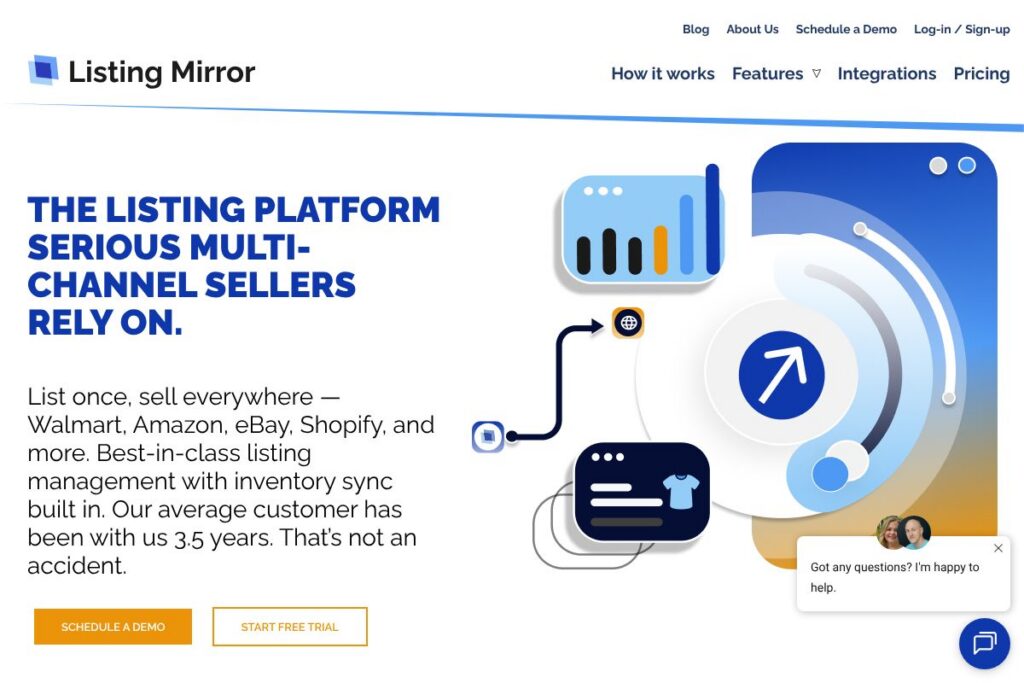
Listing Mirror is a multi-channel e-commerce management platform designed to help merchants list products, synchronize inventory, and route orders across marketplaces such as Amazon, Walmart, eBay, and Shopify. It consolidates listings and orders into a single dashboard so sellers can avoid overselling, apply channel-specific pricing, and manage fulfillment from multiple warehouses or third-party logistics providers.
Compared with competitors, Listing Mirror targets SMBs and mid-market sellers with a mix of self-service plans and integrations. ChannelAdvisor focuses on large-enterprise sellers with high-volume onboarding and custom contracts, while Linnworks provides deep automation and inventory orchestration geared at technically complex operations. Sellbrite is more similar on pricing and usability for small teams, but Listing Mirror emphasizes flexible fulfillment routing, marketplace coverage, and bulk cross-listing tools.
Listing Mirror does particularly well at keeping inventory consistent across many channels, simplifying cross-listing for large catalogs, and integrating with FBA/MCF and common shipping platforms. This makes it a useful choice for sellers who sell on multiple marketplaces and need centralized control without the overhead of a custom enterprise implementation.
How Listing Mirror Works
The platform imports your existing product catalog from a connected marketplace or storefront and creates a central product record you can map to other channels. Titles, descriptions, images, and variants are carried over and can be edited centrally or adjusted per channel using templates and bulk actions.
Inventory is managed by assigning a source of truth warehouse or fulfillment service; when an order is placed on any connected channel, Listing Mirror decrements inventory across the remaining channels in near real-time. Pricing rules let you maintain a master price and apply channel-specific markups or fixed overrides.
Order management aggregates orders from all marketplaces into a single interface where you can route fulfillment to your warehouse, a 3PL, or Amazon MCF. Tracking details sync back to the originating marketplace automatically, and integrations with shipping platforms reduce manual fulfillment steps.
Listing Mirror features
Listing Mirror centers on listing management, inventory synchronization, pricing controls, and order routing, with integrations to major marketplaces and shipping tools. Recent emphasis includes dynamic repricing integration options, more granular inventory source selection by marketplace, and expanded marketplace connectors.
Listing management
Centralized listing creation and editing lets you take an existing catalog and push listings to multiple marketplaces while preserving titles, images, and variants. Bulk tools and templates speed large catalog rollouts and support per-channel attribute mapping.
Inventory synchronization
Inventory quantities are synchronized across channels in near real-time, with options to select different inventory sources per marketplace and set minimum and maximum thresholds. This reduces overselling and supports mixed fulfillment models across warehouses and FBA.
Order fulfillment and routing
Orders from all channels appear in a unified dashboard where you can route fulfillment to in-house warehouses, third-party logistics providers, or Amazon MCF. Fulfillment status and tracking numbers are returned to marketplaces automatically to close the loop.
Pricing and repricing rules
You can set a master product price and create channel-specific pricing rules, including percentage markups, fixed markups, or fully independent prices per channel. Listing Mirror can also integrate with external dynamic repricers to respond to marketplace competition.
Integrations and marketplace coverage
Native integrations include Amazon (US, CA, MX, UK, EU), Walmart (US, CA), eBay, Shopify, Etsy, Wayfair, BigCommerce, WooCommerce, Newegg, Reverb, and others. Shipping and fulfillment integrations include common providers and platforms such as ShipStation. For a full list of connectors, see the Listing Mirror integrations hub.
Bulk import and cross-listing
Imported listings can be cross-listed to additional marketplaces using filters, tags, and bulk actions to target specific SKUs. This is useful for sellers who maintain their most complete catalog on one channel and want to expand coverage with minimal manual work.
With its mix of listing, inventory, pricing, and fulfillment controls, Listing Mirror is strongest at reducing manual channel management work and protecting merchants from oversells while enabling flexible routing of orders across multiple fulfillment sources.
Listing Mirror Pricing
Listing Mirror uses tiered subscription plans based on SKU counts, connected sales channels, and included FBM order volumes. The platform offers separate pricing for combined listing and inventory management versus listing-only access, with plans targeted at small sellers through scaled accounts for larger catalogs.
Monthly Billing:
Bronze – $129/mo (1,000 SKUs, 4 sales channels, 1 user, 300 FBM orders; listing & inventory)
Bronze – $69/mo (1,000 SKUs, 4 sales channels, 1 user, 300 FBM orders; listing only)
Silver – $199/mo (5,000 SKUs, 5 sales channels, 5 users, 1,000 FBM orders; listing & inventory)
Silver – $129/mo (5,000 SKUs, 5 sales channels, 5 users, 1,000 FBM orders; listing only)
Gold – $279/mo (50,000 SKUs, 8 sales channels, 10 users, 5,000 FBM orders; listing & inventory)
Gold – $199/mo (50,000 SKUs, 8 sales channels, 10 users, 5,000 FBM orders; listing only)
Annual Billing:
Annual billing and multi-year discounts are available, with reduced effective monthly costs for customers who commit to yearly plans; contact Listing Mirror sales or view the Listing Mirror homepage for current annual options and promotional discounts.
Enterprise
Enterprise – Custom pricing for high-volume sellers and complex multi-marketplace operations, typically including advanced onboarding, SLA options, dedicated support, and custom connectors; contact sales for a tailored quote via the Listing Mirror homepage.
What is Listing Mirror Used For?
Listing Mirror is used to centralize and automate the core tasks of multi-channel selling: creating and syncing listings, managing inventory across multiple warehouses and fulfillment services, and routing orders to the appropriate fulfillment source. It reduces the manual work of updating listings on each marketplace and keeps inventory accurate across channels.
Typical users include direct-to-consumer brands selling on marketplace plus storefront combinations, 3PL-backed merchants who need automatic routing to various warehouses, and resellers who maintain large SKU counts and rely on bulk listing and pricing rules to stay competitive. The platform is useful when sellers need per-channel pricing strategies, Amazon MCF routing, or integration with ShipStation and other fulfillment tools.
Pros and Cons of Listing Mirror
Pros
- Centralized inventory and listings: Consolidates product data, images, and quantities so sellers can avoid overselling and manage multi-channel catalogs from a single platform. This reduces reconciliation work and simplifies multi-warehouse setups.
- Flexible pricing rules: Supports master product pricing and per-channel overrides, plus integration with dynamic repricers to maintain competitive pricing across marketplaces. This lets sellers implement complex pricing strategies without manual edits.
- Multi-source fulfillment routing: Integrates with FBA/MCF, third-party logistics providers, and in-house warehouses to route orders automatically and sync tracking back to marketplaces. That reduces manual fulfillment decisions and speeds order processing.
Cons
- Learning curve for complex setups: Configuring multiple inventory sources, channel-specific mappings, and advanced repricing rules can take time for merchants with large catalogs or custom workflows. Professional onboarding may be required for complex accounts.
- Feature gaps for enterprise-level reporting: Larger enterprises that need deep, built-in BI and advanced custom reporting may find Listing Mirror less feature-rich than high-end enterprise platforms and might need to export data to external analytics tools.
- Channel connector limitations vary: Marketplaces and storefronts differ in supported attributes and update cadence, so some channel-specific fields or rapid marketplace-side changes can require custom mapping or workarounds.
Does Listing Mirror Offer a Free Trial?
Listing Mirror offers a free trial. The trial lets you connect marketplaces, import a limited number of SKUs, and test inventory syncing, cross-listing, and order management without providing a credit card; contact Listing Mirror or sign up through the Listing Mirror homepage to begin.
Listing Mirror API and Integrations
Listing Mirror provides extensive marketplace integrations and connectors for major platforms including Amazon, Walmart, eBay, Shopify, Etsy, Wayfair, BigCommerce, WooCommerce, Newegg, and more. You can see the supported channels on the Listing Mirror integrations page.
The platform also supports integration with shipping and fulfillment tools such as ShipStation and can route orders to Amazon MCF. Listing Mirror offers developer-facing integration options and APIs for automation and custom workflows; check the vendor documentation or contact sales for API access and developer guides via the Listing Mirror homepage.
10 Listing Mirror alternatives
Paid alternatives to Listing Mirror
- ChannelAdvisor – Enterprise-grade marketplace management and advertising tools, best for high-volume sellers who need global marketplace coverage and enterprise support.
- Linnworks – Inventory and order automation with strong workflow automation for complex operations and multi-warehouse orchestration.
- Sellbrite – User-friendly multi-channel listing and inventory sync geared at SMBs with straightforward pricing and fast setup.
- Zentail – Focuses on automation and catalog management for brands and retailers with tools to simplify listing optimization and channel rules.
- ChannelEngine – Marketplace connectivity and product feed management for brands and manufacturers wanting broad global marketplace coverage.
- SkuVault – Inventory and warehouse management software with multi-channel integrations and strong warehouse operational controls.
- Sellercloud – End-to-end commerce management with advanced integrations for catalogs, inventory, and order routing across channels.
Open source alternatives to Listing Mirror
- Odoo – Community edition provides open-source ERP modules including e-commerce and inventory that can be extended to support multichannel workflows through custom modules.
- Spree Commerce – Open-source e-commerce platform that can be integrated with custom connectors to marketplaces and third-party sync tools.
- ERPNext – Open-source ERP with inventory and sales modules that can be adapted for multi-channel selling through integrations and scripting.
Frequently asked questions about Listing Mirror
What marketplaces does Listing Mirror support?
Listing Mirror supports a wide set of marketplaces including Amazon, Walmart, eBay, Shopify, Etsy, Wayfair, BigCommerce, WooCommerce, Newegg, and more. For the most current list see the Listing Mirror integrations.
How does Listing Mirror handle inventory syncing?
Listing Mirror syncs inventory in near real-time by designating a source of truth per SKU or marketplace. When a sale occurs the system decrements inventory across connected channels and honors min/max thresholds and per-channel inventory sources.
Can Listing Mirror route orders to Amazon Multi-Channel Fulfillment?
Yes, Listing Mirror can route eligible orders to Amazon MCF. Orders from supported channels can be sent to Amazon for pick, pack, and ship, with tracking returned to the originating marketplace.
Does Listing Mirror integrate with shipping software like ShipStation?
Yes. Listing Mirror integrates with ShipStation and other shipping platforms. Orders can be pushed for fulfillment and tracking numbers are synced back to marketplaces automatically.
How much does Listing Mirror cost per month?
Listing Mirror offers tiered plans starting at $69/mo for listing-only access and $129/mo for combined listing and inventory in the Bronze tier. Higher tiers are available for larger SKU counts and additional channels; view current pricing options on the Listing Mirror homepage.
Final Verdict: Listing Mirror
Listing Mirror is a practical, focused solution for merchants who need centralized control over listings, inventory, and multi-source fulfillment without the complexity of a full enterprise onboarding. Its strengths lie in reliable inventory synchronization, flexible pricing rules, and routing orders to multiple fulfillment options including Amazon MCF and common 3PLs.
Compared with ChannelAdvisor, which targets enterprise customers with custom pricing and heavyweight services, Listing Mirror at its tiered plans starting at $69/mo offers a more accessible entry point for SMBs and mid-market sellers while still covering core multi-channel needs. For sellers who require enterprise-grade analytics or bespoke integrations at scale, an enterprise platform may be more appropriate, but for most multi-channel merchants Listing Mirror provides a balanced feature set at a reasonable price.