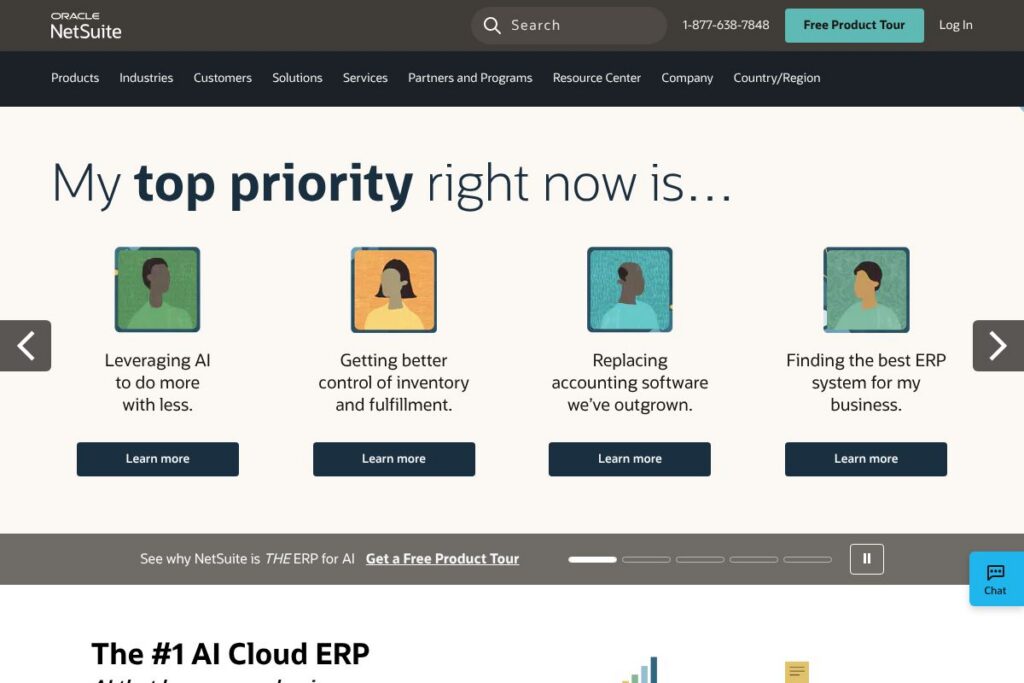

NetSuite: An Overview
NetSuite is a unified cloud business management suite that combines ERP, accounting, CRM, and ecommerce capabilities into a single platform. It is built to centralize transactional and master data so finance, operations, sales, and commerce teams can work from a consistent single source of truth.
Compared with SAP S/4HANA, NetSuite is often positioned for fast cloud adoption and multi-subsidiary management with fewer heavy integration projects, while Microsoft Dynamics 365 emphasizes modular apps that integrate with the broader Microsoft stack. For smaller finance-first needs, Sage Intacct focuses on core accounting and financial reporting and can be less complex to implement than a full-suite ERP deployment.
NetSuite does particularly well at combining commerce, financials, and CRM into one ecosystem, which reduces data handoffs and reconciliation work. This makes it well suited for distributed product businesses, companies scaling internationally, and organizations that want to consolidate multiple legacy systems into one cloud platform.
How NetSuite Works
NetSuite operates as a multi-tenant cloud service where core modules share a central data model so transactions flow from sales and ecommerce into inventory, order management, and financials without manual exports. Customers access NetSuite through web-based interfaces, role-based dashboards, and configurable reports that reflect a single set of master records.
Implementation commonly follows staged adoption: start with core financials and order-to-cash, then add inventory, manufacturing, CRM, and SuiteCommerce storefronts as needed. Administrative tools like role permissions, saved searches, and SuiteFlow workflows let teams automate approvals, notifications, and routing without modifying underlying code.
NetSuite supports multi-subsidiary and multi-currency setups with consolidated reporting and intercompany eliminations, making it practical for global businesses that need automated consolidation and localized tax handling.
NetSuite features
NetSuite’s feature set covers transactional systems, customer records, ecommerce, and extensibility tools that let organizations build processes and automate work. Recent product messaging highlights embedded AI capabilities under the NetSuite Next initiative to add conversational search, agentic workflows, and business-aware recommendations.
ERP and Financial Management
Comprehensive general ledger, accounts payable, accounts receivable, and fixed asset management provide continuous accounting with automated journal entries and period close tools. Built-in intercompany, multi-currency, and multi-book accounting simplify consolidated reporting for global enterprises.
Inventory and Order Management
Real-time inventory visibility, demand planning, and order fulfillment workflows coordinate supply and distribution across warehouses and sales channels. Native order management ties ecommerce and B2B orders directly into fulfillment and invoicing.
CRM and Customer Lifecycle
CRM maintains customer records, opportunity pipelines, quotes, and service cases in the same system as financials so sales and support teams see order history and billing status. This integrated record reduces data duplication and improves sales-to-cash transparency.
SuiteCommerce and Ecommerce
SuiteCommerce provides storefront and headless commerce capabilities integrated with inventory, pricing, and customer data. Online orders feed directly into order management and fulfillment without separate middleware.
Analytics and Reporting
Saved searches, customizable dashboards, and role-specific KPIs let teams monitor activity in real time, while native reporting supports financial statements and regulatory outputs. Extended analytics options integrate with data warehousing and BI tools for larger reporting requirements.
Automation and Workflows
SuiteFlow and scripting options enable approval routing, scheduled processes, and automated record updates to eliminate manual steps. Automations reduce reconciliation work and accelerate repetitive transaction processing.
SuiteCloud Platform and Extensibility
SuiteCloud tools, including SuiteScript, SuiteTalk APIs, and developer frameworks, let technical teams extend NetSuite, build custom integrations, and package industry-specific extensions. The platform supports partner-built modules and managed bundles to address vertical requirements.
Global and Localization Capabilities
Localization for tax, regulatory reporting, and local currency handling help multinational companies comply with regional rules while consolidating reporting. Features include localized tax engines and configurable fiscal calendars.
Embedded AI and NetSuite Next
NetSuite Next brings natural-language search, AI-assisted recommendations, and agentic workflow options that surface insights from the unified dataset so users can find records, suggest actions, and automate routine decisions. AI features act on the shared data model to reduce guesswork in forecasting and anomaly detection.
With these features combined, NetSuite’s biggest strength is providing a single data model across core enterprise functions, which reduces integrations and manual reconciliation while enabling cross-functional reporting and automation.
NetSuite pricing
NetSuite uses an enterprise SaaS pricing model with subscription and implementation costs that vary by modules, user counts, transaction volumes, and deployment options. Pricing is typically offered through custom quotes rather than fixed public price tiers because deployments are commonly tailored to each customer’s configuration.
For current package options, module details, and assistance obtaining a quote, consult NetSuite’s site for enterprise pricing guidance and sales contact channels. See NetSuite’s enterprise product information and the contact sales and demo options for personalized pricing and deployment planning.
What is NetSuite used for
NetSuite is used to centralize financial operations, manage order-to-cash and procure-to-pay cycles, run inventory and fulfillment, and operate B2B or B2C commerce channels. Businesses use it to replace fragmented systems so reporting, cash flow management, and operational execution happen in one platform.
Typical users include mid-market and enterprise product companies, distributors, software companies that require revenue recognition, and global businesses that need consolidated accounting and localized tax support. It is also used by organizations pursuing standardization of business processes across divisions or acquisitions.
Pros and cons of NetSuite
Pros
- Complete unified suite: Reduces data handoffs by combining ERP, CRM, and ecommerce into one platform, which simplifies reconciliation and reporting.
- Strong multi-subsidiary support: Built-in consolidation, intercompany eliminations, and multi-currency handling help global companies manage financials across entities.
- Extensible platform: SuiteCloud, SuiteScript, and APIs let teams build custom workflows, integrations, and vertical solutions without replacing core functionality.
- Commerce and ERP integration: Native SuiteCommerce links storefronts to inventory and order management which streamlines online order processing.
Cons
- Implementation complexity: Deployments can require significant configuration and professional services time for large or highly customized businesses.
- Enterprise cost profile: Total cost of ownership often includes subscription, implementation, and ongoing professional services which can be substantial for smaller organizations.
- Customization maintenance: Heavy customization can increase long-term maintenance and upgrade effort when platform releases occur.
Can You Test NetSuite Before Buying?
NetSuite offers demos and guided trial options through its sales team rather than a public free plan. Prospective customers can request a product tour or demo, and NetSuite often provides sandbox environments or trial access as part of the sales and evaluation process to validate configuration and workflows.
NetSuite API and Integrations
NetSuite provides developer APIs and integration frameworks through SuiteTalk (web services), REST Web Services, and SuiteScript for custom business logic. The SuiteCloud developer documentation describes available endpoints, scripting patterns, and integration practices.
NetSuite integrates with many third-party systems and connectors, including common services such as Salesforce, Shopify, Avalara, ADP, Stripe, Zendesk, Google Workspace, and Microsoft 365, either through native connectors, partner integrations, or custom integrations built on SuiteTalk and REST APIs.
10 NetSuite alternatives
Paid alternatives to NetSuite
- SAP S/4HANA – Enterprise-grade ERP oriented to complex manufacturing and large global deployments with deep industry capabilities.
- Microsoft Dynamics 365 – Modular cloud ERP and CRM apps that integrate tightly with Microsoft cloud services and productivity tools.
- Sage Intacct – Financial management and accounting-first cloud solution favored by finance teams for robust reporting and core accounting workflows.
- Acumatica – Cloud ERP focused on mid-market needs with flexible deployment and licensing models and strong distribution features.
- Oracle Fusion Cloud ERP – Oracle’s enterprise ERP offering for large organizations that want deep finance, procurement, and HCM capabilities.
- Workday – Strong in finance and HR for enterprise organizations, best for workforce and financial planning combined deployments.
- Infor CloudSuite – Industry-specific cloud suites for manufacturing, distribution, and services with strong vertical feature sets.
Open source alternatives to NetSuite
- Odoo – Modular open source ERP and business apps with a large app store for CRM, ecommerce, inventory, and accounting.
- ERPNext – Open source ERP focused on SMBs with integrated accounting, inventory, manufacturing, and HR modules.
- Dolibarr – Lightweight ERP and CRM that is simple to deploy for small businesses and non-profits.
- Tryton – A three-tier open source ERP framework suitable for customization and smaller enterprise deployments.
Frequently asked questions about NetSuite
What does NetSuite do for businesses?
NetSuite provides cloud-based ERP, financials, CRM, and ecommerce in a single platform. It centralizes transactions and master data so finance, operations, and sales teams can work from the same records and reporting.
Does NetSuite include ecommerce capabilities?
Yes, NetSuite includes SuiteCommerce for integrated ecommerce functionality. SuiteCommerce connects storefronts to inventory, pricing, and order management to streamline online order processing.
Can NetSuite integrate with other systems like Salesforce?
Yes, NetSuite supports integrations via SuiteTalk, REST APIs, and partner connectors. Common integrations include CRM, payroll, tax engines, payment processors, and specialized industry systems.
How is NetSuite priced for companies?
NetSuite uses enterprise subscription pricing tailored to modules, users, and transaction volumes. Pricing is provided via custom quotes so organizations should contact sales for a detailed estimate and licensing options.
Is NetSuite suitable for multinational companies?
Yes, NetSuite supports multi-subsidiary, multi-currency, and localized tax handling. Built-in consolidation and localization tools make it appropriate for organizations operating across multiple countries.
Final verdict: NetSuite
NetSuite stands out for offering a single data model across ERP, financials, CRM, and commerce, which reduces integration overhead and supports consolidated reporting for global enterprises. Its extensibility via SuiteCloud and rich automation features make it capable of handling complex operational workflows across finance, supply chain, and customer-facing channels.
Compared with Sage Intacct, which focuses tightly on accounting and financial reporting and can be more cost effective for finance-led small to mid-sized organizations, NetSuite delivers a broader end-to-end platform that includes commerce and full operational modules but typically requires a larger investment and implementation effort. Organizations that need an integrated suite across finance, operations, and commerce will find NetSuite a comprehensive option; those needing only core financials may prefer a more focused solution.