
What is OneTrust
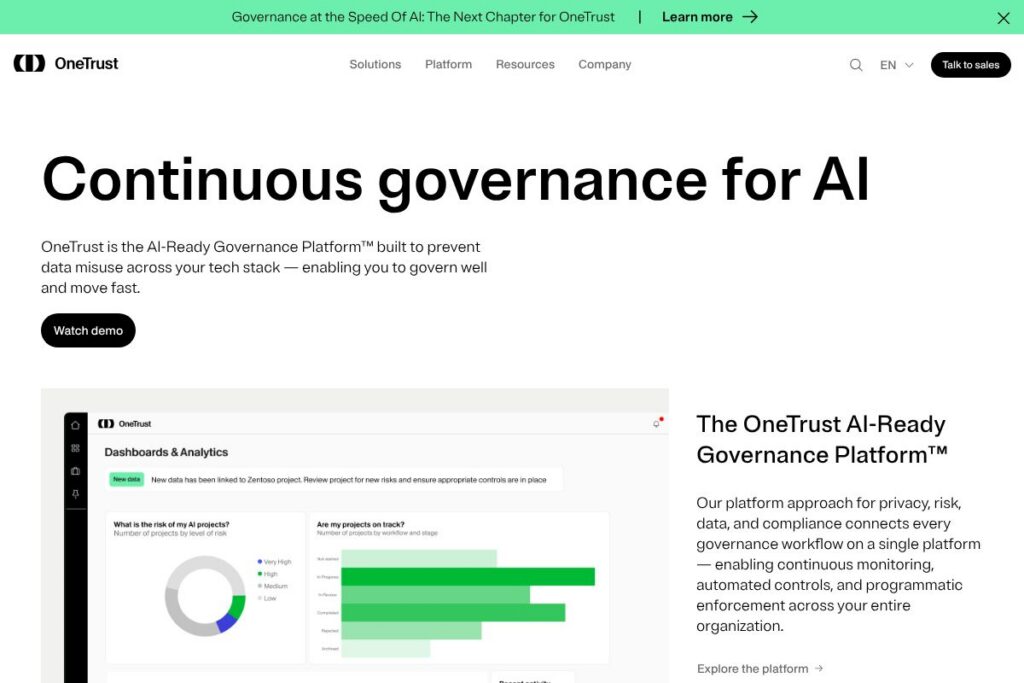
OneTrust is an enterprise governance platform that combines privacy, consent, data use governance, AI model governance, and third-party risk management on a single platform. It provides tools for model inventory, risk assessments, policy enforcement, consent capture, and automated compliance reporting designed for regulated organizations handling sensitive data and AI systems.
Compared with other solutions, TrustArc focuses strongly on privacy assessments and regulatory mapping while BigID emphasizes deep data discovery and classification across data stores. Collibra specializes in data catalog and data governance workflows, making Collibra a stronger choice when the primary requirement is metadata management. OneTrust positions itself as a broad governance platform that unifies these disciplines rather than acting as a single-point tool.
OneTrust does particularly well at connecting privacy, risk, and compliance workflows to runtime controls and continuous monitoring, making it suitable for large enterprises and regulated industries that need an integrated program across multiple teams. It is best for organizations that require centralized governance for privacy, AI lifecycle management, and vendor risk, and that need to enforce policies consistently across cloud and on-prem systems.
How OneTrust Works
The platform ingests inventories, policies, and data mappings to build a centralized source of truth for governance. Users create model and data inventories, run automated assessments and risk scoring, and apply policies that map to regulatory requirements; those outputs feed into monitoring and reporting dashboards for stakeholders.
In practice, a privacy team can use OneTrust to register datasets, attach legitimate interest or consent metadata, and drive data access controls through connectors and enforcement agents. A separate AI governance workflow lets model owners document model purpose, training data lineage, bias testing results, and mitigation steps, then surface those records to compliance reviewers for approvals and audit trails.
What does OneTrust do?
OneTrust groups capabilities across privacy automation, consent and preference management, data use governance, AI governance, tech risk and compliance, and third-party management. The platform emphasizes continuous monitoring and programmatic enforcement so policies can translate into runtime controls across systems.
AI Governance
Model inventory and lifecycle controls let teams catalog models, record training data provenance, and attach risk assessments and testing artifacts. This supports review workflows, approval gates, and documentation needed for audits or regulatory inquiries.
Consent & Preferences
Centralized consent capture and preference centers provide configurable flows for consumer transparency, consent tracking, and preference enforcement across web, mobile, and backend systems. Integrations let preference signals propagate to marketing, analytics, and downstream systems.
Data Use Governance
Data use policies and automated policy enforcement help teams declare permitted uses, map uses to datasets, and prevent unauthorized processing via runtime controls. Lineage and classification features support identifying AI-ready data and restricting access where required.
Privacy Automation
Privacy impact assessments, record of processing activities, and automated workflows reduce manual work for privacy teams. The platform automates evidence collection for audits and generates compliance artifacts for common regulations.
Tech Risk & Compliance
Risk assessment frameworks, control libraries, and remediation tracking scale program management across security and compliance teams. Continuous monitoring dashboards surface control failures and highlight remediation priorities.
Third-Party Management
Vendor intake, risk scoring, contract questionnaires, and monitoring streamline third-party risk workflows from onboarding through ongoing review. Automated reporting and escalation rules help maintain audit-ready vendor records.
OneTrust’s biggest feature benefit is the integration between governance domains; privacy, AI, data use, and third-party workflows share inventories and controls so teams avoid duplicated effort and maintain consistent policy enforcement. For more on the platform approach, see OneTrust’s AI governance platform.
OneTrust pricing
OneTrust uses an enterprise subscription model with custom pricing tailored to each organization’s scale, modules selected, and deployment needs, rather than fixed public plans. Pricing typically depends on modules, number of users or seats, data connectors, and professional services for implementation.
For tailored pricing and licensing options, contact OneTrust sales or request a demo through OneTrust’s contact page to get a quote aligned with your governance scope and deployment preferences.
What is OneTrust Used For?
OneTrust is used to build and operate integrated governance programs that cover data privacy, consent management, data use policies, AI lifecycle governance, and vendor risk. Teams use it to automate assessments, centralize inventories, demonstrate compliance, and apply policy enforcement that reduces manual controls.
Typical users include privacy officers, legal and compliance teams, AI model owners, data governance leads, and vendor risk managers at medium and large enterprises. Organizations facing sector-specific regulations or complex vendor ecosystems will use OneTrust to create consistent, auditable controls across teams.
Pros and Cons of OneTrust
Pros
- Comprehensive governance platform: OneTrust brings privacy, AI governance, consent, data use, and third-party risk into a single platform, reducing fragmentation across toolchains.
- Continuous monitoring and enforcement: Programmatic enforcement and runtime controls make it easier to translate policies into operational safeguards across systems.
- Scalable for large enterprises: Features such as automated assessments, workflows, and reporting scale to support enterprise compliance needs across regions and business units.
- Prebuilt templates and frameworks: Regulatory mappings, assessment templates, and control libraries speed implementation and standardize programs.
Cons
- Enterprise focus means complexity: The breadth of capabilities requires configuration and change management, which can extend implementation timelines for smaller teams.
- Custom pricing and procurement: Lack of public pricing means procurement can require multiple vendor engagements and may be slower for organizations seeking rapid evaluation.
- Feature overlap with specialist tools: Organizations that only need deep data discovery or advanced metadata management may find specialist tools such as BigID or Collibra better aligned to that specific need.
Does OneTrust Offer a Free Trial?
OneTrust is offered as paid enterprise software and typically provides demos and trial options on request. There is no blanket public free tier; organizations usually engage with sales to arrange demos, proof-of-concept pilots, or limited trials that target specific modules. To arrange a demo or trial, use OneTrust’s request a demo page.
OneTrust API and Integrations
OneTrust provides APIs and connectors for common enterprise systems to automate inventories, sync records, and enforce preferences; available integrations cover cloud platforms, identity providers, CRM systems, and data stores. See OneTrust’s integrations catalog for a list of prebuilt connectors.
Developer and API documentation is available for customers to build custom automations and integrate governance workflows with internal systems; refer to the OneTrust developer resources for endpoint details and integration guides.
10 OneTrust alternatives
Paid alternatives to OneTrust
- TrustArc — Provides privacy management and assessment tools with strong regulatory mapping and assessment workflows.
- BigID — Focuses on enterprise data discovery and classification to support privacy and risk programs with deep data scanning.
- Collibra — Offers data catalog and governance capabilities suited for metadata-driven data governance programs.
- Securiti — Combines data intelligence, privacy, and governance features with automation for data access and subject rights.
- Microsoft Purview — Integrates data governance with Microsoft cloud services and offers classification, lineage, and policy management.
- Privitar — Specializes in data anonymization and privacy-preserving transformations for analytics and AI use cases.
- SAP GRC — Provides governance, risk, and compliance controls focused on enterprise resource planning and SAP landscapes.
Open source alternatives to OneTrust
- Apache Atlas — An open source data governance and metadata framework for data classification and lineage across big data ecosystems.
- Open Policy Agent — A general-purpose policy engine that can enforce authorization and policy decisions across services and infrastructure.
- Ory Keto — An open source authorization and access control system useful for implementing policy enforcement for data access.
Frequently asked questions about OneTrust
What is OneTrust used for?
OneTrust is used to centralize privacy, consent, AI governance, and third-party risk workflows. Organizations use it to document inventories, run assessments, enforce policies, and maintain audit-ready compliance artifacts.
Does OneTrust have an API for automation?
Yes, OneTrust provides APIs and developer resources for automation and integrations. Customers can use those APIs to sync inventories, automate assessments, and connect governance outcomes to enforcement points; see the OneTrust developer resources.
How much does OneTrust cost?
OneTrust uses enterprise, custom pricing tailored to modules, users, and deployment needs. For specific quotes and licensing options, contact OneTrust sales via their contact page.
Can OneTrust manage AI model risk?
Yes, OneTrust supports AI governance workflows including model inventory, risk assessments, testing artifacts, and approval gates. These capabilities help teams document model lifecycle details, testing results, and mitigation actions for governance and audit purposes.
Does OneTrust integrate with common enterprise apps like Salesforce?
Yes, OneTrust offers prebuilt integrations and connectors for major enterprise systems. The integrations catalog includes CRM, identity, cloud storage, and analytics platforms to propagate consent and policy signals; review the integrations catalog for details.
Final verdict: OneTrust
OneTrust stands out for its broad, platform-level approach to governance that combines privacy, consent, data use governance, AI lifecycle controls, and third-party risk in a single system. That integration reduces duplicate inventories and enables policy enforcement that flows from governance teams into operational controls, which is particularly valuable for highly regulated enterprises.
Compared with a competitor like TrustArc, which centers on privacy assessments and regulatory mapping, OneTrust offers a wider set of modules covering AI governance and runtime enforcement, though both vendors follow enterprise pricing models that require direct engagement with sales. If you need an integrated governance platform that connects privacy, AI, and vendor risk across cloud and on-prem systems, OneTrust is a strong option; organizations focused purely on specialized data discovery or metadata catalogs may still prefer tools such as BigID or Collibra for those narrow purposes.