
Paylocity: An Overview
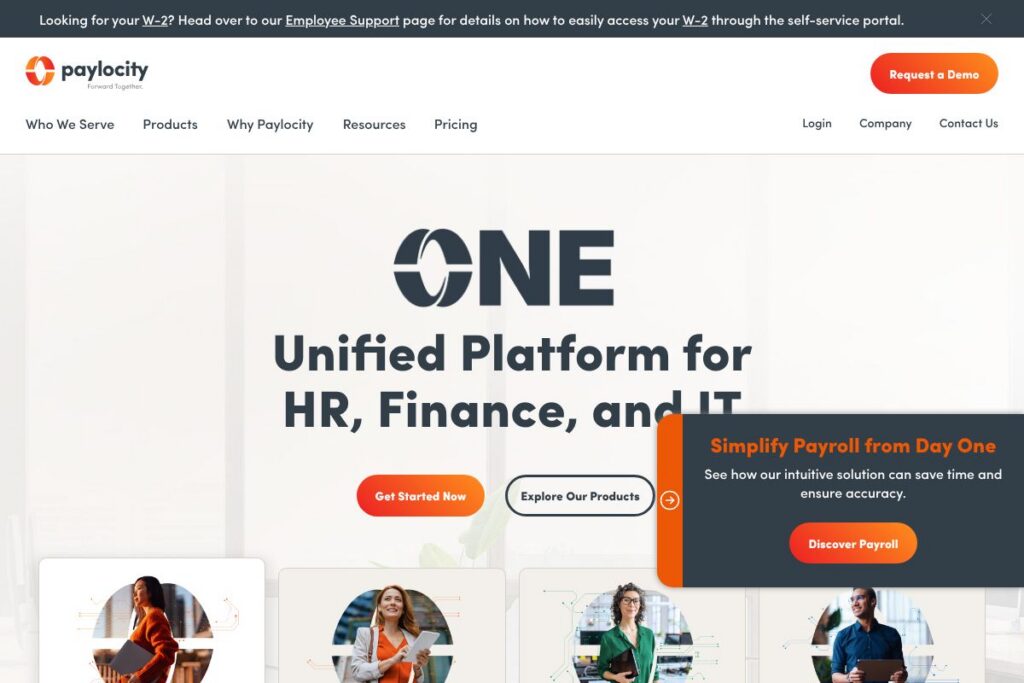
Paylocity provides a cloud-native payroll and human capital management suite designed for mid-market employers. Core capabilities include payroll processing, tax filing, benefits administration, time and attendance, recruiting, performance management, and reporting, all delivered from a single platform that integrates HR data across modules.
Compared with ADP, Paychex, and Workday, Paylocity focuses on mid-market organizations that value an integrated, single-vendor HR and payroll experience with strong self-service for employees and managers. ADP and Paychex offer broader outsourced services and long-standing payroll operations, while Workday targets larger enterprises with deep HR and finance integrations; Paylocity sits between those options with a mix of configurability and packaged HR features.
Paylocity is particularly well suited for organizations that need consolidated payroll and HR workflows with configurable reports and employee self-service. It does payroll accurately at scale, centralizes benefits administration, and offers tools for recruiting and performance that reduce the number of separate systems needed by HR teams.
How Paylocity Works
Paylocity centralizes employee records so payroll, timekeeping, benefits, and HR processes share a single source of truth. Administrators import or enter employee data, configure pay rules and tax settings, and run payroll cycles that produce paychecks, tax filings, and reporting outputs from the same dataset.
Managers interact with the platform to approve time entries, manage schedules, and request hires, while employees use mobile and web self-service to view pay stubs, enroll in benefits, and submit time-off requests. The platform supports automated tax calculations and filings, configurable approval workflows, and audit logs that help maintain compliance.
In practice, a typical workflow looks like this: time is captured via web, kiosk, or mobile; managers approve time; payroll runs are validated with built-in checks; and payroll processing produces direct deposits and tax filings. HR tasks such as onboarding, benefits elections, and performance reviews are tied into the same employee profile to reduce duplicate data entry and reporting drift.
Paylocity features
Paylocity’s platform brings payroll, HR, time tracking, benefits, and talent tools into a single system so teams can reduce manual handoffs. The vendor continuously adds product improvements focused on reporting, mobile self-service, and automations that shorten payroll cycles.
Let’s talk Paylocity’s Features
Payroll processing
Payroll supports multi-state payroll, configurable pay rules, direct deposit, and automated tax calculations and filings, so teams can run payroll on regular schedules and produce compliant tax outputs. Built-in validation checks help catch common payroll errors before payments are issued.
Human resources information system (HRIS)
The HRIS centralizes employee records, job history, and organizational charts, letting HR teams manage life-cycle events from hiring through separation. Centralized records reduce duplication and provide a consistent source for reporting and audits.
Time and attendance
Time and attendance includes web clocking, mobile punches, geofencing and kiosk options, overtime and rounding rules, and manager approvals. Integration with payroll eliminates manual exports and ensures hours flow directly into payroll calculations.
Benefits administration
Benefits administration manages open enrollment, carrier connections, and benefit deductions, and it supports ACA tracking and reporting. The module simplifies employee enrollment and streamlines carrier billing reconciliation for HR and finance teams.
Talent management and recruiting
Recruiting, applicant tracking, onboarding, and performance management are available to help HR attract and retain employees while tying performance outcomes back to payroll and compensation. Workflows support requisitions, interview tracking, offer letters, and review cycles.
Compliance and tax management
Compliance tools include tax filing automation, year-end reporting, and configurable policies that help organizations meet federal and state requirements. Audit trails and documentation features assist with recordkeeping and regulatory responses.
Reporting and analytics
Configurable reports, dashboards, and analytics provide visibility into payroll costs, headcount, benefits spend, and time utilization. Reporting tools support ad hoc queries and scheduled delivery to stakeholders.
Mobile employee experience
Employees can access pay stubs, time punches, schedules, and benefits details via mobile apps and web self-service, which reduces HR inquiries and enables remote or deskless workers to manage routine tasks. Manager mobile functionality supports approvals and team oversight on the go.
Integrations and API access
Paylocity provides prebuilt integrations for common HR and finance systems and supports data exchange with third-party vendors to reduce manual imports. Integration options help connect payroll data to accounting systems and benefits carriers.
With these capabilities, the biggest practical benefit is reducing the number of disconnected HR and payroll systems by housing core people operations in a single platform, which speeds payroll cycles and improves reporting consistency.
Paylocity pricing
Paylocity uses a subscription-based pricing model with enterprise-style, custom quotes rather than publicly listed plans; organizations typically obtain pricing through a sales conversation tailored to their headcount, modules required, and implementation needs. For current cost information and to request a tailored quote, visit Paylocity’s contact page or explore options through Paylocity’s homepage.
What is Paylocity Used For?
Paylocity is used for payroll processing, benefits administration, time collection, recruiting, onboarding, and performance management within a single system. HR and payroll teams use it to centralize employee data and remove manual, spreadsheet-driven processes.
It is commonly deployed by mid-market employers that need scalable payroll services alongside HR functionality without stitching together multiple vendors. Organizations with multi-state payroll, complex benefits, or distributed workforces benefit from Paylocity’s integrated approach and employee self-service tools.
Pros and cons of Paylocity
Pros
- Unified payroll and HR platform: Consolidates payroll, time, benefits, and talent management in one system, reducing duplicate data entry and simplifying reporting.
- Strong employee self-service: Mobile and web self-service reduce HR workload for routine tasks like viewing pay stubs and requesting time off.
- Configurable time collection: Supports kiosks, mobile punches, geofencing, and manager approvals, which helps organizations with hourly and distributed workforces.
Cons
- Custom pricing model: Without public pricing tiers, budgeting requires direct engagement with sales and may vary significantly by organization size and feature set.
- Implementation effort for complex setups: Organizations with complex pay rules or numerous integrations may face longer implementations and require professional services.
- Advanced reporting may require configuration: While reporting is comprehensive, creating complex cross-module reports can require setup and training to realize full value.
Does Paylocity Offer a Free Trial?
Paylocity does not offer a public free plan; pricing and trial access are handled through sales and demos. Interested organizations can request a demonstration or contact Paylocity’s sales team to discuss a trial or pilot via Paylocity’s contact page.
Paylocity API and Integrations
Paylocity offers integration options and data interchange capabilities to connect payroll and HR data with accounting systems, benefits carriers, and other HR tools. Explore Paylocity’s partner and integration information on Paylocity’s partner network for details about supported connections.
For organizations that need programmatic access, Paylocity provides API endpoints and developer resources to automate data flows and custom integrations; contact Paylocity to request developer access and documentation through their sales or partner channels.
10 Paylocity alternatives
Paid alternatives to Paylocity
- ADP — Comprehensive payroll and HR services with global capabilities and a broad set of outsourcing options for organizations of many sizes.
- Paychex — Payroll and HR solutions with strong small to mid-market offerings, including co-employment and retirement services.
- Workday — Enterprise-grade HCM with deep HR, payroll, and financial planning features for large organizations.
- Gusto — Simpler payroll and benefits platform aimed at small businesses, with transparent pricing and easy setup.
- BambooHR — HR-focused platform with applicant tracking and employee records, often paired with third-party payroll providers.
- UKG — Workforce management and HR platform that emphasizes timekeeping and employee experience for large workforces.
- Ceridian — Global HCM and payroll with Dayforce for large employers requiring continuous payroll processing.
Open source alternatives to Paylocity
- Odoo — Open-source ERP that includes HR and payroll modules; flexible and extensible for organizations willing to self-host or use community modules.
- ERPNext — Open-source ERP with HR and payroll features, good for organizations that want full control over customization and hosting.
- OrangeHRM — Open-source HR management system offering core HR functionality and modules that can be extended for payroll and time tracking.
Frequently asked questions about Paylocity
What is Paylocity used for?
Paylocity is used to manage payroll and HR processes in a single platform. Organizations use it to run payroll, administer benefits, collect time, recruit, and run HR reporting.
Does Paylocity integrate with accounting systems?
Yes, Paylocity supports integrations with common accounting and HR systems. Integration and partner options let organizations export payroll journals and sync employee data with finance systems.
How much does Paylocity cost?
Paylocity uses custom pricing tailored to each customer. Pricing depends on headcount, selected modules, implementation needs, and support level; contact Paylocity via Paylocity’s contact page for a tailored quote.
Can Paylocity handle multi-state payroll?
Yes, Paylocity supports multi-state payroll and tax management. The platform calculates taxes and supports filings across multiple state jurisdictions as part of payroll processing.
Does Paylocity provide mobile access for employees?
Yes, Paylocity offers mobile and web self-service for employees and managers. Mobile functionality includes viewing pay stubs, submitting time and time-off requests, and accessing benefits information.
Final verdict: Paylocity
Paylocity is a strong choice for mid-market employers that need integrated payroll and HR functionality with solid self-service and time-collection features. It centralizes payroll, benefits, and talent workflows into a single platform, reducing the need for multiple point solutions and improving data consistency across HR processes.
Compared with ADP, Paylocity emphasizes a unified mid-market platform and employee experience delivered through a single vendor, while ADP offers broader outsourced payroll services and globally available products with some publicly available pricing options. Organizations that prioritize a consolidated mid-market HR and payroll platform and want configurable reporting will find Paylocity well suited; for organizations seeking fully published price tiers or large global payroll outsourcing, considering ADP or other enterprise payroll providers may be appropriate.