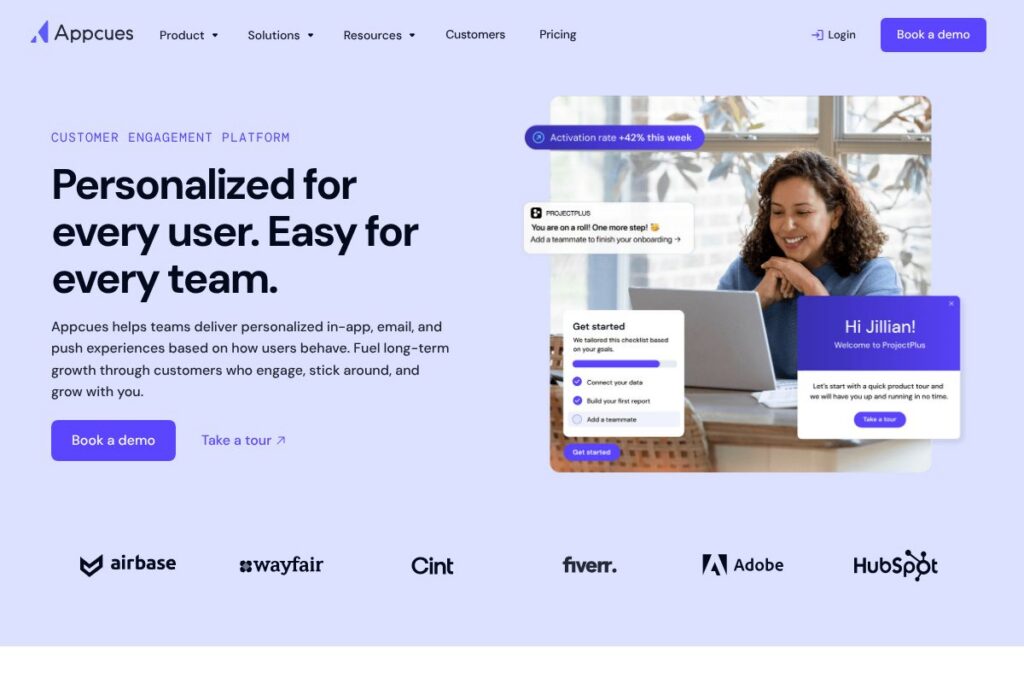

What is Appcues
Appcues is a customer engagement platform that helps product, growth, and go-to-market teams design and deliver targeted in-app, email, and mobile experiences without requiring engineering work for each change. It focuses on onboarding flows, feature announcements, contextual nudges, and surveys so teams can move users toward activation and retention milestones faster.
Compared with competitors, Appcues emphasizes a no-code editor and lightweight integrations that let non-technical teams iterate quickly. Pendo provides deeper product analytics and broader feature-level telemetry, making it a better fit for teams that require robust instrumentation alongside guides. WalkMe targets large enterprises with complex training needs and heavy customization, while Userpilot is closer to Appcues on pricing and simplicity but offers fewer built-in analytics in some configurations.
Appcues excels at letting product and marketing teams prototype, target, and roll out experiences without long dev cycles. That makes it well suited for product-led companies, mid-market SaaS teams, and any group that needs to scale onboarding and adoption without adding headcount.
How Appcues Works
Appcues runs as a client-side SDK for web and mobile that captures user behavior, evaluates audience rules, and presents pre-built or custom experiences in real time. Teams create flows with a visual editor, set targeting based on user attributes or events, and publish without code changes to the application.
Common workflows include building an onboarding checklist, triggering a tool-tip or modal when a user reaches a specific event, sending follow-up onboarding emails, and using surveys to collect qualitative feedback. The platform collects engagement signals back into its analytics and can forward those signals to third-party analytics and CDP tools for deeper analysis.
What does Appcues do?
Appcues groups its capabilities around experience creation, audience targeting, delivery across channels, and outcome measurement. Core functionality centers on a no-code builder, multi-channel messaging, user segmentation, experiment support, and analytics that tie experiences to product outcomes.
Let’s talk Appcues’s Features
No-code visual editor
The editor lets non-developers build flows, modals, tooltips, banners, and onboarding checklists with drag-and-drop controls. This reduces reliance on engineering for content changes and accelerates iteration cycles for product and growth teams.
Multi-channel delivery
Support for in-app, mobile, and email messaging lets teams meet users where they are in their journey. Messages can be coordinated so users receive contextual follow-ups across channels to improve completion and retention rates.
Audience segmentation and targeting
Create audiences using behavioral events, user properties, and integrations with other systems to show tailored experiences. Granular targeting enables progressive onboarding and personalized feature discovery for different user cohorts.
Analytics and experiment support
Built-in analytics track engagement with flows and measure lift on activation and retention metrics. Experimentation features allow A/B testing of experiences so teams can validate what moves key metrics and scale winners.
No-code surveys and feedback collection
Push NPS, microsurveys, and qualitative prompts inside the product to capture user sentiment and contextual feedback. Responses can be routed to product teams or integrated systems for follow-up and analysis.
Integrations and data forwarding
Appcues connects to common analytics, CDP, and CRM tools so events and results can be sent to platforms like Segment, Amplitude, and Salesforce. This ensures experience data is available where teams already analyze user behavior.
AI-powered recommendations and automation
The platform applies behavior signals and context to recommend next-best actions and to automate experience selection. Over time those signals help prioritize which flows to scale and which to retire, improving efficiency.
Appcues’s biggest benefit is speed to value for non-technical teams: you can design, target, and measure product experiences without long development cycles, and then use engagement signals to refine work continuously.
Appcues pricing
Appcues uses a subscription model with flexible, quote-based pricing that varies by feature set, number of users, and required integrations. Because pricing is tailored to each customer, specific plan costs are not centrally published.
For current plan options and to get a quote for your team, see the Appcues product pages or request a custom estimate through their site. Enterprises can discuss scoped deployments, SLAs, and advanced integration needs with sales to build a plan that fits their usage and support requirements.
What is Appcues Used For?
Appcues is commonly used to scale user onboarding and feature adoption, especially when teams want to reduce time-to-value for new users. Typical projects include first-run experiences, progressive checklists, in-app announcements, and contextual help that guide users through key flows.
Beyond onboarding, teams use Appcues to increase retention through targeted re-engagement, gather in-product feedback with microsurveys, and run experiments to find experience variants that improve activation and retention. It is ideal for product managers, growth marketers, and customer success teams focused on product-led growth.
Pros and cons of Appcues
Pros
- Rapid no-code deployment: Non-technical teams can build and publish in-product experiences without developer cycles, which accelerates testing and iteration.
- Multi-channel reach: Ability to coordinate in-app, mobile, and email messaging improves consistency in user journeys and increases the chance of desired actions.
- Behavioral targeting: Granular audience rules and event-based triggers make it possible to deliver highly relevant experiences to specific user cohorts.
- Actionable analytics: Built-in measurement and experiment support help teams validate which experiences move key metrics and scale winners.
Cons
- Custom pricing model: Pricing is quote-based which can make initial budget comparison harder for smaller teams evaluating multiple vendors.
- Less deep analytics than dedicated analytics platforms: Teams that require exhaustive event-level analytics may still need a separate analytics tool for detailed instrumentation and exploration.
- Feature parity across mobile and web: Some advanced UI behaviors or custom native mobile interactions may need additional engineering or careful design to match web capabilities.
Does Appcues Offer a Free Trial?
Appcues offers trial and demo options for prospective customers. You can request a demo or trial through the Appcues site to evaluate the no-code editor, targeting capabilities, and analytics in the context of your product, and to see how experiences perform before committing to a subscription.
Appcues API and Integrations
Appcues provides developer documentation and an API for sending events, managing users, and extending delivery logic; see the Appcues developer documentation for endpoint details and examples. The platform also supports server-side event ingestion for workflows that require back-end signaling.
Native and partner integrations include common analytics, CDP, CRM, and support tools so event data and survey responses can flow to systems like Segment, Amplitude, and Salesforce. Explore the Appcues integrations to see available connectors and configuration guides.
10 Appcues alternatives
Paid alternatives to Appcues
- Pendo — Product adoption and analytics platform with strong feature-level telemetry and in-app guidance suited for teams that need deeper analytics alongside guides.
- WalkMe — Enterprise digital adoption platform for complex training and large-scale change management use cases with heavy customization options.
- Whatfix — In-app guidance and performance support with a focus on enterprise learning and interactive walkthroughs.
- Userpilot — Product adoption tool that emphasizes no-code experiences and is often chosen by teams seeking a simpler alternative to Appcues.
- Gainsight PX — Combines product experience with customer success workflows to align adoption with retention and revenue signals.
- Intercom — Customer messaging platform with product tours and in-app messaging that integrates tightly with support and sales workflows.
- WalkMe for Digital Adoption — Platform for automating user guidance and training across complex enterprise applications.
Open source alternatives to Appcues
- Intro.js — Lightweight open source library for step-by-step user guides that works well for basic onboarding flows with developer integration.
- Shepherd — A flexible JavaScript library for building guided product tours that developers can embed and control programmatically.
- Driver.js — Front-end library for creating guided tours and interactive hints with a small footprint for custom implementations.
- Bootstrap Tour — Tour framework that integrates with Bootstrap-based UIs and provides a simple way to add step-based tours.
Frequently asked questions about Appcues
What is Appcues used for?
Appcues is used to build and deliver in-app, mobile, and email experiences that improve onboarding, adoption, and retention. Teams rely on it to create targeted flows, collect feedback, and measure the impact on activation and retention metrics.
Does Appcues have an API?
Yes, Appcues provides an API and developer documentation. The API supports event ingestion, user identification, and programmatic control of experiences; see the Appcues developer documentation for details.
Can Appcues integrate with analytics and CDP tools?
Yes, Appcues integrates with common analytics and CDP systems. Integrations with tools like Segment and Amplitude let you forward event data and use existing user attributes for audience targeting.
How much does Appcues cost?
Appcues uses flexible, quote-based pricing tailored to business needs. For current plan structures and to request a custom quote, visit the Appcues product pages or contact their sales team.
Is Appcues suitable for non-technical teams?
Yes, Appcues is designed for non-technical product and growth teams. The visual editor and no-code targeting reduce developer dependency for creating, testing, and publishing experiences.
Final verdict: Appcues
Appcues is a pragmatic choice for product-led teams that need to move quickly on onboarding, feature discovery, and retention without long engineering cycles. Its no-code editor, multi-channel delivery, and audience targeting empower growth and product teams to prototype and measure experiences in days rather than weeks.
Compared with Pendo, Appcues leans more toward ease of use and rapid iteration, while Pendo provides deeper product analytics and more comprehensive instrumentation for enterprise analytics needs. Pricing for both platforms is typically quote-based, so teams should evaluate which combination of guidance, analytics, and integrations maps best to their roadmap before selecting a vendor.
Appcues is particularly well suited for mid-market SaaS companies and product teams focused on scaling onboarding and adoption with limited engineering bandwidth, offering a balanced mix of creative control, targeting, and measurable outcomes.