
RetailOps: An Overview
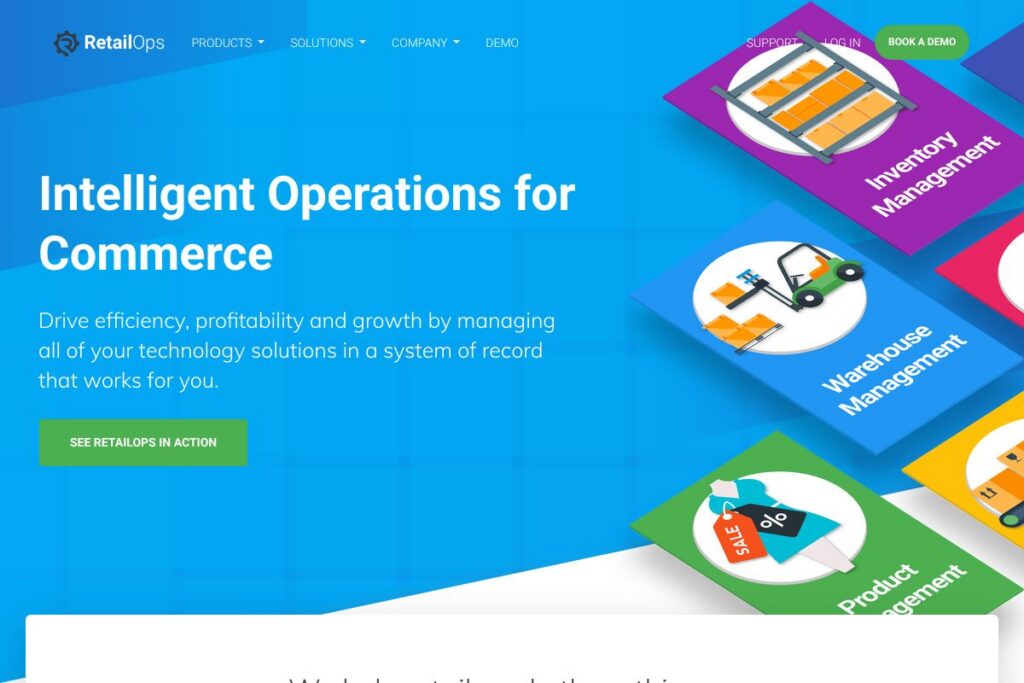
RetailOps is an all-in-one retail and eCommerce operations platform built to manage orders, inventory, fulfillment, and catalog distribution from a single authoritative source. It combines order management system (OMS) capabilities, inventory control, warehouse automation tools, and channel cataloging so teams can run operations without juggling multiple disconnected systems. The platform targets direct-to-consumer brands and omnichannel retailers that need a single system to keep SKUs, orders, and metrics in sync as they scale.
Compared with other retail operations platforms, RetailOps focuses on providing a tightly integrated operations stack rather than a piecemeal set of add-ons. For example, Brightpearl emphasizes accounting and back-office ERP features alongside OMS, while NetSuite provides a broader ERP suite with deep financial controls. ShipBob focuses primarily on outsourced fulfillment and logistics rather than providing a combined catalog and operations system. RetailOps sits between these approaches by combining inventory and warehouse control with channel synchronization.
All of this makes RetailOps particularly useful for retailers who need reliable order accuracy, low-latency catalog updates across channels, and process automation that preserves margins as they add products or sales channels. It is well suited to mid-market and growing DTC brands that want operational consistency without stitching together multiple vendors. You can learn more about the platform from the RetailOps homepage.
How RetailOps Works
RetailOps acts as the central operations layer that connects sales channels, warehouses, and business metrics. Orders flow into RetailOps from connected channels, then the platform routes fulfillment, reserves inventory, and updates order status so customers and channel partners see accurate information in real time.
On the inventory side, RetailOps maintains a single source of truth for catalog data and stock levels, so any change to product attributes, pricing, or quantities propagates to connected marketplaces and storefronts automatically. Warehouse staff use the platform to manage picking, packing, receiving, and returns with tools designed to reduce mistakes and speed throughput.
Automation rules and cost-based routing let teams define how orders are split between warehouses, carriers, and fulfillment methods. RetailOps also tracks KPIs at the SKU, warehouse, and channel level so operations leaders can identify bottlenecks and measure the impact of process changes.
What does RetailOps do?
RetailOps organizes operations around three core outcomes: accurate order delivery, lean inventory and process tracking, and scalable channel/catalog management. Core capabilities include an order management system, inventory control with catalog as source of record, warehouse execution tools, and configurable automation rules that reduce manual decision making.
Let’s talk RetailOps’s Features
Order Management
Order Management in RetailOps ingests orders from multiple channels, validates payment and inventory availability, and routes orders for fulfillment. This reduces oversells and ensures the right item ships to the right customer, improving customer experience and reducing returns.
Inventory and Catalog Management
RetailOps keeps one authoritative product catalog and synchronizes changes to all connected sales channels in real time. That centralization prevents mismatched descriptions, duplicate SKUs, and pricing errors while making it simple to add new channels without manual uploads.
Warehouse Tooling
Warehouse tooling automates picking, packing, receiving, and returns workflows so warehouses operate with fewer errors and faster cycle times. The platform also supports barcode scanning and configurable process steps to match existing facility layouts and staffing models.
Automation and Cost-based Routing
Automation rules let teams define routing based on cost, location, inventory age, or other attributes so each order follows the most efficient fulfillment path. This reduces manual decisions during peak times and ensures orders are routed to the optimal warehouse and carrier.
KPI Tracking and Reporting
RetailOps tracks operational KPIs such as order cycle time, inventory accuracy, and fill rate to help teams measure performance and pinpoint where process changes are needed. Dashboards make it easier for operations managers to compare warehouses and channels at a glance.
Channel Integrations
Channel integrations connect marketplaces, ecommerce platforms, and POS systems so inventory and order status are updated automatically across the entire stack. Using RetailOps as the catalog system of record simplifies multi-channel growth and reduces reconciliation work.
With these capabilities RetailOps helps retailers reduce errors in fulfillment, keep inventory accurate, and scale across channels while maintaining operational visibility.
RetailOps pricing
RetailOps uses a custom enterprise-style pricing model tailored to each retailer’s footprint and requirements rather than fixed public rates. Pricing typically reflects the number of channels, warehouses, order volume, and required integrations, with options for implementation and support that vary by deployment.
Because pricing is customized to business size and integration needs, prospective customers should contact sales for detailed rates. View the RetailOps homepage to request a demo or to reach their sales team for a pricing evaluation.
What is RetailOps Used For?
RetailOps is used to centralize the operational functions that growing retailers need to keep orders accurate and inventory reliable. Typical use cases include multi-channel order routing, warehouse execution, real-time catalog synchronization, and inventory reconciliation across warehouses and channels.
It is especially useful for direct-to-consumer brands expanding from a single storefront to multiple marketplaces and international channels, because it reduces the operational overhead of maintaining consistent product data and order status across systems.
Pros and cons of RetailOps
Pros
- Order accuracy and fulfillment control: RetailOps combines OMS and warehouse tooling so retailers can reduce shipping errors and ensure orders are fulfilled from the right location.
- Single catalog source of truth: Centralized product and inventory data eliminates mismatched listings and manual updates across channels.
- Automation for operational decisions: Cost-based routing and configurable automation reduce manual work and help teams handle peak volume without adding headcount.
Cons
- Custom pricing model: Because pricing is tailored, prospective buyers must contact sales to get a quote which can slow initial evaluation for small teams.
- Implementation effort for complex setups: Large multi-warehouse or highly customized operations require implementation planning and configuration before retail teams see full benefits.
Does RetailOps Offer a Free Trial?
RetailOps offers paid subscriptions with custom enterprise pricing and does not advertise a self-serve free plan. Prospective customers can request a demo or trial instance through the sales team to evaluate the platform with their own data and workflows.
RetailOps API and Integrations
RetailOps provides API access and prebuilt connections to common sales channels, shipping carriers, and ecommerce platforms so developers can automate workflows and exchange data programmatically. The API documentation outlines endpoints for orders, inventory, products, and webhooks for event-driven updates.
Key integrations typically include marketplaces, storefront platforms, shipping providers, and ERP or accounting systems so RetailOps fits into existing enterprise stacks without replacing financial back ends. Check the RetailOps homepage for a current list of supported partners and connectors.
10 RetailOps alternatives
Paid alternatives to RetailOps
- Brightpearl — Cloud ERP and retail operations software that combines accounting, inventory, and order management for multichannel retailers.
- NetSuite — A broad ERP suite with strong financial controls and inventory management for larger retailers and brands.
- ShipBob — Fulfillment-first platform that provides outsourced warehousing and order fulfillment with integration into ecommerce channels.
- ChannelAdvisor — Channel management and listing optimization for retailers that need deep marketplace presence and advertising integrations.
- Skubana — Operations platform that focuses on automating order routing, forecasting, and analytics for ecommerce sellers.
- Orderhive — Cloud-based inventory and order management with multichannel sync for small to mid-sized retailers.
- ShipHero — Warehouse management and fulfillment software with strong compatibility for 3PLs and in-house warehouses.
Open source alternatives to RetailOps
- Odoo — Open source suite that includes inventory, manufacturing, and ecommerce modules which can be extended into an operations stack.
- ERPNext — Open source ERP with inventory and warehouse management features suitable for retailers wanting self-hosted control.
- OpenBoxes — Inventory management focused on supply chains and warehouses, useful for simpler warehouse operations and receiving workflows.
Frequently asked questions about RetailOps
What types of retailers use RetailOps?
RetailOps is used by direct-to-consumer brands and omnichannel retailers of varying sizes. It is commonly adopted by businesses that sell across multiple marketplaces and need unified inventory and order control.
Does RetailOps integrate with ecommerce platforms and marketplaces?
Yes, RetailOps integrates with major ecommerce platforms, marketplaces, and shipping providers. Integrations and connectors keep inventory and orders synchronized across sales channels.
Can RetailOps handle multiple warehouses and locations?
Yes, RetailOps supports multi-warehouse inventory management and warehouse execution workflows. It routes orders to the appropriate facility and provides tools for receiving, picking, and returns.
Is there an API for custom integrations with RetailOps?
Yes, RetailOps provides an API for orders, products, inventory, and webhooks. Developers can use the API documentation to automate workflows and build custom connectors.
How do I get pricing for RetailOps?
RetailOps uses custom pricing tailored to each business’s channels, warehouses, and order volume. Contact their sales team via the RetailOps homepage to request a demo and a pricing proposal.
Final verdict: RetailOps
RetailOps excels at tying together order management, inventory control, and warehouse execution in a single operations platform. Its emphasis on a single catalog source of truth and configurable automation helps retailers reduce fulfillment errors and scale channel count without multiplying operational complexity.
Compared with competitors such as Brightpearl, which blends ERP and accounting features, RetailOps places more focus on operational workflows and warehouse tooling rather than full financial consolidation. In terms of pricing, RetailOps follows a custom enterprise model that aligns costs with channel and warehouse scale, while some competitors offer more standardized subscription tiers or fee-based fulfillment models. For mid-market and growing DTC retailers that need a practical operations core rather than a general ERP, RetailOps is a strong option.