
SAP: An Overview
SAP is a portfolio of enterprise applications, platform services, and industry solutions designed to run core business processes at scale. The suite combines cloud ERP, data services, analytics, and embedded AI so organizations can operate finance, supply chain, procurement, human resources, and industry-specific processes from a unified platform.
SAP competes directly with enterprise suites such as Oracle Cloud, Microsoft Dynamics 365, and Workday. Compared with Oracle Cloud, SAP emphasizes deep industry-specific functionality and a large partner ecosystem; Oracle often competes on database and infrastructure integration. Compared with Microsoft Dynamics 365, SAP typically targets larger, more complex deployments and a broader set of infrastructure and data services, while Dynamics focuses on tighter integration with Microsoft 365 and Azure offerings.
All of this makes SAP a strong fit for enterprises that need modular applications tied to a consistent data layer and embedded intelligence across processes. Organizations that require extensive industry templates, a global partner network, and flexible deployment models will find SAP’s portfolio particularly relevant.
How SAP works
SAP applications connect transactions, operational data, and analytics through a shared platform that includes business process orchestration, data services, and AI capabilities. Customers deploy core modules such as finance, supply chain, and HR either as cloud-native services or in hybrid models; these modules exchange context through SAP Business Data Cloud and the SAP Business Suite.
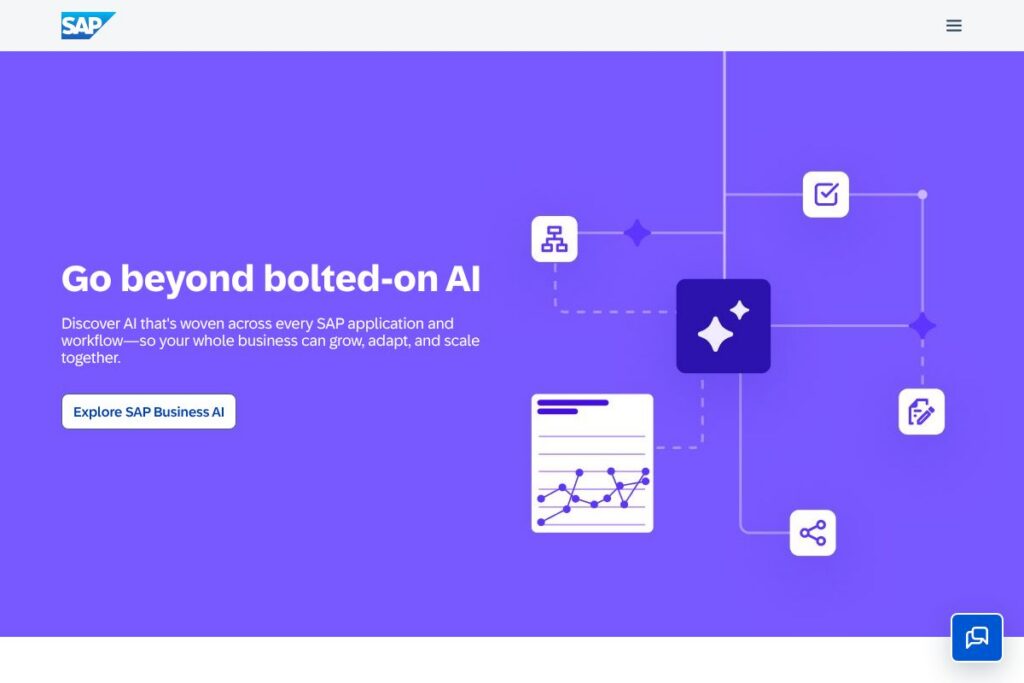
Embedded AI, branded as SAP Business AI and features like Joule Agents, operate inside workflows to surface recommendations, automate routine tasks, and convert operational signals into prioritized actions. Implementation typically combines SAP best-practice processes, configuration of modules, and integration with third-party systems via connectors or the SAP API Business Hub.
Operational teams use a combination of cloud ERP apps, analytics, and process automation to close the loop between insight and execution; IT teams manage integrations, security, and lifecycle using SAP platform tooling and partner-delivered services.
What does SAP do?
SAP’s product set spans cloud ERP applications, data services, embedded AI, industry suites, and an ecosystem for partner apps and extensions. Core capabilities include transaction processing, master data management, analytics, process automation, and developer services that let organisations extend functionality or embed third-party apps.
Let’s talk SAP’s Features
SAP Business AI
Embedded AI brings context-aware suggestions and task automation directly into business processes so users see recommendations where they work. This reduces handoffs and accelerates decision loops by applying models to live transactional and master data.
SAP Business Data Cloud
A data foundation that centralizes trusted, contextualized business data across systems for use by AI and applications. It helps ensure consistent master data and provides the shared context that powers cross-application workflows and analytics.
SAP Cloud ERP applications
Cloud ERP modules cover finance, supply chain, procurement, manufacturing, and human resources with native cloud services for orchestration and scalability. These apps activate data and AI insights to automate routine tasks, enforce controls, and manage end-to-end processes.
SAP Business Suite
The SAP Business Suite provides an integrated environment for composing and running business processes across multiple SAP and partner applications. It supports process lifecycle management and enables reuse of services and business objects across solutions.
Joule Agents and agentic AI
Agentic capabilities coordinate tasks across apps and workflows, automating multi-step activities and surfacing insights without manual orchestration. Joule Agents are designed to work within existing processes and reduce the need for bespoke automation scripts.
Sustainability and industry solutions
SAP offers industry-specific modules and sustainability tools to capture environmental, social, and governance metrics within regular business processes. These features help organizations measure and report on sustainability alongside operational KPIs.
Apps and extensions marketplace
An extensive partner ecosystem provides prebuilt integrations, vertical solutions, and extensions available through SAP’s marketplace so customers can discover, try, and buy complementary offerings. Partners often supply implementation, managed services, and specialized industry accelerators.
With these capabilities SAP ties operational systems, trusted data, and embedded intelligence into a single platform that supports continuous improvement and consistent governance across large organizations.
SAP pricing
SAP uses a flexible, enterprise licensing and subscription model tailored to deployment choices, product mix, number of users, and support requirements. Pricing is typically negotiated with sales or partners and varies by modules, cloud consumption, and optional services.
Enterprise and subscription
Enterprise licensing – Custom pricing (Core product licenses, cloud subscriptions, optional modules, and professional services).
Consumption-based – Custom pricing (Cloud platform services and infrastructure consumption billed according to usage where applicable).
Licensing and support
Support and maintenance – Custom pricing (Options for premium support, updates, and managed services through SAP or partners).
For specific licensing models, contract options, and guidance on cost drivers, consult SAP’s product and licensing information or contact SAP sales and partners for a tailored quote via the SAP product and licensing information pages.
What is SAP Used For?
SAP is used to run end-to-end core business functions such as finance close, order-to-cash, procure-to-pay, manufacturing execution, and human capital management at scale. Its strengths are in standardizing processes across global operations and integrating data for consistent reporting and process orchestration.
Typical users include enterprise IT teams, finance and supply chain leaders, HR operations, and industry specialists in sectors like manufacturing, retail, utilities, and healthcare. SAP is also used by system integrators and partners to deliver industry-specific implementations and managed operations.
Pros and Cons of SAP
Pros
- Comprehensive enterprise coverage: SAP offers a broad portfolio across ERP, CRM-adjacent functions, data services, and analytics that supports end-to-end processes for large organizations.
- Industry depth: Many modules include industry-specific best practices and templates that reduce implementation time for regulated or complex sectors.
- Embedded AI and data consistency: The combination of SAP Business AI and the Business Data Cloud gives organizations a consistent source of truth and AI that runs within operational workflows.
- Large partner ecosystem: A wide network of partners supplies implementation, extensions, and managed services to handle complex rollouts and customization.
Cons
- Complex licensing and procurement: Pricing and packaging can be complex and require negotiation, which can extend procurement cycles and planning.
- Implementation scale and cost: Deployments for large enterprises often involve substantial configuration, integration work, and professional services, which increases time to value.
- Customization requirements: Heavily customized deployments can complicate upgrades and cloud migration unless managed through disciplined governance and partner support.
Does SAP Offer a Free Trial?
SAP offers limited free trials and developer editions for specific cloud products alongside paid enterprise licenses. Many SAP cloud services provide trial accounts or developer editions that let teams evaluate functionality, while full production deployments require licensing or subscription agreements. Explore available trials and developer resources through the SAP free trials and developer editions portal.
SAP API and Integrations
SAP provides developer-facing APIs and prebuilt connectors via the SAP API Business Hub, which documents REST, OData, and SOAP endpoints for SAP applications and services. The SAP API Business Hub is the primary reference for available APIs and integration scenarios.
Key integrations cover cloud platforms and productivity suites, including connectors for Microsoft Azure and Microsoft 365, common CRM and marketing platforms, third-party logistics systems, and middleware vendors. Partners and integrators commonly use SAP Cloud Integration or third-party iPaaS solutions to connect SAP to downstream systems.
10 SAP alternatives
Paid alternatives to SAP
- Oracle Cloud — A comprehensive enterprise cloud suite for ERP, HCM, and database services with deep infrastructure and database integration.
- Microsoft Dynamics 365 — Cloud ERP and CRM services with tight integration to Microsoft 365 and Azure, often chosen for familiarity with Microsoft ecosystems.
- Workday — Strong for human capital management and financial management with a cloud-first approach and user-centric design.
- Infor — Industry-focused ERP solutions with specialized vertical features and partner services for manufacturing and distribution.
- IFS — ERP tailored for service providers and asset-intensive industries with strong field service and maintenance capabilities.
- NetSuite (Oracle NetSuite) — Cloud-first ERP for mid-market companies with rapid time-to-value and unified financial and operational modules.
- Salesforce (with ERP partners) — CRM leader that many organizations pair with partner ERP solutions to create a front-to-back office platform.
Open source alternatives to SAP
- Odoo — Modular open source ERP with apps for accounting, inventory, manufacturing, and e-commerce that can be self-hosted or used via Odoo’s cloud.
- ERPNext — Free, open source ERP designed for small and medium businesses covering accounting, HR, manufacturing, and CRM.
- Apache OFBiz — A robust open source framework for building ERP and e-commerce applications, suited to organizations with development resources.
- Dolibarr — Lightweight open source ERP/CRM for small businesses, offering modules for invoicing, inventory, and project management.
- Adempiere — Community-driven open source ERP focused on manufacturing and distribution workflows with a Java-based architecture.
Frequently asked questions about SAP
What is SAP used for?
SAP is used to run core enterprise processes such as finance, supply chain, procurement, manufacturing, and HR. Organizations use SAP to centralize transactional systems, standardize processes, and create consistent reporting across global operations.
Does SAP offer cloud ERP options?
Yes, SAP provides cloud ERP applications as part of its portfolio. Products such as SAP S/4HANA Cloud and industry-specific cloud offerings support SaaS and hybrid deployment models.
Can SAP integrate with non-SAP systems?
Yes, SAP supports integration through APIs, prebuilt connectors, and middleware. The SAP API Business Hub documents available endpoints and common integration patterns for third-party systems.
How does SAP handle embedded AI?
SAP embeds AI into application workflows through SAP Business AI and agentic features like Joule Agents. These capabilities provide context-aware recommendations, automation, and task coordination inside operational processes.
Is SAP suitable for small businesses?
SAP can be used by small and mid-market companies but is most commonly deployed by larger enterprises. Small businesses often evaluate scaled or modular SAP cloud offerings or turn to lighter-weight alternatives when implementation scope and cost are primary constraints.
Final verdict: SAP
SAP stands out for delivering a broad suite of enterprise applications combined with a shared data foundation and embedded AI, which helps organizations run complex, industry-specific processes at scale. Its partner ecosystem and industry templates accelerate specialized implementations that would be difficult to assemble from disparate products.
Compared with Oracle Cloud, SAP tends to emphasize industry-specific processes and a layered partner ecosystem, while both vendors use custom enterprise pricing and negotiation. Feature-wise, SAP offers deep vertical capabilities and a strong toolset for embedding AI into workflows, whereas Oracle Cloud may compete more on integrated infrastructure and database services; both require engagement with sales and partners to determine the best commercial and technical fit.
Overall, SAP is a compelling option for organizations that need comprehensive, industry-aware enterprise applications, integrated data governance, and AI that runs inside business processes. For teams focused on rapid, low-cost deployments or lighter ERP footprints, mid-market cloud alternatives or open source ERPs may be more appropriate.