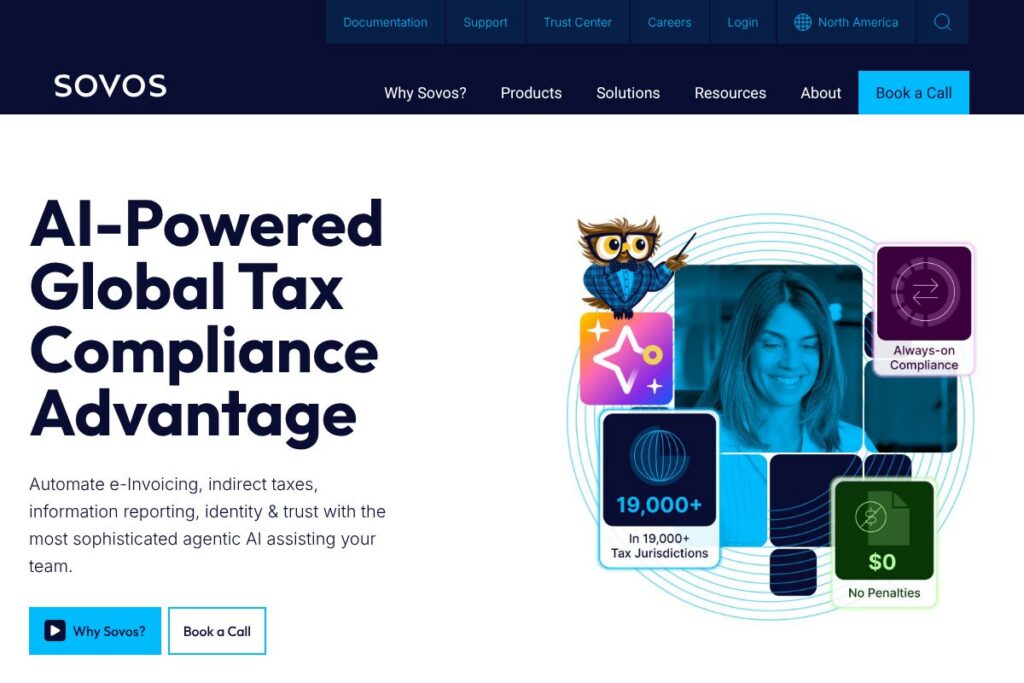

Sovos: An Overview
Sovos provides a global compliance platform designed to keep corporate tax and regulatory reporting continuously accurate and auditable. The platform centralizes e-invoicing, indirect tax calculation, statutory filing, information reporting, and regional trust and identity workflows so finance and tax teams can meet a wide variety of jurisdictional requirements from one place.
Compared with competitors, Sovos emphasizes enterprise-grade coverage and regulatory relationships. Compared to Avalara, which focuses heavily on automated tax calculation and transactional tax services, Sovos puts more emphasis on statutory reporting, e-invoicing networks, and regulatory engagement. Compared with Thomson Reuters ONESOURCE, Sovos offers a more unified cloud-native Compliance Cloud designed for large-scale transaction processing and regional compliance flows, while ONESOURCE remains strong on integrated tax provision and broader tax suite capabilities.
Sovos works particularly well for large multinationals, companies operating in highly regulated verticals like financial services, insurance, and alcohol distribution, and organizations that need to automate cross-border information returns and e-invoicing mandates. Its strengths are global reach, regulatory intelligence, and embedding into existing ERP and finance landscapes to reduce manual filing and audit risk.
How Sovos Works
Sovos connects to a company’s finance and ERP systems to capture transaction data, apply jurisdictional business rules, and route documents and filings to the correct government endpoints. Data mapping and connectors are used to ingest invoices, payments, and withholding events so the platform can perform validations and generate compliant messages for mandated e-invoicing networks.
Workflows typically include tax determination at the point of transaction, automated generation of statutory reports, and submission to local authorities through Sovos-managed integrations or customer-hosted agents. Teams can use dashboards and audit trails to trace every filing, review exceptions, and reconcile notices with accounting records.
Sovos also offers tools to reduce ongoing maintenance; regulatory updates and format changes are delivered centrally so customers do not need to rebuild mapping for each change. For new mandates teams can onboard with a combination of prebuilt templates, regional tax expert guidance, and managed services where needed.
What does Sovos do?
Sovos is organized around continuous compliance for transactional tax and regulatory reporting. Core capabilities include e-invoicing connectivity, indirect tax determination, information reporting and withholding management, identity and trust solutions, and a regulatory intelligence layer called Sovos Intelligence that tracks changes across jurisdictions.
Let’s talk Sovos’s Features
Compliance Cloud
The Compliance Cloud is Sovos’s centralized platform for managing filings, e-invoicing, and tax determinations across regions. It ingests transaction streams, applies validation rules, and routes outputs to government channels or third-party processors, reducing the need for multiple bespoke point solutions.
Sovi AI
Sovi AI adds agentic AI to accelerate mapping, exception handling, and document classification to reduce manual work. The AI assists with matching invoices to transactions, predicting likely filing outcomes, and surfacing high-risk items for human review.
Indirect Tax Suite
The Indirect Tax Suite performs tax determination and tax calculation across multiple tax types and jurisdictions. It integrates with major ERPs to apply rates and rules at the line-item level and supports reporting that feeds into statutory filings.
e-Invoicing
Sovos provides prebuilt connectivity to national e-invoicing networks and formats, handling conversions and translations required by local authorities. This reduces time to compliance for countries with mandatory electronic invoicing and supports continuous submission and acknowledgements processing.
Filing & Reporting
The filing and reporting engine automates information returns like 1099s, VAT declarations, and other statutory submissions, including validation prechecks to lower the chance of rejection. It keeps audit logs and submission receipts so teams can reconcile with accounting records and respond to inquiries.
Information Reporting and Withholding Suite
This suite consolidates processes for information return generation and tax withholding across payroll, vendor payments, and financial transactions. It manages form preparation, digital submission, and correction workflows when authorities require updates.
Trust & Identity Verification
Sovos supports regional identity and trust verification flows required for access to government services in select markets, notably in Latin America. These capabilities help organizations meet e-invoicing and reporting prerequisites tied to business identity and authorization.
With Sovos you get a platform built to reduce manual filings and regulatory risk at scale, combining automated transaction processing, regulatory updates, and centralized monitoring as the biggest operational benefit.
Sovos pricing
Sovos uses an enterprise, custom-pricing model tailored to a company’s footprint, transaction volume, and required services. Pricing typically varies by geographic coverage, whether managed services are included, and the number of filing types and integrations a customer requires; organizations should engage Sovos for a quote suited to their needs. For detailed purchasing and configuration options, contact Sovos through the Sovos contact page or review the Compliance Cloud overview for feature alignment.
Sovos Use Cases
Large multinational companies use Sovos to meet mandatory e-invoicing and VAT reporting requirements across many countries while keeping a single source of truth for filings. This reduces rework from rejected filings and centralizes compliance operations under one team.
Other common uses include automating 1099 and information returns to reduce penalties, routing tax withholding events through validated workflows, and applying jurisdictional tax determination to transactions in real time so accounting closes faster and audits are simpler.
Pros and Cons of Sovos
Pros
- Extensive global coverage: Sovos covers around 200 countries and local filing formats, which helps multinational teams consolidate compliance work under one platform.
- Regulatory intelligence and engagement: Strong relationships with regional authorities and a team of tax experts help customers adapt to frequent regulatory changes quickly and with fewer disruptions.
- Managed connectivity for e-invoicing and filings: Prebuilt connectors to e-invoicing networks and government endpoints reduce integration effort and ongoing maintenance.
Cons
- Enterprise focus and pricing: The solution is designed for mid-market and enterprise customers, which may make it less attractive for small businesses with simpler compliance needs.
- Implementation complexity: Onboarding for large, global footprints can require significant project coordination between finance, IT, and Sovos implementation teams.
- Customization needs for niche workflows: Highly specialized industry scenarios sometimes require custom configuration or managed services which can extend timelines.
Does Sovos Offer a Free Trial?
Sovos offers enterprise licensing and does not publish a public free trial; instead Sovos provides demos and consultative onboarding so potential customers can assess capabilities against their compliance requirements. You can schedule a demonstration or request a trial-style proof of concept via the Sovos contact page or by booking a call through the Compliance Cloud overview.
Sovos API and Integrations
Sovos provides APIs and connectors to integrate with major ERP systems and finance tools for real-time transaction ingestion and filing orchestration. The Sovos developer documentation outlines available endpoints, authentication methods, and sample payloads for common integration scenarios.
Key integrations typically include ERPs, tax engines, and third-party data providers; Sovos also operates a marketplace for partner connectors and can work with SI partners to create custom interfaces. For partner listings and marketplace options see the Sovos marketplace.
10 Sovos alternatives
Paid alternatives to Sovos
- Avalara — Offers tax calculation, returns filing, and exemption certificate management with strong transactional tax automation for businesses of many sizes. See Avalara’s tax automation for more on their services.
- Thomson Reuters ONESOURCE — A full tax and accounting platform that combines compliance, tax provision, and indirect tax solutions for large enterprises. Explore ONESOURCE’s enterprise tax suite to compare capabilities.
- Vertex — Focuses on indirect tax calculation and enterprise tax solutions with strong integration paths for ERPs and commerce platforms. Review Vertex product portfolio for details.
- TaxJar — Targets sales tax automation for e-commerce and retail, offering rate calculation and returns support with developer-friendly APIs. Check TaxJar’s developer resources for API details.
- Wolters Kluwer CCH — Provides tax compliance and workflow tools with deep coverage for statutory reporting and corporate tax processes. Learn about CCH’s tax and accounting tools.
- CPA Global (Clarivate) — For companies needing complex statutory filings and IP-related compliance, offering managed services and filing platforms. See Clarivate’s compliance solutions.
Open source alternatives to Sovos
- ERPNext — An open-source ERP with invoicing and tax modules that can be extended for country-specific compliance using custom scripts and community apps. Explore ERPNext’s documentation to assess fit.
- Odoo — A modular open-source suite with invoicing and accounting applications; localization modules exist for many countries though additional customization is often required for full statutory compliance. Review Odoo’s localization modules for region-specific features.
- OpenFisca — A policy and tax calculation framework used to model tax and benefit systems; useful for organizations building custom tax engines or simulations rather than full filing automation. See OpenFisca project resources.
Frequently asked questions about Sovos
What is Sovos used for?
Sovos is used for automating global tax compliance, e-invoicing, and statutory reporting. Organizations rely on it to centralize filings, reduce manual compliance work, and maintain audit trails across jurisdictions.
Does Sovos integrate with ERPs like SAP and Oracle?
Yes, Sovos provides connectors and API integrations for major ERPs including SAP and Oracle. Integrations allow transaction data to flow into Sovos for tax determination and filing without manual exports.
Can Sovos handle e-invoicing mandates in multiple countries?
Yes, Sovos supports connectivity and format conversion for many national e-invoicing networks. The platform manages translations, validations, and submissions required by local authorities.
How does Sovos address regulatory changes?
Sovos maintains regulatory intelligence and updates mappings centrally to reflect changes in filing rules and formats. This reduces the maintenance burden on customer IT and finance teams when mandates evolve.
Is Sovos suitable for small businesses?
Sovos is primarily targeted at mid-market and enterprise organizations with complex, multinational compliance needs. Small businesses with simple filing requirements may find lighter-weight or lower-cost solutions more appropriate.
Final Verdict: Sovos
Sovos stands out for its deep focus on continuous, enterprise-grade tax and regulatory compliance across a very large number of jurisdictions. Its Compliance Cloud, combined with regulatory intelligence and prebuilt e-invoicing connections, reduces the operational risk and manual maintenance typically associated with global filings.
Compared with Avalara, Sovos emphasizes statutory filing and e-invoicing network management more than transactional tax calculation pricing models; Avalara often uses per-transaction fees and modular services, while Sovos is priced and packaged for enterprise deployments with broader managed services. For organizations needing centralized control over filings across many countries and frequent regulatory change, Sovos is a strong choice; for smaller, transaction-focused use cases, a vendor like Avalara or TaxJar may be more cost-effective.