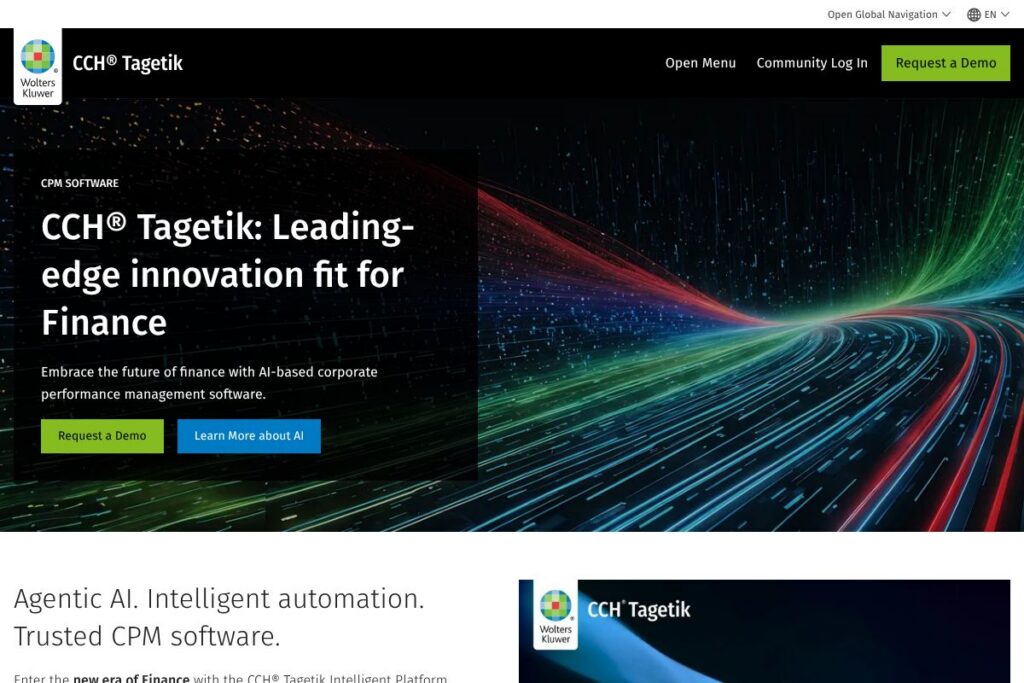

CCH Tagetik: An Overview
CCH Tagetik is a corporate performance management platform from Wolters Kluwer that centralizes financial consolidation, planning, reporting, and disclosure management. It combines a common data model with reporting, analytics, and workflow controls so finance teams can run close processes, produce statutory and management reports, and iterate plans with traceability and audit trails. The vendor positions Tagetik for medium to large enterprises and finance organizations with complex consolidation, regulatory, and planning needs; explore the vendor site on the CCH Tagetik product page for full product context.
Compared with competitors, CCH Tagetik is frequently compared to OneStream, Anaplan, and Oracle Hyperion. Compared to OneStream, Tagetik emphasizes packaged functionality for disclosure management and statutory reporting alongside consolidation; OneStream focuses on a unified platform approach that can reduce the need for additional modules. Against Anaplan, Tagetik provides deeper native financial consolidation and governance features while Anaplan focuses on highly flexible driver-based planning and modeling. Versus Oracle Hyperion, Tagetik tends to present a more modern cloud deployment and tighter integration with disclosure and regulatory reporting workflows.
All of this makes CCH Tagetik well suited for centralized finance functions that must consolidate multi-entity accounts, produce audited disclosures, and link planning to outcomes. It is particularly helpful for companies that need native consolidation, multi-GAAP reporting, and a governed audit trail across planning and close activities.
How CCH Tagetik Works
CCH Tagetik stores financial and operational data in a unified data model that supports consolidation, planning, and reporting from the same source of truth. Data feeds arrive through connectors or flat-file imports, are validated and mapped, and then become available for consolidation logic, currency translation, intercompany elimination, and multi-GAAP reporting.
Finance teams use Tagetik to run period-end close routines, apply consolidation rules, and generate statutory and management packs through templated reports. Planning workflows let teams build driver-based budgets and forecasts, run what-if scenarios, and route iterations through approval workflows, while audit logs and reconciliation features support compliance and auditability. The platform integrates with ERPs and other systems; see the integration capabilities for typical connector options.
CCH Tagetik features
CCH Tagetik organizes financial operations around consolidation, planning, disclosure, and analytics. Core capabilities include financial consolidation, budgeting and forecasting, disclosure management, close automation, reporting and dashboards, and integration tools. Recent platform updates have expanded AI-assisted planning and automation to speed forecasting and narrative generation; check the product features overview for details.
Let’s dive into the standout features:
Financial consolidation
The platform automates consolidation processes including intercompany eliminations, currency translation, minority interest, and ownership structures. Tagetik supports multiple accounting standards and maintains audit trails for each consolidation step, which reduces manual reconciliation work and shortens the close cycle.
Planning, budgeting, and forecasting
Tagetik supports driver-based and zero-based budgeting, rolling forecasts, and scenario modeling. Users can create linked planning models that feed into consolidated plans, run what-if analyses, and compare scenarios with actuals for variance analysis and decision support.
Disclosure and statutory reporting
Built-in disclosure management handles narrative, formatted financial statements, and regulatory packs with auditability and version control. The solution streamlines XBRL tagging, report packaging, and the distribution of statutory filings, useful for companies with multi-jurisdictional reporting requirements.
Close process automation
Workflow and task management features orchestrate close activities across teams with notifications, checkpoints, and reconciliations. Automated reconciliations, configurable controls, and status tracking improve visibility into the close timeline and reduce manual dependencies.
Reporting and analytics
Interactive reporting and dashboarding let finance and business users visualize consolidated results, drivers, and KPIs. Prebuilt financial templates combine with ad hoc analytical tools to support management reporting, board packs, and drill-through from aggregated numbers to transaction-level detail.
Data integration and master data management
Connectors, ETL routines, and a centralized chart of accounts enable consistent master data across consolidation and planning. Mapping tools and data validation rules reduce errors during ingestion and help maintain traceability from source systems to reports.
Workflow, security, and auditability
Role-based access, segregation of duties, and comprehensive audit logs provide governance across financial processes. Approval routing, configurable workflows, and encrypted data handling support compliance and internal control requirements.
Cloud deployment and platform security
CCH Tagetik is available as a cloud-hosted solution and through hybrid deployments, with enterprise-grade security controls and certifications. Cloud delivery simplifies maintenance, patching, and upgrades while preserving centralized administration and backup.
AI-assisted planning and automation
The platform now includes AI-driven features to assist with forecasting, anomaly detection, and narrative generation for management commentary. These capabilities help accelerate plan iterations and generate explainable commentary that complements numeric reports.
With these capabilities, CCH Tagetik helps finance teams shorten close cycles, unify planning and consolidation, and produce audited disclosures from a single platform. The biggest benefit is having consolidation, planning, and disclosure workflows tied to one governed data model so results and narratives stay consistent across reporting outputs.
CCH Tagetik pricing
CCH Tagetik follows an enterprise, modular licensing model with custom pricing that varies by deployment, modules selected, and scale of implementation. Pricing is generally tailored for medium to large organizations and typically combines software licensing, implementation services, and optional managed services; contact Wolters Kluwer to obtain a proposal that matches your requirements through the CCH Tagetik contact options.
Enterprise
Enterprise licensing is custom and usually priced based on the selected modules, number of legal entities, and the scope of users and services required. Implementation, data migration, integrations, and optional ongoing support are commonly scoped and priced separately, so expect an itemized quote after a product and requirements discussion.
What is CCH Tagetik Used For?
CCH Tagetik is used for financial consolidation, statutory and management reporting, and centralizing planning and budgeting across multiple entities. Teams typically deploy it to standardize close processes, reduce reconciliation effort, and produce consistent financial narratives for stakeholders.
Other common uses include regulatory disclosure preparation, integrated financial and operational planning, balance sheet close orchestration, and board-level reporting. The platform is ideal for finance organizations that need governance, auditability, and multi-GAAP capability while consolidating multiple data sources into a single reporting environment.
Pros and Cons of CCH Tagetik
Pros
- Comprehensive consolidation and disclosure capabilities: The platform provides native consolidation logic and disclosure management, which reduces the need for separate tools and streamlines statutory reporting across jurisdictions.
- Unified data model for planning and reporting: A single source of truth allows planning, forecasting, and consolidation to be linked and reconciled, improving accuracy and reducing manual rework.
- Strong governance and audit trail: Role-based security, approval workflows, and detailed audit logs make it easier to demonstrate controls and compliance during audits.
Cons
- Complex implementation for large organizations: Large-scale deployments often require professional services, detailed configuration, and significant time to integrate with source systems and validate data flows.
- Enterprise pricing model: Pricing is custom and typically aimed at medium to large enterprises, which can be a barrier for smaller companies with tighter budgets.
- Learning curve for advanced features: Finance teams may need training to fully leverage advanced planning models, disclosure tools, and AI-assisted features.
Does CCH Tagetik Offer a Free Trial?
CCH Tagetik is a paid enterprise solution and does not publish a public free plan; trial and demonstration options are available by request. Wolters Kluwer typically offers product demonstrations, proof-of-concept engagements, or limited trial arrangements for qualified buyers through their sales team; request access via the CCH Tagetik contact page.
CCH Tagetik API and Integrations
CCH Tagetik provides APIs and connector frameworks for integrating with ERPs, data warehouses, and reporting systems. The CCH Tagetik integration documentation outlines available connectors, supported file formats, and best practices for data ingestion.
Prebuilt integrations and ETL tools connect common source systems such as SAP, Oracle, and Microsoft Dynamics, while RESTful APIs and web services support custom integrations and automation. Developers can use these interfaces to automate data loads, trigger consolidation jobs, and pull reporting artifacts into downstream systems.
10 CCH Tagetik alternatives
Paid alternatives to CCH Tagetik
- OneStream: A unified corporate performance platform that combines consolidation, planning, and financial close features with an emphasis on extensibility and XF MarketPlace solutions.
- Anaplan: Cloud-native planning and modeling platform focused on driver-based planning, scenario modeling, and enterprise-wide planning use cases.
- Oracle Hyperion (Oracle EPM Cloud): A long-established suite for financial consolidation, planning, and reporting with deep Oracle ecosystem integration.
- SAP BPC: Financial consolidation and planning solution native to the SAP ecosystem, suited for companies already invested in SAP ERP.
- IBM Planning Analytics (TM1): A planning and analysis platform with strong in-memory modeling capabilities and deep analytics integration.
- Workday Adaptive Planning: A planning tool with a user-friendly interface and cloud-first design geared for finance and operational planning.
- Board: An integrated platform for planning, analytics, and reporting with a strong focus on dashboarding and decision support.
Open source alternatives to CCH Tagetik
- ERPNext: An open source ERP with accounting, budgeting, and reporting modules that can be extended for basic consolidation and planning in smaller organizations.
- Odoo (Community Edition): The community edition provides accounting and reporting features; organizations can extend modules for budgeting and consolidated reporting needs.
- Metabase: An open source analytics and reporting tool that can serve as a lightweight reporting layer for financial data when combined with data warehousing and ETL processes.
- Apache Superset: A data visualization platform useful for building dashboards and financial reports on top of consolidated data stores.
Frequently asked questions about CCH Tagetik
What is CCH Tagetik used for?
CCH Tagetik is used for financial consolidation, planning, budgeting, forecasting, and regulatory disclosure. Finance teams use it to centralize close processes, produce statutory and management reports, and maintain auditability across financial workflows.
Does CCH Tagetik integrate with ERP systems?
Yes, CCH Tagetik supports integrations with major ERPs and data sources. The platform includes connectors and APIs to import transactional and master data from systems such as SAP, Oracle, and Microsoft Dynamics; see the integration capabilities for specifics.
Can CCH Tagetik handle multi-GAAP reporting?
Yes, CCH Tagetik supports multi-GAAP and multi-currency reporting. The system maintains parallel ledgers and consolidation rules to produce statutory statements under different accounting standards and to handle currency translation and eliminations.
Does CCH Tagetik provide cloud deployment?
Yes, CCH Tagetik is available as a cloud-hosted solution and through hybrid deployments. Wolters Kluwer offers managed cloud options that include security controls, backups, and platform maintenance.
How much does CCH Tagetik cost?
CCH Tagetik uses a custom enterprise pricing model rather than fixed public prices. Costs depend on modules, number of entities, deployment model, and implementation scope; contact Wolters Kluwer for a tailored quote via the CCH Tagetik contact page.
Final verdict: CCH Tagetik
CCH Tagetik is a robust CPM solution that excels at bringing consolidation, planning, and disclosure management into a governed, auditable platform. It is particularly strong for organizations that need native consolidation logic, multi-GAAP reporting, and integrated disclosure workflows, backed by a unified data model and enterprise governance.
Compared with OneStream, CCH Tagetik generally offers deeper out-of-the-box disclosure and statutory reporting capabilities, while OneStream emphasizes a single-platform extensibility model. Both solutions follow enterprise licensing and custom pricing, so the better fit depends on whether your priority is packaged disclosure and consolidation functionality or a highly extensible single-platform approach; contact Wolters Kluwer to evaluate fit and obtain pricing details on the CCH Tagetik product page.