
What is Baremetrics
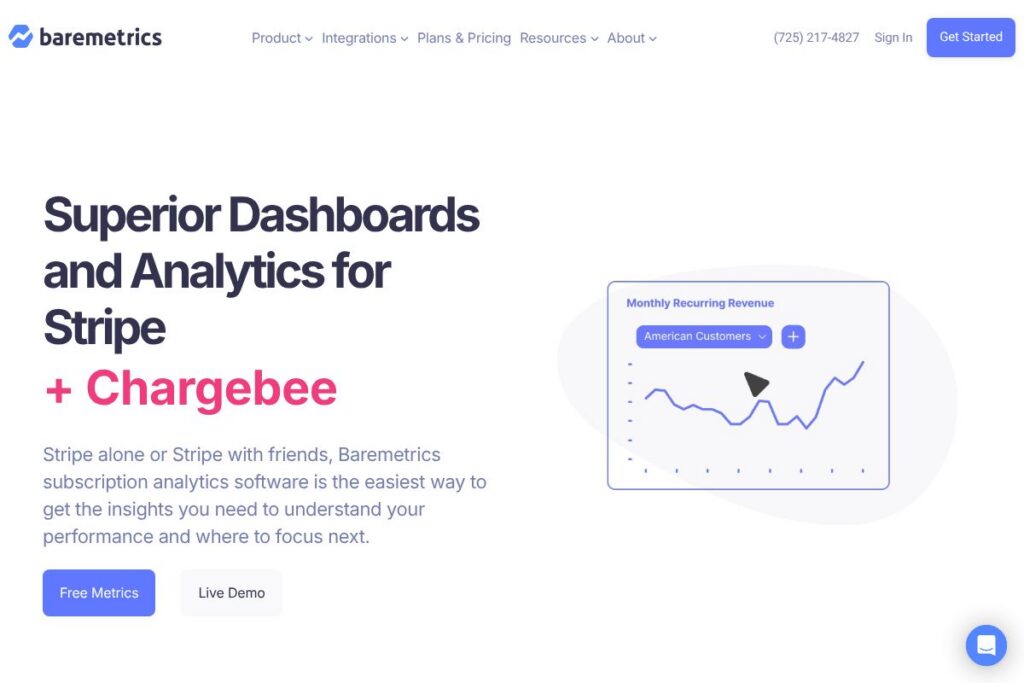
Baremetrics is a subscription analytics platform that consolidates billing data and customer events into dashboards, reports, and actionable workflows. It connects to payment systems and subscription platforms to produce standard SaaS metrics such as MRR, ARR, churn, LTV, expansion, and cohort performance without spreadsheets or manual queries.
Compared to ChartMogul and ProfitWell, Baremetrics puts more emphasis on operational tools that act on the data, not just reporting. ChartMogul focuses tightly on clean analytics and CSV imports, while ProfitWell bundles pricing and retention products; Baremetrics adds features like cancellation insights, recover workflows for failed payments, and augmentation to merge external data into customer profiles.
All of this makes Baremetrics especially useful for mid-market SaaS companies and growth-stage teams that need both clear reporting and built-in tools to reduce churn and recover revenue. It is well suited to teams that want one-click integrations with billing providers and an interface designed for quick, repeatable analyses.
How Baremetrics Works
Baremetrics pulls transaction and subscription events from your billing provider, normalizes the data, and computes hundreds of standard metrics automatically. Once connected, dashboards update in near real time so teams can monitor MRR movements, cohort trends, and revenue drivers without custom engineering work.
Teams use Baremetrics to slice customers by plan, activity, and custom attributes; set goals and alerts; and run experiments such as pricing or onboarding changes while tracking impact through Trial Insights and cohort comparisons. Operational features like Cancellation Insights and Recover sit alongside analytics so teams can act on issues directly from the analytics interface.
Implementation is typically a matter of connecting a billing provider such as Stripe or Paddle, optionally enabling webhooks for real-time updates, and configuring augmentations to bring CRM or product data into customer records. That workflow moves organizations from raw transaction logs to a single source of truth for subscription metrics.
What does Baremetrics do?
Baremetrics centers on subscription metrics and actionable insights while also offering tools to reduce churn and recover revenue. Core capabilities include automated MRR/ARR calculations, cohort analysis, benchmarks to compare performance with similar companies, cancellation feedback collection, recover for failed payments, and augmentation to enrich profiles with external data. The platform also publishes transparency pages through its Open Startups feature and maintains a learning hub with practical guides.
Benchmarks
Benchmarks provide context by comparing your key metrics to anonymized aggregates of similar companies, helping teams judge whether growth or churn is normal for their industry and size.
Goals
Goals let teams set numeric targets for metrics like MRR growth or churn reduction, track progress over time, and share scorecards to align stakeholders around measurable objectives.
Trial Insights
Trial Insights capture notes and performance indicators for experiments, campaigns, and onboarding changes so teams can quantify how new initiatives affect activation, conversion, and revenue retention.
Augmentation
Augmentation merges external data such as CRM fields, product usage, or campaign tags into Baremetrics customer records, enabling richer segmentation and more precise cohort analysis.
Segmentation
Segmentation enables discovery of high-value cohorts by attributes like plan, acquisition channel, usage, or geography, and supports direct comparison of revenue metrics across those segments.
Customers
The Customers view stores a full history of payments, subscription changes, and events for each account, making it simple to audit lifecycle activity and troubleshoot billing issues.
Cancellation Insights
Cancellation Insights collects structured feedback when customers cancel, aggregates reasons and associated revenue, and surfaces patterns that inform product and retention work.
Recover
Recover automates failed-payment workflows by retrying charges, sending dunning emails, and offering payment updates or discounts, which reduces delinquent churn and recovers lost revenue.
One-click Integrations
Baremetrics supports one-click connections with major billing platforms so you can get hundreds of metrics without engineering work; integrations reduce setup time and keep event flows synched.
With this feature set, the biggest benefit is that Baremetrics turns subscription data into both strategic analytics and operational actions, letting teams measure and improve revenue performance from a single product. For organizations focused on recurring revenue, that blend of reporting plus remediation is the primary advantage.
Baremetrics pricing
Baremetrics uses a SaaS subscription model with plans that scale by feature set and company needs; specific plan pricing is not published here. For up-to-date plan tiers, seat counts, and billing cycles, visit the Baremetrics pricing page on their site.
What is Baremetrics used for
Baremetrics is commonly used to measure and explain subscription revenue movements, such as new MRR, churned MRR, expansion, and contraction. Finance and revenue teams use it for forecasting, reconciling billing events, and reporting to executives without writing SQL or building dashboards from scratch.
Customer success and product teams use Baremetrics to identify at-risk cohorts, analyze cancellation reasons, and test retention initiatives. Marketing teams leverage segmentation and cohort analysis to measure acquisition channel efficiency and lower customer acquisition cost over time.
Pros and cons of Baremetrics
Pros
- Comprehensive subscription metrics: Provides a wide range of prebuilt SaaS metrics so teams avoid manual calculations and inconsistent definitions. This reduces reconciliation work and standardizes reporting.
- Operational features integrated with analytics: Cancellation Insights and Recover let teams act on problems directly from the analytics interface, which shortens the loop between insight and action.
- Easy connections to billing providers: One-click integrations minimize engineering overhead and accelerate time to value for analytics and alerts.
Cons
- Custom reporting flexibility: Deeply custom visualizations or highly specialized calculations may still require external BI tools or SQL for some organizations with complex data models.
- Enterprise-level needs: Large organizations with extensive data governance and on-prem requirements may need custom contracts or integrations, which can add implementation complexity.
Does Baremetrics Offer a Free Trial?
Baremetrics offers a free trial for new users. The trial typically provides access to core analytics and operational features so teams can evaluate dashboards, cohort tools, Cancellation Insights, and Recover before committing to a subscription; check the Baremetrics homepage for current trial terms and sign-up instructions.
Baremetrics API and Integrations
Baremetrics provides an API and supports standard webhooks for developers who need programmatic access to metrics, customer records, and event data. Explore the Baremetrics API documentation for endpoints, authentication, and examples.
Key native integrations include major billing providers and CRMs such as Stripe, Paddle, Braintree, Recurly, Chargebee, and common tools like HubSpot, enabling automatic ingestion of subscription events and easy enrichment of customer data.
10 Baremetrics alternatives
Paid alternatives to Baremetrics
- ChartMogul — Subscription analytics focused on clean imports and rigorous metric definitions that suit finance teams and data-driven startups.
- ProfitWell — Offers subscription analytics plus retention and pricing tools, with a focus on revenue recovery and monetization features.
- Chargebee — Billing platform with built-in analytics and revenue reporting designed for billing and finance teams at scale.
- Recurly — Subscription management and analytics that integrate billing operations with revenue insights and dunning controls.
- Zuora — Enterprise-grade subscription billing and revenue recognition with deep finance integrations for large companies.
- Stripe Sigma — SQL-based analytics for businesses on Stripe that want to query raw payments data directly inside Stripe.
- Mixpanel — Product and behavioral analytics with event-based tracking that can complement subscription metrics when tied to payment data.
Open source alternatives to Baremetrics
- Metabase — Open source BI tool that provides dashboards and question-driven analytics for teams that want self-hosted reporting.
- Apache Superset — Scalable data visualization platform for SQL-driven analytics, often used with data warehouses for custom subscription reports.
- Redash — Query and dashboard tool for teams that want to build custom reports on billing data from their databases.
- PostHog — Open source product analytics that can be combined with billing data to analyze user behavior alongside revenue signals.
Frequently asked questions about Baremetrics
What is Baremetrics best used for?
Baremetrics is best used for subscription analytics and revenue operations. It centralizes billing events into clear SaaS metrics, cohort analysis, and operational tools like cancellation tracking and recover workflows.
Does Baremetrics integrate with Stripe and other billing providers?
Yes, Baremetrics integrates with major billing providers such as Stripe, Paddle, Braintree, Recurly, and Chargebee. These integrations enable automatic ingestion of transactions and subscription events for accurate metric calculations.
Can Baremetrics help reduce churn?
Yes, Baremetrics includes features aimed at reducing churn, such as Cancellation Insights and Recover for failed payments. These tools capture cancellation reasons, automate recovery attempts, and surface patterns that drive retention work.
Does Baremetrics provide an API for developers?
Yes, Baremetrics provides an API and webhooks for programmatic access to metrics and customer data. Developers can use the API to extract metrics, sync enriched customer profiles, and build custom automations; see the Baremetrics API documentation.
How does Baremetrics handle company benchmarking?
Baremetrics offers benchmarking to compare your metrics to similar companies. Benchmarks provide context for MRR growth, churn, and retention so you can evaluate performance relative to industry peers.
Final verdict: Baremetrics
Baremetrics is a practical choice for subscription businesses that want both instant visibility into SaaS metrics and tools to act on that data without lengthy engineering projects. Its combination of prebuilt metrics, cancellation feedback, and Recover workflows helps teams not only measure but also improve revenue health.
Compared with ChartMogul, Baremetrics leans more into operational features that directly impact churn and recovery, while ChartMogul emphasizes clean, exportable analytics. For teams that value built-in remediation and customer-level workflows alongside dashboards, Baremetrics often represents stronger operational value. For more analytics-only use cases or very price-sensitive small teams, ChartMogul and lighter-weight tools may be worth comparing.
Overall, Baremetrics is well suited to growth-stage SaaS companies and revenue teams that need an integrated analytics-to-action platform to accelerate data-driven revenue decisions and reduce manual billing work.