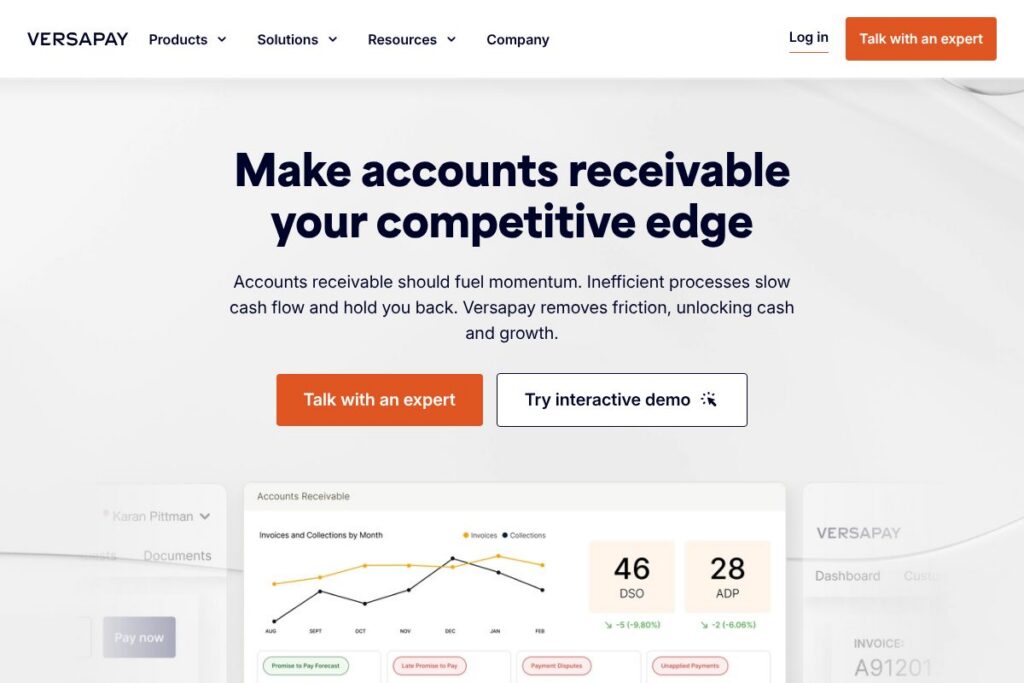

Versapay: An Overview
Versapay is an accounts receivable automation platform that consolidates invoicing, customer payment portals, collections, and cash application into a single workflow. It presents invoices to customers, accepts digital payments including ACH and card transactions, and uses automation and AI to match payments to invoices and post results back to ERP systems in real time.
Compared with other AR and payment solutions, Versapay focuses on an integrated invoice-to-cash flow rather than point solutions. For example, Bill.com targets small and midsize businesses with standalone payables and receivables workflows and transparent per-user pricing, while HighRadius offers enterprise-scale credit-to-cash automation centered on treasury and receivables orchestration. Tipalti is stronger on supplier payments and global payout automation, whereas Versapay concentrates on customer-facing invoice presentment and automated cash application.
All of this makes Versapay particularly well suited for finance teams that need an end-to-end AR solution with built-in payments and reconciliation. It works best for mid-market and enterprise organizations that want to reduce DSO, eliminate manual matching, and centralize collections activity across multiple payment methods.
How Versapay Works
Versapay integrates with a companys ERP to extract invoices and customer data, then delivers those invoices through a branded, cloud-based portal where customers can view, manage, and pay their accounts. Payment options typically include ACH, credit card, virtual card, and wire, and the platform applies configurable acceptance and routing rules.
When a customer pays, Versapay captures the transaction, applies automated matching logic to reconcile payments to invoices, and posts the results back to the ERP for straight-through processing. Collections workflows run in parallel: automated dunning notifications, predicted delinquencies, and prioritized collection lists help AR teams focus on high-risk accounts instead of manual outreach.
A practical workflow example: finance exports an AR file from their ERP into Versapay, invoices are delivered to customers via the portal, late-account scoring flags accounts for follow-up, payments received by ACH are auto-matched to invoices, and reconciled entries are posted back to the ERP without manual intervention.
Versapay features
Versapay centers on invoice presentment, digital payments, AI-assisted cash application, and collections automation. The platform combines self-service customer portals, configurable payment acceptance, automated reconciliation, and AR analytics to reduce manual work and accelerate cash flow.
Key functionality includes:
Invoice delivery and presentment
Versapay automates invoice delivery by pulling billing data from the ERP and presenting invoices in a branded customer portal, reducing email and PDF-based workflows. This centralized presentment improves visibility for both customers and AR teams and supports bulk presentment for high-volume billers.
Customer self-serve portal
The cloud-based portal lets customers view statements, pay multiple invoices at once, schedule recurring payments, and manage stored payment methods. Self-service reduces support calls and speeds collections by making it easier for customers to complete payments on their schedule.
Payments acceptance and routing
Versapay accepts ACH, credit cards, virtual cards, and wires within the same payments environment and lets administrators configure payment acceptance rules. Supporting multiple payment rails and routing rules helps reduce friction and can lower transaction costs through preferred processors.
Automated collections and predictive scoring
Collections workflows use automation to send dunning notices, prioritize accounts based on predicted delinquency risk, and surface high-risk customers for manual follow-up. Predictive scoring helps AR teams allocate resources to accounts most likely to become overdue.
Cash application and reconciliation
The platform uses matching rules and AI-assisted logic to reconcile remittances to invoices automatically, including partial payments, multi-invoice receipts, and different remittance formats. Automatic reconciliation reduces exceptions, accelerates posting, and shortens the close cycle.
ERP integration and posting
Versapay integrates with major ERPs to synchronize invoices, payments, and posting entries back to the general ledger in near real time. Tight ERP connections enable straight-through processing and reduce duplicate data entry across finance systems.
Reporting and cash forecasting
Built-in dashboards track DSO, collections performance, unapplied cash, and payment trends, helping teams forecast cash flow and identify payment risks before reconciliation. These analytics support decision making and provide transparency into AR health.
Fraud protection and transaction monitoring
The platform includes configurable fraud and risk controls, allowing teams to monitor transactions, block suspicious payments, and set acceptance thresholds. Monitoring tools reduce exposure and support compliance with internal risk policies.
With these capabilities, Versapay’s biggest benefit is that it combines invoicing, payments, collections, and reconciliation into a single flow, reducing manual handoffs and improving cash visibility across the entire invoice-to-cash lifecycle.
Versapay pricing
Versapay uses an enterprise SaaS and payments model with customized pricing rather than public, fixed-tier plans. Pricing typically depends on factors such as transaction volume, payment methods, integration scope, and service levels.
For detailed plan structures and quotes, consult Versapay’s commercial team or view their platform details on the company site. See Versapay’s current pricing options and plan details to arrange a tailored quote or request a proposal.
What is Versapay Used For?
Versapay is used to automate the invoice-to-cash process, replacing manual invoice delivery, payment collection, and reconciliation tasks with a unified platform. Finance teams use it to reduce DSO, lower the cost of collections, and eliminate time-consuming matching work during close periods.
Typical users include mid-market and enterprise companies in distribution, manufacturing, wholesale, utilities, and services where B2B invoicing volume and payment complexity create manual work. IT and finance collaborate to integrate Versapay with ERPs so that payments and reconciliations post automatically and financial records stay synchronized.
Pros and cons of Versapay
Pros
- Unified invoice-to-cash platform: Automates invoicing, payments, collections, and cash application in a single workflow, reducing system fragmentation and manual handoffs.
- Automated cash application: AI-assisted matching handles partial and multi-invoice payments, lowering unapplied cash and shortening reconciliation cycles.
- Customer self-service: Branded portals let customers view and pay invoices, which reduces support volume and speeds collections.
- Multiple payment rails: Accepts ACH, credit cards, virtual cards, and wires in one platform with configurable acceptance rules and fraud controls.
- ERP-native posting: Integrates with ERPs to post reconciled payments back to the ledger for straighter-through processing and faster closes.
Cons
- Enterprise-focused pricing: Pricing is typically customized for larger organizations, which may be a barrier for smaller businesses looking for transparent, low-cost plans.
- Implementation scope: Full benefits depend on ERP integration and process alignment, so implementation can require cross-functional project work and time.
- Feature depth varies by market: Some organizations may need advanced treasury or procurement payout features that other specialized platforms focus on more deeply.
Does Versapay Offer a Free Trial?
Versapay does not publish a free plan, but the company provides demos and trial access on request. Prospective customers can request a demo or pilot to evaluate invoice presentment, payment acceptance, and reconciliation workflows; contact details and demo request options are available through Versapay’s request a demo page.
Versapay API and Integrations
Versapay provides integration options and APIs to connect with ERPs and payment processors; the developer resources and integration guides are available from their platform pages. For specifics on endpoints, authentication, and supported ERP connectors, consult Versapay’s developer documentation and integration resources.
The platform offers prebuilt connectors and partner integrations for common ERP systems such as SAP, Oracle NetSuite, and Microsoft Dynamics, and it can be configured to post reconciled transactions back to those systems for straight-through processing.
10 Versapay alternatives
Paid alternatives to Versapay
- HighRadius — Enterprise-scale order-to-cash automation focused on credit, collections, and treasury operations with AI-driven decisioning.
- Bill.com — Cloud accounts payable and receivable platform targeting small and midsize businesses with simple workflows and transparent pricing.
- Tipalti — Global payments and AP automation with strong support for cross-border payouts and supplier onboarding.
- YayPay (a Quadient solution) — Receivables automation and cash application with an emphasis on AR analytics and collections workflows.
- Esker — Document automation and order-to-cash solutions, including electronic invoicing and cash application services.
- AvidXchange — Accounts payable and payment automation geared toward middle-market companies, often used in real estate and financial services.
Open source alternatives to Versapay
- Odoo — Open-source ERP with accounting and invoicing modules that can be extended to support basic receivables automation and customer portals.
- ERPNext — Open-source ERP that includes accounting, invoicing, and payment tracking; suitable for teams that can self-host and customize workflows.
- Dolibarr — Modular open-source ERP and CRM with invoicing and payment modules for smaller organizations seeking a self-managed solution.
Frequently asked questions about Versapay
What is Versapay used for?
Versapay is used to automate the invoice-to-cash lifecycle, including invoice presentment, digital payments, collections, and cash application. Finance teams use the platform to reduce manual reconciliation work and improve cash visibility.
Does Versapay integrate with my ERP?
Yes, Versapay integrates with major ERPs to synchronize invoices and post reconciled payments back to the ledger. Common integrations include systems such as SAP, Oracle NetSuite, and Microsoft Dynamics through prebuilt connectors or API-based integrations.
How does Versapay handle payments?
Versapay accepts multiple payment methods, typically including ACH, credit card, virtual card, and wire transfers. Administrators can configure acceptance rules, fraud monitoring, and routing to preferred processors.
Can Versapay reduce days sales outstanding (DSO)?
Yes, by centralizing invoice presentment, enabling self-serve payments, and automating collections and cash application, Versapay helps shorten DSO. Prioritized collection activities and predictive scoring also focus effort on accounts most likely to fall behind.
Is Versapay suitable for small businesses?
Versapay is generally targeted at mid-market and enterprise organizations that need integrated invoice-to-cash automation. Smaller businesses may prefer simpler or more transparent pricing options such as Bill.com or open-source ERPs if they do not require enterprise-grade integrations.
Final verdict: Versapay
Versapay excels at combining invoice presentment, digital payments, automated collections, and AI-assisted cash application into a single, ERP-connected flow. Its strengths are reducing manual reconciliation, enabling customer self-service, and posting reconciled transactions back to ERPs for straight-through processing, which together accelerate cash flow and reduce errors.
Compared to Bill.com, which targets smaller organizations with clear per-user pricing and simpler workflows, Versapay is positioned for larger, AR-intensive businesses that need deeper integration and end-to-end automation. Pricing for Versapay is typically custom and enterprise-focused, while Bill.com provides standard tiers for SMBs; the choice comes down to scale, integration needs, and whether a unified invoice-to-cash platform is required for automated reconciliation and payments.
Overall, Versapay is a strong fit for finance teams that need a single platform to manage invoicing, payments, collections, and reconciliation at scale, and for organizations that prioritize reducing DSO and achieving straight-through AR processing.