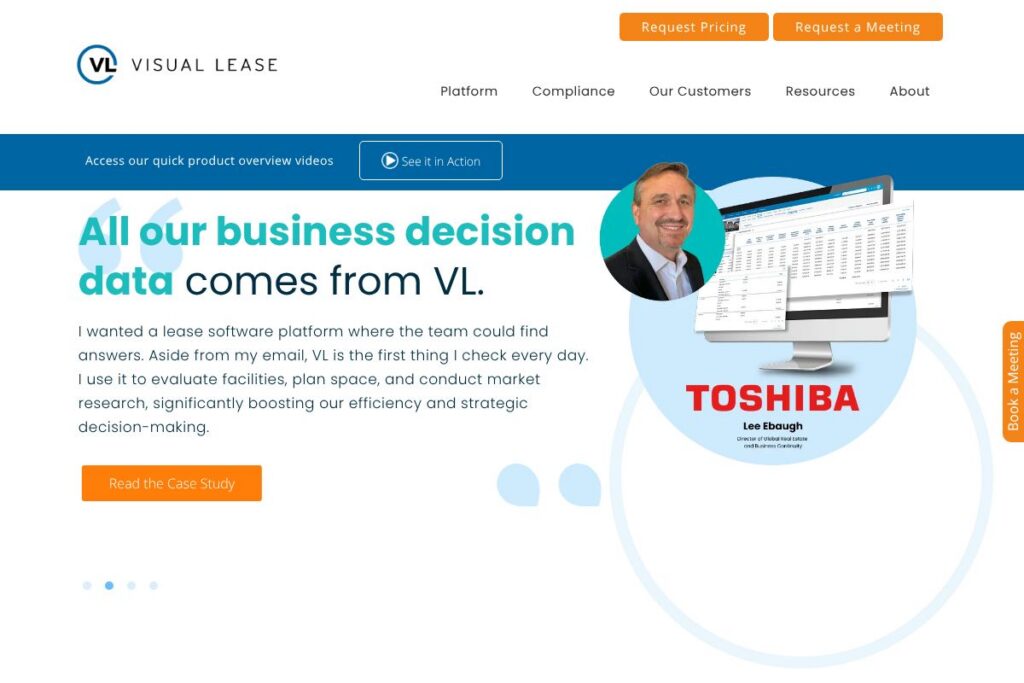

Visual Lease: An Overview
Visual Lease is an enterprise lease accounting and lease management platform that centralizes lease records, automates accounting under ASC 842, IFRS 16, and GASB 87, and provides operational controls for real estate and equipment portfolios. It combines a single lease repository with accounting calculations, workflow controls, and reporting to reduce manual work and support audit readiness.
Compared with competitors such as LeaseQuery, Nakisa, and MRI Software, Visual Lease emphasizes an end-to-end approach that spans both accounting and operational lease management. Compared to LeaseQuery, which targets mid-market accounting teams with a strong focus on accounting calculations, Visual Lease places more emphasis on portfolio reporting, cross-functional access, and integrations with ERP systems. Against Nakisa and MRI Software, Visual Lease competes on usability and a SaaS-first delivery model aimed at large, distributed real estate and finance teams.
All of this makes Visual Lease especially useful for finance-led real estate programs and corporate accounting teams that need controls, audit support, and integrated data to make strategic lease and portfolio decisions. It is a solution for enterprises that require scalable reporting, multi-standard accounting support, and integration with ERPs and general ledgers.
How Visual Lease Works
Visual Lease ingests lease documents and metadata into a centralized repository where leases can be tagged, dated, and linked to related assets and contracts. The platform runs accounting calculations to generate journal entries compliant with ASC 842, IFRS 16, and GASB 87, and it stores amortization schedules, right-of-use asset balances, and lease liability detail.
Teams use Visual Lease to create approvals and renewal workflows, assign responsibilities across real estate, finance, procurement, and legal, and schedule reminders for critical dates like renewals and termination windows. Integrations push accounting outputs into ERPs and general ledgers so finance teams can close periods without manual spreadsheet reconciliations.
What does Visual Lease do?
Visual Lease combines lease accounting, operational lease management, reporting, and integrations into a single platform that supports the full lease lifecycle from acquisition to termination. Core capabilities include automated accounting calculations, a centralized lease register, workflow and role-based access, and enterprise reporting and analytics.
The platform includes several powerful capabilities worth highlighting:
Lease Accounting Automation
Visual Lease automates lease accounting calculations required for ASC 842, IFRS 16, and GASB 87, producing journal entries, amortization schedules, and lease liability rollforwards. This reduces manual spreadsheet work, enforces consistent methodology across leases, and supports audit trails for accounting teams.
Centralized Lease Repository
All lease data, documents, and key dates live in a single system of record that is searchable, auditable, and accessible to authorized stakeholders. Centralization helps eliminate data silos and makes it easier to reconcile lease information with financial records.
Lifecycle and Workflow Management
The platform manages lease lifecycle events including renewals, options, amendments, and terminations with configurable workflows and approval routing. Notifications and task lists help crossfunctional teams stay on top of critical dates and contractual obligations.
Reporting and Analytics
Visual Lease provides operational and financial reporting tools for lease portfolios, including dashboards, exportable reports, and customizable analytics. Users can slice portfolio data by geography, asset class, lease type, or business unit to support budgeting and strategic planning.
Integrations and API
Visual Lease connects lease accounting outputs to ERPs and general ledgers for posting journal entries and supporting close processes. Integration points typically include systems like SAP, Oracle, NetSuite, Intacct, and Workday, enabling automated data exchange between lease and finance systems.
Audit, Controls, and Compliance
Built-in audit trails, role-based permissions, and configurable approval workflows help companies demonstrate internal controls for auditors and regulators. The platform records adjustments, user activity, and version history to support compliance efforts.
AI-Powered Insights
AI-assisted features surface anomalies, suggest classification or tagging, and help extract metadata from lease documents to reduce manual data entry. These capabilities speed up onboarding of leases and improve data consistency across large portfolios.
With these capabilities Visual Lease helps reduce manual accounting effort, strengthen control environments, and provide real-time visibility into lease obligations and portfolio performance.
Visual Lease pricing
Visual Lease uses an enterprise subscription pricing model that is typically quoted based on portfolio size, feature set, and deployment requirements. Pricing is tailored to enterprise customers and often includes implementation, training, and support components.
Because Visual Lease does not publish standardized public plan pricing, organizations should contact the vendor for a custom quote and implementation estimate. For current pricing options and to request a tailored quote, see the Visual Lease website or reach out via the Visual Lease contact page.
What is Visual Lease Used For?
Large finance and real estate teams use Visual Lease to maintain a single source of truth for all leases, automate accounting entries, and prepare for audits under ASC 842, IFRS 16, or GASB 87. It is commonly used to centralize lease records, manage critical dates, and produce accounting outputs that feed into monthend close processes.
Operational teams use the platform to coordinate renewals, analyze space and asset needs, and run scenario modeling for portfolio decisions. Legal and procurement groups use Visual Lease to track amendments and ensure contract compliance across business units.
Pros and Cons of Visual Lease
Pros
- Comprehensive accounting coverage: Visual Lease automates ASC 842, IFRS 16, and GASB 87 calculations and produces journal entries and schedules that simplify period close and audit preparation.
- Centralized portfolio visibility: Consolidates lease documents, dates, and financial details into a searchable system of record, reducing reliance on spreadsheets and ad hoc tracking.
- Strong integration focus: Integrates with ERPs and general ledger systems so accounting teams can post journals and reconcile balances without manual rekeying.
- Enterprise controls and workflow: Rolebased access, approvals, and audit trails provide governance that meets enterprise compliance and internal control requirements.
Cons
- Enterprise-focused pricing and implementation: Organizations with small portfolios or simple lease needs may find the platform more comprehensive than necessary and should budget for implementation and onboarding.
- Configuration and change management: Large deployments require planning across finance, real estate, and IT teams to map data, configure workflows, and train users, which can extend time to value.
Does Visual Lease Offer a Free Trial?
Visual Lease provides demos and can offer trial or pilot access for qualified enterprise customers. Prospective customers can request a demo or pilot through the Visual Lease contact page, where sales and implementation teams will outline trial scope, sample data requirements, and next steps.
Visual Lease API and Integrations
Visual Lease offers integration capabilities and developer APIs to connect lease data and accounting outputs with ERPs, general ledgers, and other enterprise systems. The Visual Lease integrations page describes common connectors and integration approaches.
Typical integrations include ERP and accounting systems such as SAP, Oracle, NetSuite, Intacct, and Workday, as well as document repositories and BI tools. The API and connector options allow automation of journal entry exports, lease metadata synchronization, and scheduled reporting to downstream systems.
10 Visual Lease alternatives
Paid alternatives to Visual Lease
- LeaseQuery — Lease accounting platform focused on ASC 842 and IFRS 16 for mid-market and enterprise accounting teams with streamlined accounting workflows and audit support.
- Nakisa — Lease and asset accounting software with a focus on complex global portfolios and configurable accounting engines for enterprise clients.
- MRI Software — Enterprise real estate and lease management suite with modules for accounting, facilities, and portfolio operations across property types.
- Accruent — Provides real estate and asset management solutions with lease accounting, facilities management, and capital planning tools for enterprise customers.
- ProLease — Lease administration system combined with accounting and reporting features tailored to corporate real estate teams.
- IBM TRIRIGA — Enterprise real estate and facilities platform with integrated lease and financial management capabilities for large organizations.
Open source alternatives to Visual Lease
- ERPNext — Open source ERP with accounting and asset management modules that can be extended for basic lease tracking and reporting in smaller deployments.
- Odoo — Modular open source business apps that include accounting and contract management modules which can be customized to manage leases for smaller teams.
- Dolibarr — Open source ERP and CRM that can be adapted to track lease-related contracts and billing in lowercomplexity environments.
Frequently asked questions about Visual Lease
What does Visual Lease do for lease accounting?
Visual Lease automates accounting for leases under ASC 842, IFRS 16, and GASB 87. It generates schedules, journal entries, and amortization tables to support monthend close and audit processes.
Does Visual Lease integrate with ERP and general ledger systems?
Yes, Visual Lease integrates with common ERPs and general ledger systems. Typical integrations include SAP, Oracle, NetSuite, Intacct, and other financial systems to automate posting and reconciliation.
How much does Visual Lease cost compared to competitors?
Visual Lease uses enterprise pricing with custom quotes based on portfolio size and requirements. For a direct comparison, enterprise buyers often request quotes from Visual Lease and competitors like LeaseQuery to compare implementation, support, and total cost of ownership.
Can Visual Lease help with audit and compliance readiness?
Yes, Visual Lease provides audit trails, rolebased permissions, and documentation exports to support audits. The platform records adjustments and user activity so teams can demonstrate controls and reconciliations.
Is there an API for Visual Lease to automate journal exports?
Visual Lease exposes integration options and APIs to automate data exchange. Developers and integration teams can use connectors to export journal entries and synchronize lease metadata with downstream systems as part of close and reporting workflows.
Final Verdict: Visual Lease
Visual Lease is a mature, enterprise-focused lease accounting and management platform that excels at consolidating lease data, automating ASC 842/IFRS 16/GASB 87 accounting, and delivering portfolio reporting and workflow controls. Its strengths are centralized data, audit-friendly controls, and a focus on integrations that let finance teams close more efficiently and real estate teams make better portfolio decisions.
Compared to LeaseQuery, Visual Lease targets broader enterprise needs by combining operational lease management and crossfunctional access with accounting automation, while LeaseQuery often provides a simpler, accounting-first experience for mid-market teams. Pricing for Visual Lease is quoted per enterprise deployment and reflects implementation and integration scope, whereas LeaseQuery typically offers more standardized SaaS tiering for smaller accounting teams. For large organizations that need an integrated lease-to-ledger workflow and enterprise controls, Visual Lease is a strong option; smaller teams with straightforward accounting needs may find competitor offerings more costeffective.