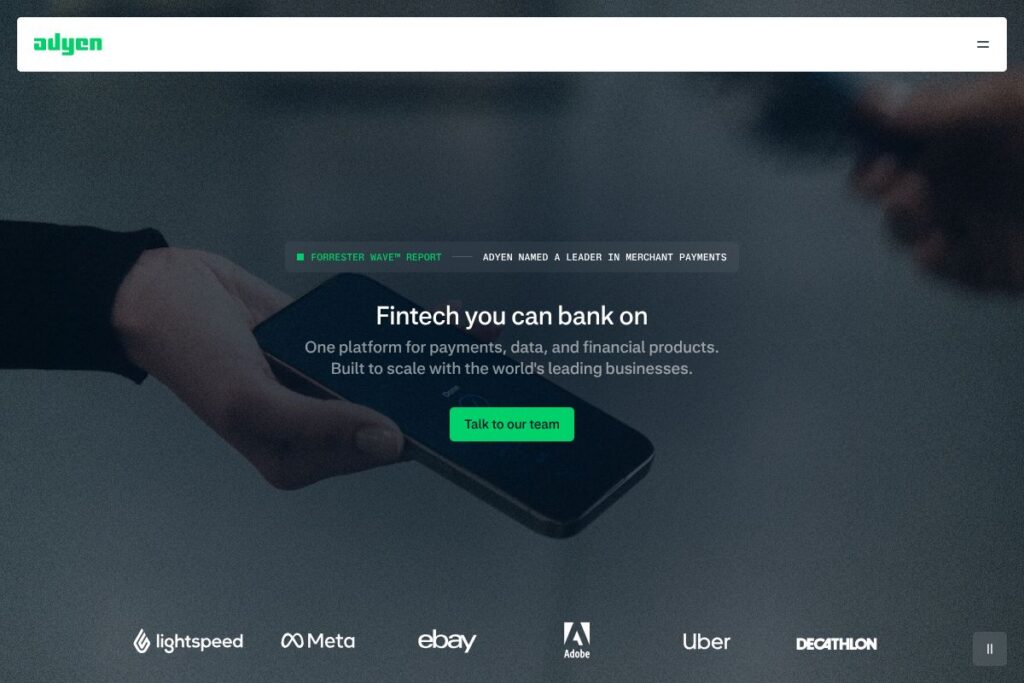
Adyen: An Overview
Adyen is a single-stack payments platform built for large merchants that need global scale and local acquiring. It combines online and in-store payment acceptance, centralized reporting, risk management, and financial products so businesses can run payments and money movement from one technical and operational environment.
Adyen competes with platforms such as Stripe, PayPal, and Worldpay on global reach and developer tooling. Compared with Stripe, Adyen focuses more on integrated acquiring and enterprise-grade global payouts; compared with PayPal, Adyen offers a broader suite of merchant-level financial services rather than consumer wallet-led checkout flows; compared with Worldpay, Adyen emphasizes a single technical stack across channels and merchants.
All of this makes Adyen especially well suited to retailers, marketplaces, travel and hospitality platforms, and large enterprises that need one platform to manage payments, reconciliation, risk controls, and financial services across multiple countries.
How Adyen Works
Adyen combines client-side SDKs and server-side APIs with an acquiring layer and a risk engine so merchants can accept payments across web, mobile, and point-of-sale channels. Developers integrate Adyen’s Checkout SDKs into storefronts or mobile apps and call server-side endpoints to create payments, handle webhooks, and reconcile transactions.
Transactions flow through Adyen’s global processing network to local acquirers and card schemes, while the risk engine evaluates fraud signals in real time. Merchants can also route transactions by country, payment method, or cost, and use centralized reporting to reconcile settlements and fees across markets.
For enterprises, typical implementation patterns include using Adyen’s hosted checkout for PCI scope reduction, the Client-Side Encryption or Drop-in for fast front-end integration, and the Adyen API documentation for server-side customization and back-office automation.
Adyen features
Adyen’s platform groups payment acceptance, risk control, issuing, and settlement into one stack, with developer-friendly APIs and global acquiring capabilities. Recent focus areas include expanded local payment methods, improved reconciliation tools, and deeper merchant-facing reporting.
Payments acceptance
Adyen supports card payments, local alternative payment methods, and in-person payments using its POS integrations and terminals. That lets merchants provide consistent checkout flows across web, mobile, and retail locations while consolidating settlements and reporting.
Global acquiring and settlement
The platform offers direct acquiring in many markets so merchants can keep local merchant-of-record relationships and reduce cross-border fees. This capability makes it easier to reconcile revenue per region and manage local payment flows.
Risk and fraud management
Adyen provides a risk engine with configurable rule sets, machine learning scoring, and chargeback management tools. Teams can tune rules per market, apply dynamic friction, and integrate third-party signals for a layered approach to fraud prevention.
Issuing and payouts
Adyen supports card issuing and marketplace payouts so platforms can manage disbursements to sellers and partners. Built-in issuing tools let businesses create virtual or physical cards and control spend programmatically through the API.
Data, reporting, and reconciliation
Centralized dashboards and reporting APIs provide transaction-level data, settlement reports, and exportable files for accounting systems. This reduces manual reconciliation and speeds up settlement analysis for finance teams.
Developer tooling and SDKs
Adyen supplies client SDKs, server libraries, a sandbox environment, and extensive API documentation to help engineering teams integrate payments and automate workflows. The developer experience emphasizes idempotent API calls, webhook handling, and clear testing guides.
With these capabilities combined, Adyen helps enterprises simplify operations by keeping payments, risk, and settlement data in one place while supporting global payment methods and local acquiring.
Adyen pricing
Adyen uses a customized pricing model tailored to enterprise customers rather than a single public price list. Fees typically reflect transaction volume, geographic footprint, payment method mix, and whether the merchant uses Adyen as an acquirer or routes through third-party acquirers.
For detailed, account-specific rates and potential volume discounts, contact Adyen directly through Adyen’s contact and sales channels to request a tailored quote or to discuss commercial terms. You can also review technical and integration costs in the Adyen developer documentation when planning implementation effort.
What is Adyen used for
Adyen is used to accept and manage payments across channels, reduce reconciliation complexity, and centralize fraud management for multi-country businesses. Retailers use it to unify in-store and online checkouts, marketplaces use it to handle onboarding and payouts for sellers, and travel platforms use it to manage complex multi-currency flows.
Operational teams use Adyen for settlement reporting, chargeback handling, and tax-ready transaction records, while engineering teams use the APIs to automate onboarding, refunds, and payouts. The end result is a platform that supports high-volume transaction pipelines and reduces the number of separate payments vendors a business must manage.
Pros and cons of Adyen
Pros
- Global acquiring and local payment coverage: Adyen lets merchants accept local payment methods and settle locally, which reduces cross-border friction and improves authorization rates.
- Single-stack approach: Centralizing payments, risk, and issuing simplifies reconciliation and reduces integration overhead compared with stitching multiple vendors together.
- Enterprise-grade reporting and settlement: Detailed transaction exports and settlement reports help finance teams close books faster and trace fees and payouts.
- Developer-friendly APIs and SDKs: Comprehensive documentation and libraries support production integrations, testing, and webhook-driven automation.
Cons
- Enterprise commercial model: Pricing is tailored to large merchants, which can be less transparent for smaller businesses that want straightforward public rates.
- Complexity for small teams: The breadth of features and configuration options can require more engineering and operational effort for smaller merchants compared with simpler payment gateways.
- Regional limits on acquiring: While Adyen covers many markets, not every country or payment method is available for direct acquiring, which can require fallback routing in some geographies.
Does Adyen Offer a Free Trial?
Adyen is paid and does not offer a public free plan or trial. Enterprise onboarding and pricing are handled through sales, so merchants typically engage with Adyen for a pilot or proof-of-concept that is negotiated with the sales team; visit Adyen’s contact and sales channels to start a conversation and discuss any pilot arrangements.
Adyen API and Integrations
Adyen provides a comprehensive developer API and SDKs and maintains a detailed API reference and integration guides for accepting payments, handling webhooks, and managing settlements. The documentation covers online payments, POS integrations, issuing, and reconciliation endpoints.
The platform also offers ready-made plugins and connectors for common commerce platforms and ERPs, and it integrates with third-party fraud tools, tax engines, and accounting systems. If you need a specific connector, check the integration guides or use the API to build a custom connection to your stack.
10 Adyen alternatives
Paid alternatives to Adyen
- Stripe: Developer-first payments platform with public pricing, broad API coverage, and extensive global payments and financial products.
- PayPal: Global consumer-facing payments network that offers merchant checkout solutions, wallet services, and buyer protection features.
- Braintree: A PayPal company that provides card, wallet, and local payment method acceptance with developer SDKs and vaulted payment methods.
- Worldpay: Large-scale payment processor with global acquiring, POS, and enterprise services for retailers and financial institutions.
- Checkout.com: Global payments processor focused on high authorization rates, local payment methods, and data-driven routing.
- Square: Full-stack commerce platform with integrated POS hardware, online payments, and small business merchant tools.
Open source alternatives to Adyen
- Kill Bill: Open source subscription billing and payments orchestration platform for building custom payments workflows and billing systems.
- Solidus: Open source e-commerce framework based on Ruby on Rails that supports multiple payment gateways via integrations and plugins.
- Magento Open Source: Community edition of Magento with extensible payment integrations, suitable for merchants that want full control over payment flows.
- PrestaShop: Open source e-commerce platform with modules to integrate with various payment processors and local payment methods.
Frequently asked questions about Adyen
What is Adyen used for?
Adyen is used to accept and manage payments across online, mobile, and in-store channels. Merchants consolidate processing, risk controls, and settlement reporting on a single platform to simplify operations across markets.
Does Adyen have an API for developers?
Yes, Adyen provides a full API and SDKs for multiple languages. The Adyen API documentation includes guides, reference endpoints, and examples for building payment flows and handling webhooks.
How does Adyen handle fraud and risk?
Adyen provides a configurable risk engine with machine learning scoring and rule-based controls. Merchants can apply market-specific rules, tune sensitivity, and integrate external signals to reduce chargebacks and false declines.
Can Adyen handle marketplace payouts and issuing?
Yes, Adyen supports issuing virtual and physical cards and marketplace disbursements. That lets platforms create programmatic payout flows and control spend with issued cards.
How much does Adyen cost per transaction?
Adyen uses a tailored pricing model rather than a single public per-transaction rate. Costs depend on volume, payment method mix, and geographic footprint; contact Adyen through Adyen’s contact and sales channels for a customized quote.
Final Verdict: Adyen
Adyen stands out as a single-stack platform that brings together payments acceptance, risk management, issuing, and settlement for large, global merchants. It excels when a business needs centralized control across multiple channels and markets, with strong developer tooling and consolidated reporting for finance teams.
Compared with Stripe, which publishes straightforward per-transaction rates and is very accessible for developers and startups, Adyen is positioned more toward enterprise customers that require custom commercial terms and integrated acquiring in multiple countries. If you run an international business with complex routing, regulatory, or settlement needs, Adyen’s unified stack and local acquiring make it a compelling choice; for smaller teams that prioritize transparent, self-serve pricing, Stripe may be easier to evaluate quickly. For enterprise inquiries and to discuss commercial terms, contact Adyen through Adyen’s contact and sales channels.