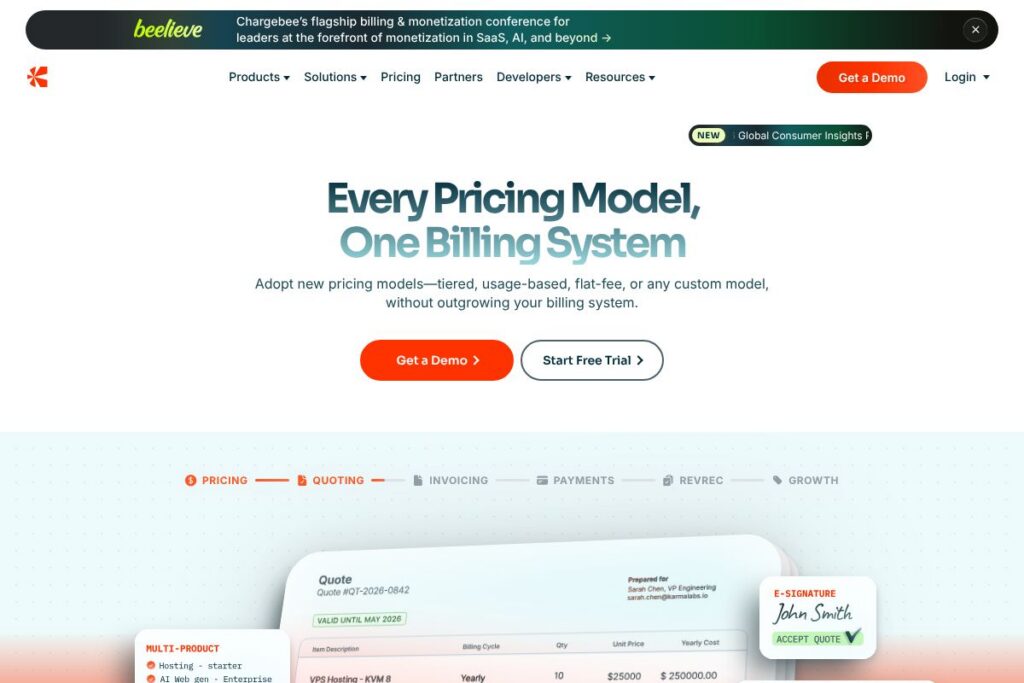
Chargebee: An Overview
Chargebee is a subscription billing and revenue growth platform focused on automating recurring billing, revenue recognition, tax calculation, and retention. It combines a centralized product catalog, flexible pricing engines, and integrated payment and tax handling to help companies launch and scale subscription programs across multiple markets.
Chargebee sits in the same category as platforms such as Zuora, Stripe Billing, and Recurly. Compared with Zuora, Chargebee typically targets a broader range of mid-market customers with faster time to value, while Zuora often fits very large, highly customized enterprise deployments. Compared with Stripe Billing, Chargebee offers more out-of-the-box revenue management and compliance features, while Stripe emphasizes embedded payments and developer-first integrations. Against Recurly, Chargebee provides a wider set of financial controls and advanced revenue recognition features for organizations with complex monetization models.
Chargebee does particularly well at handling mixed pricing models, from fixed plans to usage-based and hybrid approaches, and at integrating invoicing and accounting workflows for audit-ready revenue reporting. This combination makes it suitable for SaaS companies, digital subscriptions, media businesses, and any company shifting to recurring revenue models that need robust billing, tax, and RevRec capabilities.
How Chargebee Works
Chargebee organizes subscription products in a centralized product catalog where teams define plans, tiers, metered usage, add-ons, and entitlements. Changes in the catalog drive invoices, customer entitlements, and downstream reporting, which reduces catalog drift and manual errors across billing and finance.
Customer-facing flows such as checkout, trial onboarding, self-service subscription management, and cancellation screens are configurable to match pricing experiments and sales processes. Payment collection is handled through integrations with 40+ payment gateways, and tax handling is automated for major jurisdictions including EU VAT, US sales tax, and GST, reducing manual tax configuration.
On the finance side, Chargebee automates revenue recognition and ASC 606/IFRS 15 compliant entries, syncs transactions to accounting systems, and provides retention and receivables tools that trigger targeted recovery actions. Developers extend and automate behaviors through a comprehensive API surface, pre-built webhooks, and workflow templates that connect billing events to internal systems.
Chargebee features
Chargebee’s feature set centers on flexible billing models, revenue operations, and integrations that keep finance and product teams aligned. Recent enhancements emphasize RevRec automation, AI-assisted retention during cancellation, and expanded CPQ and quoting capabilities for sales-led deals.
Key functionality includes:
Product catalog
A centralized product catalog stores plans, add-ons, and pricing logic to avoid catalog bloat and support fast iterations. Teams can version offerings and publish changes without touching billing code, which helps product and finance coordinate experiments and launches.
Usage-based billing
Usage-based billing tracks consumption and converts usage into value-based invoices, lowering friction for customers who prefer pay-for-what-you-use models. Metering, rating, and charge aggregation are handled in-platform so finance teams get predictable revenue records.
CPQ and quoting
Chargebee CPQ enables sales to generate accurate quotes with configurable contract terms, durations, and offer validity without engineering support. Quotes can convert to subscriptions and invoices with preserved terms, improving sales cycle speed and reducing manual quote rework.
Entitlements and provisioning
No-code entitlements let product and support teams provision or revoke access tied to subscription state, freeing engineering from repetitive provisioning tasks. This supports trial gating, feature flagging, and staged rollouts tied to billing events.
Checkout and self-service
Customizable checkout and self-service portals let customers subscribe, upgrade, downgrade, and manage payment methods. Built-in localization, multiple currencies, and gateway options support international customers and improve conversion.
Trial and onboarding automation
Trial management automates conversion flows, onboarding emails, and usage-based triggers to surface activation signals and nudge trials toward paid plans. Self-serve upgrades and in-app billing reduce support load and accelerate conversion.
Revenue recognition and RevRec
Built-in revenue recognition automates ASC 606 and IFRS 15 compliant schedules and journal entries, reducing spreadsheet work for finance teams and producing audit-ready reports. Deferred revenue and amortization are handled automatically based on contract terms.
Receivables and recovery
Chargebee Receivables provides segmented recovery workflows, smart retries, and reminder cadences to reduce involuntary churn. Payment failure mitigation and card update flows give each failed payment a chance to recover revenue.
Accounting and analytics integrations
Native connectors sync invoices, payments, credits, and tax details to accounting systems to keep ledgers accurate and simplify month-end close. Subscription analytics and dashboards provide subscription metrics and custom reports for finance and growth teams.
With these capabilities, Chargebee helps teams reduce manual billing work, maintain compliance, and iterate on pricing and packaging quickly while keeping finance systems aligned.
Chargebee pricing
Chargebee uses a SaaS subscription pricing model that is tailored to business size and needs, with plans that scale from growing companies to enterprise deployments. Specific plan tiers and fees are typically customized based on seats, transaction volume, and required modules such as RevRec or CPQ.
For the most up-to-date plan structures and commercial terms, see Chargebee’s pricing and plan information. If you need enterprise-level contracts or add-on modules, the site provides contact paths for sales and customer success to walk through scope and pricing.
What is Chargebee Used For?
Chargebee is used to launch, operate, and scale subscription and recurring revenue businesses. Common uses include implementing flat-rate subscription plans, introducing usage-based pricing, running freemium-to-paid funnels, and managing complex enterprise quotes and renewals.
Product, finance, and growth teams use Chargebee to reduce billing errors, enforce consistent pricing across channels, automate ASC 606-compliant revenue schedules, and run retention campaigns tied to cancellation flows. It is especially useful when organizations need multi-currency billing, tax automation, and predictable accounting integrations.
Pros and Cons of Chargebee
Pros
- Flexible pricing models: Chargebee supports fixed, tiered, per-user, usage, and hybrid pricing, making it easy to experiment and iterate on monetization.
- Strong revenue recognition: Built-in RevRec and ASC 606 workflows reduce manual journal adjustments and simplify audit preparation.
- Comprehensive integrations: Native connectors to accounting systems and 40+ payment gateways keep financial systems synchronized and reduce reconciliation effort.
- Retention and recovery tools: Segmented recovery workflows, intelligent retries, and cancellation-save experiences help reclaim failed payments and reduce churn.
Cons
- Custom pricing for enterprises: Negotiated enterprise pricing means smaller teams may need to engage sales to understand exact costs and available modules. This can delay budget planning for smaller companies.
- Feature depth may be broad but complex: The breadth of functionality adds configuration overhead for teams without dedicated revenue ops or billing specialists.
- Advanced features require implementation: CPQ, RevRec, and complex usage billing often need planning and initial implementation work to align with existing systems and processes.
Does Chargebee Offer a Free Trial?
Chargebee offers a free trial that allows teams to test core subscription and billing flows, experiment with the product catalog, and validate invoicing and payment gateway connections before committing. Trial sign-up is available from the Chargebee homepage and typically includes access to most platform features for evaluation.
Chargebee API and Integrations
Chargebee provides a developer-friendly REST API and SDKs with comprehensive API documentation and an API Explorer for testing endpoints. The API covers customers, subscriptions, invoices, payments, events, and webhooks so engineering teams can automate workflows and integrate billing data into internal systems.
Key integrations include gateways like Stripe, PayPal, and Braintree, accounting systems such as QuickBooks, Xero, and NetSuite, and sales and support platforms like Salesforce and HubSpot. Pre-built workflows and webhooks accelerate integration and reduce time to production.
10 Chargebee alternatives
Paid alternatives to Chargebee
- Zuora — Enterprise-grade subscription and billing platform with deep finance controls for very large subscription businesses.
- Stripe Billing — Developer-first billing and payments suite optimized for embedded payments and simple subscription flows.
- Recurly — Subscription billing and churn management platform focused on reducing involuntary churn and optimizing billing logic.
- Paddle — All-in-one commerce platform that combines billing, taxes, and payments with simplified revenue operations for software vendors.
- Chargify — Recurring billing platform that emphasizes subscription modeling for B2B SaaS businesses and metered billing.
- SaaSOptics — Finance-first subscription management and revenue recognition software targeted at scaling SaaS companies and investors.
- Zoho Subscriptions — Cost-effective subscription billing solution with integrations across the Zoho product suite for small and medium businesses.
Open source alternatives to Chargebee
- Kill Bill — Open source subscription billing and payments platform that provides a modular system for custom billing needs and integrations.
- Invoice Ninja — Self-hosted invoicing and billing software that supports recurring invoices and payment gateway integrations for smaller organizations.
- Solidus — Open source e-commerce platform that can be extended for recurring billing workflows through plugins and custom development.
- Apache OFBiz — An enterprise automation suite with invoicing and billing modules that can be adapted to subscription scenarios with development effort.
Frequently asked questions about Chargebee
What does Chargebee do for subscription businesses?
Chargebee automates subscription billing, revenue recognition, tax handling, and retention workflows. It centralizes product catalogs, supports flexible pricing models, and produces accounting-ready revenue schedules to simplify finance operations.
Does Chargebee integrate with accounting systems like QuickBooks or NetSuite?
Yes, Chargebee provides native integrations with major accounting platforms. These integrations sync invoices, payments, credits, and tax details to keep ledgers accurate and speed up month-end close.
Can Chargebee handle usage-based billing and metered consumption?
Yes, Chargebee supports metered and usage-based billing. It provides metering, rating, and charge aggregation so usage can be converted into invoices without manual intervention.
Is Chargebee compliant with ASC 606 and revenue recognition requirements?
Chargebee offers built-in revenue recognition features for ASC 606 and IFRS 15 compliance. The platform automates recognition schedules and journal entries to reduce spreadsheet work and audit friction.
Does Chargebee have an API for developers?
Yes, Chargebee provides a full REST API and SDKs for popular languages. Developers can use the API documentation and API Explorer to automate billing events and integrate with internal tools.
Final verdict: Chargebee
Chargebee is a comprehensive choice for businesses that need a centralized subscription billing system with strong revenue recognition and retention capabilities. It excels at handling mixed pricing strategies, automating month-end revenue processes, and connecting billing to accounting systems which reduces manual reconciliation work for finance teams.
Compared with Stripe Billing, Chargebee offers deeper out-of-the-box RevRec and CPQ features at the cost of more configuration and potentially higher total contract value for enterprise modules. For teams that prioritize developer-first payment integration and minimal billing complexity, Stripe Billing may be a lighter-weight option; for businesses that require full revenue operations and financial controls, Chargebee provides more specialized tooling and reporting.