Fishbowl: An Overview
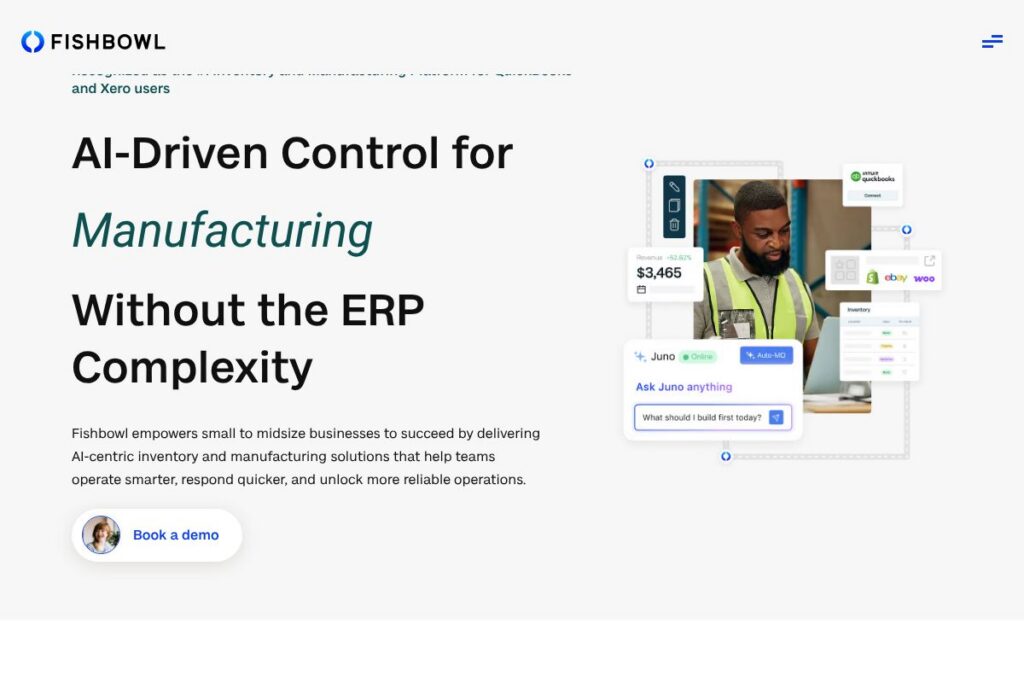
Fishbowl is an inventory and manufacturing platform designed to sit alongside accounting systems such as QuickBooks and Xero, acting as the operational source of truth for inventory, work orders, and production. The platform combines traditional inventory controls with AI-driven replenishment, finite-capacity scheduling, and warehouse management to reduce stockouts and accelerate fulfillment.
Compared with Zoho Inventory and inFlow Inventory, Fishbowl focuses more heavily on manufacturing and finite-capacity planning rather than only order management, which makes it a stronger fit for make-to-order and mixed-mode manufacturers. Against ERP suites like NetSuite, Fishbowl offers narrower scope but faster time to value and lower implementation complexity when the primary need is inventory, BOMs, and production scheduling.
All of this makes Fishbowl particularly strong for businesses that need deep inventory control, traceability, and accounting alignment without undertaking a full ERP rollout. It suits manufacturers, wholesalers, and multichannel merchants that require accurate landed cost accounting, multi-location control, and a single source of truth for inventory tied to QuickBooks or Xero.
How Fishbowl Works
Fishbowl operates as the operational layer that records and manages inventory transactions, while syncing financial postings to QuickBooks or Xero. Typical workflows include receiving and costing inventory, creating purchase orders, converting sales orders into work orders, managing bills of materials, and capturing labor and variance during assembly.
Operational teams interact via Fishbowl’s desktop and mobile apps to scan barcodes, update work order status, and pick and pack shipments. Behind the scenes Fishbowl’s AI analyzes demand and capacity, auto-creates POs and MOs when appropriate, and proposes promise-date adjustments so planners and shop floor staff have actionable instructions without manual spreadsheet work.
What does Fishbowl do?
Fishbowl combines inventory control, manufacturing execution, and warehouse management into a single product that integrates with accounting systems. Core capabilities include AI-guided replenishment, editable BOMs and WOs, traceability by lot and serial, and accounting-first posting to QuickBooks Desktop, QuickBooks Online, and Xero. Recent additions emphasize agentic AI features that auto-generate POs/MOs/WOs, flag margin risks, and suggest corrective actions.
Let’s talk Fishbowl’s Features
Constraint-aware rescheduling
The system evaluates current capacity, lead times, and routing constraints to reroute jobs and update promise dates automatically. This minimizes late work orders by prioritizing tasks that keep revenue-critical orders on schedule and reduces manual rescheduling for planners.
Fishbowl AI assistant
The AI assistant monitors inventory levels, forecasts demand, and surfaces risks such as looming shortages or margin leaks with recommended fixes. Users can ask natural-language questions and receive specific actions like suggested POs, prioritized work orders, or recommended price adjustments.
Auto-create items in bulk
Users can import large catalogs or create items in bulk from BOMs and specifications to accelerate catalog growth and onboarding. This capability reduces manual item setup time and helps companies scale their SKU counts quickly while maintaining consistent cost and accounting mappings.
Editable BOMs and WOs mid-build
BOMs and work orders can be adjusted during production to capture variance or change routings without stopping the line. Real-time updates maintain accurate costing and scheduling while preserving traceability for audits and recalls.
Landed cost accounting and precise QB/Xero posting
Fishbowl calculates landed cost at the SKU and shipment level, allocates landed costs, and posts clean COGS and inventory asset adjustments to QuickBooks or Xero. This prevents margin leakages and simplifies month-end reconciliation.
Mobile work travelers and labor capture
The mobile app supports barcode scanning, lot and serial tracking, and labor/time capture on the shop floor to reduce errors and speeds up shipping accuracy. Mobile-driven tasks reduce guesswork and allow faster, more reliable fulfillment across locations.
Traceability and recall reporting
Lot, serial, and expiry tracking produce one-click recall reports that compress audit time from days to minutes. Traceability supports regulatory compliance and fast customer response in case of product quality issues.
The biggest benefit is the alignment of operations and finance: Fishbowl reduces manual reconciliation, enforces traceability, and applies AI to keep inventory and production flowing while protecting margins.
Fishbowl pricing
Fishbowl uses a subscription model with pricing tailored to deployment type, modules selected, and the size of the operation. Expect per-user and per-module licensing options with additional services for implementation and data migration.
Because Fishbowl does not publish standard list prices publicly, contact sales or review the vendor’s current pricing options to request a custom quote or ask about packaging for manufacturing, warehouse, and AI add-ons.
What is Fishbowl Used For?
Fishbowl is used to centralize inventory control, production planning, and fulfillment for businesses that need reliable stock levels and production schedules across multiple locations. Typical use cases include make-to-stock and make-to-order manufacturers, distributors managing multiple warehouses, and ecommerce companies that require tight integration between sales channels and accounting.
Operational teams rely on Fishbowl to reduce stockouts, speed up cycle counts, and automate repetitive tasks like PO creation and BOM updates. Finance teams use Fishbowl to ensure that inventory valuations, landed costs, and COGS post correctly to QuickBooks or Xero for faster closes and cleaner books.
Pros and cons of Fishbowl
Pros
- Accounting-first inventory: Fishbowl posts accurate inventory and COGS entries to QuickBooks and Xero, which reduces reconciliation work and supports GAAP-compliant closes. These tighter finance workflows help accountants close books faster and with fewer adjustments.
- Manufacturing capability: The platform supports editable BOMs, work orders, finite-capacity scheduling, and labor capture, making it suitable for complex production environments. This functionality is more advanced than pure inventory systems that lack manufacturing features.
- Agentic AI automation: Fishbowl’s AI can auto-create POs/MOs/WOs and recommend corrective actions, which reduces manual planning effort and improves on-time delivery. Customers report measurable improvements in stock optimization and fulfillment accuracy.
- Traceability and mobile execution: Lot and serial control, expiry tracking, and a mobile app improve recall readiness and speed up picking and packing. Real-time mobile updates reduce errors on the warehouse floor.
- Implementation and support: In-house implementation and responsive phone and chat support keep onboarding closer to Fishbowl’s product team and reduce reliance on third-party consultants.
Cons
- Custom pricing and quotes: Because pricing is tailored, smaller buyers may need to talk to sales to understand total cost, which can slow initial evaluation. This model requires engagement with the vendor rather than immediate self-service pricing.
- Learning curve for advanced features: Finite-capacity scheduling and manufacturing modules introduce complexity that requires planner training and process definition to fully leverage. Smaller businesses with simple needs may find some features more than they require.
- Integration setup for complex stacks: While integrations with QuickBooks and Xero are strong, connecting customized ecommerce, 3PL, or CAD workflows may require configuration work and testing to ensure accurate mappings.
Does Fishbowl Offer a Free Trial?
Fishbowl offers demos and limited trial access by request. Prospective customers can schedule a product demo, request a return-on-investment analysis, and ask for trial or sandbox access during implementation so they can validate workflows before going live.
Fishbowl API and Integrations
Fishbowl provides integration points for accounting and operational systems, and it connects directly to QuickBooks Desktop, QuickBooks Online, and Xero for automatic posting and reconciliation. The platform also integrates with ecommerce platforms, shipping providers, 3PLs, Avalara for tax, and CAD systems like SolidWorks to import BOMs.
For developers and IT teams, Fishbowl offers integration documentation and partner APIs to synchronize orders, inventory, and manufacturing transactions; see Fishbowl’s integration resources for developer guides and connector options. For accounting-specific references, explore QuickBooks’ integration guidance and Xero’s developer documentation when planning a sync architecture.
10 Fishbowl alternatives
Paid alternatives to Fishbowl
- Zoho Inventory — Cloud inventory and order management aimed at small businesses, with native multichannel and shipping integrations and a lower-cost entry point than manufacturing-focused platforms.
- Cin7 — A unified inventory, POS, and B2B order management system that scales well for retailers and wholesalers with integrated ecommerce and 3PL connectivity.
- inFlow Inventory — Desktop and cloud inventory management built for small businesses and light manufacturing, with strong barcode and order workflows.
- NetSuite — A full ERP that includes inventory, manufacturing, and financials, suitable for enterprises that need a comprehensive, end-to-end system and can manage a longer implementation.
- Odoo (Enterprise) — A modular suite that includes inventory, manufacturing, and ecommerce apps with flexible customization and a larger partner ecosystem.
- Acumatica — Cloud ERP with strong manufacturing and distribution features, built for midsize businesses that want an integrated financial and operational platform.
- Sage 100cloud — Traditional midmarket ERP with inventory and manufacturing modules, used by companies that require on-premises or hybrid deployments.
Open source alternatives to Fishbowl
- ERPNext — Open source ERP with inventory and manufacturing modules, suitable for companies that want full source access and self-hosting options.
- OpenBoxes — A supply chain and inventory management system focused on healthcare and humanitarian logistics, available under an open source license.
- Dolibarr — An open source ERP/CRM with inventory and stock management features, often used by small businesses looking for a low-cost, customizable solution.
- Odoo Community — The open source community edition of Odoo that provides basic inventory and manufacturing capabilities for organizations that can self-host and extend the platform.
Frequently asked questions about Fishbowl
Does Fishbowl integrate with QuickBooks and Xero?
Yes, Fishbowl integrates with QuickBooks Desktop, QuickBooks Online, and Xero. Inventory movements, purchase orders, and cost postings sync to your accounting system to keep books aligned with operations.
Can Fishbowl handle multi-location inventory?
Yes, Fishbowl is built to support multiple warehouses and locations. It provides centralized visibility, transfer transactions, and per-location stock control for distributed operations.
Is Fishbowl suitable for manufacturing operations?
Yes, Fishbowl provides manufacturing features such as BOMs, work orders, and finite-capacity planning. These tools help capture labor, material variance, and routing information during production.
Does Fishbowl offer AI-driven replenishment?
Yes, Fishbowl includes AI-driven forecasting and replenishment features. The AI suggests vendor-aware purchase orders, flags potential shortages, and prioritizes work that preserves margins and delivery dates.
How does Fishbowl handle landed costs and accounting?
Fishbowl calculates landed cost at SKU and shipment levels and posts accurate COGS to accounting. Landed-cost allocation and precise mapping to QuickBooks or Xero reduce month-end adjustments and protect margins.
Final Verdict: Fishbowl
Fishbowl stands out for tying operational inventory and manufacturing workflows directly to accounting systems, giving both operations and finance a common source of truth. Its strength lies in editable BOMs, finite-capacity scheduling, lot and serial traceability, and AI-driven replenishment that reduces manual planning and improves on-time delivery.
Compared to a full ERP like NetSuite, Fishbowl delivers faster implementations and a more focused set of manufacturing and warehouse features at lower operational complexity, but it requires integration with QuickBooks or Xero for financials. If you want a complete ERP that includes native finance, NetSuite may be a better fit; if your priority is advanced inventory and production control with tight QuickBooks or Xero alignment, Fishbowl is a practical choice.
For pricing, packaging, or to request a demo and ROI analysis, review Fishbowl’s product and contact options to discuss your specific needs and deployment timeline.