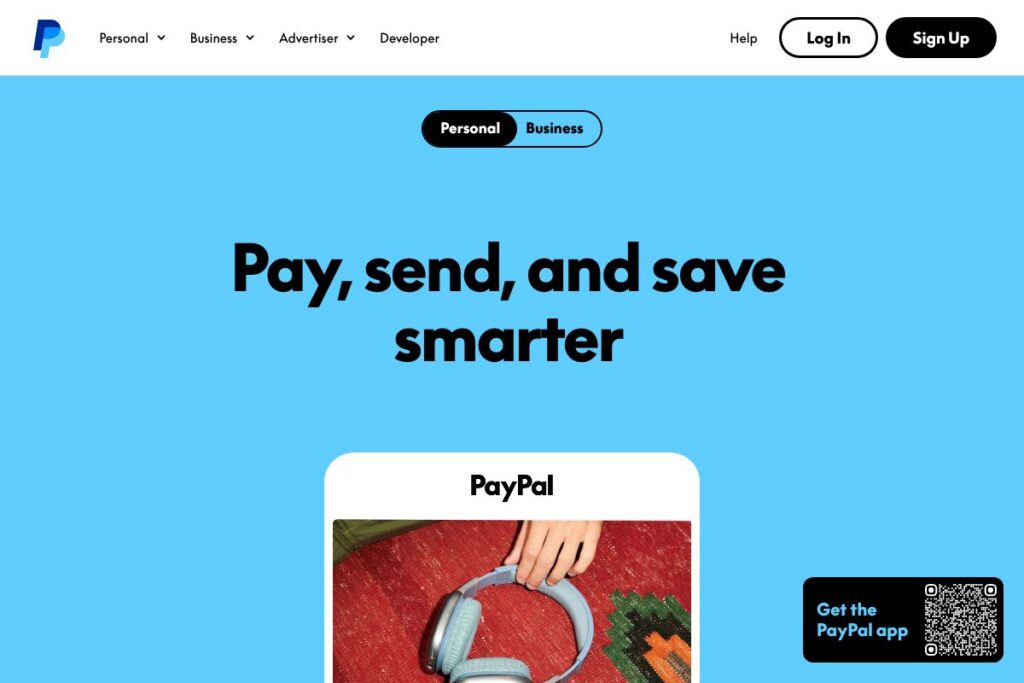

PayPal: An Overview
PayPal is a digital payments platform that lets individuals and businesses send and receive money, pay for goods and services, and manage balances in a mobile app and web interface. The service combines peer-to-peer transfers, merchant checkout, a debit card that supports tap-to-pay, and optional cryptocurrency trading in one account. Users can fund transactions with bank accounts, cards, or PayPal balances and move funds between those sources.
Compared with competitors, PayPal sits between consumer-focused peer-to-peer apps like Venmo and merchant-first processors such as Stripe. Unlike Square, which bundles point-of-sale hardware and merchant accounts, PayPal emphasizes online checkout and buyer protections while also offering in-person tap-to-pay via the PayPal Debit Card and partner card readers. For casual users who want both person-to-person transfers and mainstream merchant acceptance, PayPal tends to be more feature-complete than single-purpose wallets.
PayPal does particular well at ubiquity and convenience: it is accepted by many online stores, integrates with marketplaces like eBay, and includes consumer protections and refund pathways for purchases. That combination makes it a sensible choice for individuals who want one app for sending money, shopping, and exploring crypto, and for small merchants who need straightforward checkout and invoicing tools.
How PayPal Works
Accounts act as a digital wallet where users can add bank accounts, debit or credit cards, and hold PayPal balances. When you send money or check out, PayPal chooses funding sources based on your preferences and the merchant’s settings, and performs the transfer without exposing your full financial details to the recipient.
For purchases online, merchants integrate PayPal Checkout to accept payments; customers authenticate and complete checkout inside PayPal or via one-touch methods in the PayPal app. For in-person spending, the PayPal Debit Card supports tap-to-pay and links to your PayPal balance, letting you earn and redeem rewards when available. Peer-to-peer transfers are initiated from the app using an email, phone number, or username, and can be funded from balance, bank, or card depending on the transfer type.
What does PayPal do?
PayPal groups its core capabilities around payments, account balances, merchant services, and optional cryptocurrency trading. Recent app updates emphasize in-app shopping, reward-earning via the PayPal Debit Card, and easier crypto purchases while keeping security controls and transaction privacy visible to users.
Tap-to-pay with PayPal Debit Card
The PayPal Debit Card enables in-store tap-to-pay using funds from your PayPal balance and supports earning rewards on eligible purchases; it works where contactless cards are accepted and ties directly to your account for immediate access to funds. Linking the card is managed through the app and the card’s transaction activity appears in your PayPal history for reconciliation.
Cash back and rewards
PayPal offers reward programs tied to checkout and its debit card, allowing users to earn and roll cash back into their PayPal balance to increase future earnings. Rewards are applied to the PayPal balance so users can spend cash back immediately online or withdraw to linked bank accounts when allowed.
Peer-to-peer transfers
Send money to friends and family using names, phone numbers, or emails with instant or standard transfer options depending on your funding source; transfers between people can be free when using a bank account or PayPal balance, while card-funded transfers may incur fees. The app provides simple splitting, request, and refund workflows for casual payments.
PayPal balances and bank custody
PayPal balances can hold customer funds that are FDIC-insured when held at partner banks such as Synchrony Bank, subject to the partner bank’s FDIC coverage; PayPal itself is not a bank. The app explains custodial arrangements in account disclosures and presents options to move funds to external bank accounts or request a card-linked withdrawal.
Cryptocurrency buying, selling, and transfers
PayPal supports buying, selling, and transferring a selection of cryptocurrencies directly in the app, with in-app interfaces for market orders and simple holdings management. Crypto holdings are treated separately from PayPal balances, are not FDIC-insured, and may be subject to conversion fees and spreads; the app highlights those distinctions during purchase flows and links to more details on crypto protections.
Merchant payments, invoicing, and checkout
Merchants can accept PayPal Checkout online, use PayPal-branded invoicing, and integrate order processing and payouts; merchant-facing dashboards show sales, chargebacks, and payout schedules. These tools suit small and mid-sized sellers who want fast onboarding and a checkout option recognizable to consumers.
Security and privacy controls
PayPal encrypts payment data and limits the information merchants see, reducing the exposure of full card or bank details. The app offers password, biometric login options, transaction alerts, and dispute workflows that help users track unauthorized activity and request refunds for eligible purchases.
With this mix of features, PayPal is strongest as an all-purpose payments hub that blends consumer convenience with merchant acceptance and basic crypto functionality.
PayPal pricing
PayPal uses a fee-based model for certain types of transactions while many consumer account activities are free. Personal accounts have no recurring subscription, but merchant services and some instant transfers carry transaction fees; rates vary by region, transaction type, and funding source. For complete, transaction-specific fee schedules consult PayPal’s official merchant and fees pages.
Consumer accounts
Most core consumer actions such as creating an account, buying with a linked bank account, and receiving money from friends and family using a bank transfer are free, though funding with a credit or debit card for person-to-person transfers may incur a fee. Instant transfers to a linked debit card typically have an associated fee; check the consumer fees and transfer options for the latest amounts.
Merchant processing fees
Online merchant transactions are charged per-transaction processing fees, commonly expressed as 2.9% + $0.30 for standard domestic card payments, with different rates for international sales and micropayments. Volume discounts, alternate rates for micropayments, and PayPal Here or Zettle reader plans may alter the effective cost; merchants should review the merchant fee schedule for specifics.
Other fees
Additional fees may apply for chargebacks, cross-border payments, currency conversions, and certain withdrawals or currency transfers; cryptocurrency purchases include conversion spreads and may include service fees. For precise, current fee figures and regional differences, consult PayPal’s fees and rates documentation.
What is PayPal used for?
PayPal is commonly used for online purchases, sending money to friends and family, receiving payments for goods and services, and managing small business transactions. Consumers use it as a checkout option at merchants, to send gift payments, and to hold a balance for quick purchases.
Small merchants and marketplaces use PayPal for embedded checkout, recurring billing, and invoicing, while developers embed PayPal SDKs to accept payments without handling card data directly. Individuals curious about crypto also use the PayPal app for simple buy and sell flows without needing a separate exchange.
Pros and cons of PayPal
Pros
- Wide merchant acceptance: PayPal is accepted by a large number of online stores and marketplaces, making it a convenient checkout choice for many shoppers.
- Multiple payment modes: The platform supports bank transfers, card funding, PayPal balances, a debit card, and crypto purchases, offering flexibility for users.
- Buyer protections and dispute tools: Built-in purchase dispute and refund workflows help consumers address unauthorized or problematic transactions.
Cons
- Fee complexity for merchants: PayPal’s fees vary by transaction type, cross-border status, and funding source, which can be confusing and increase costs for sellers.
- Customer service variability: Some users report inconsistent experiences when resolving disputes or accessing account support, particularly for large or complex cases.
- Not a bank: PayPal is not a bank; FDIC insurance applies only to funds held by partner banks, and crypto holdings are not insured and can lose value.
Does PayPal Offer a Free Trial?
PayPal offers a free account that consumers can create at no cost; most standard consumer features such as sending money from a linked bank account and making purchases are free to start. Merchant services do not have a free trial in the traditional sense but offer pay-as-you-go processing where fees are deducted per transaction; check the merchant onboarding pages for promotional offers that occasionally apply.
PayPal API and Integrations
PayPal provides developer APIs and SDKs for checkout, payments, subscriptions, and payouts; the PayPal Developer documentation includes REST API reference, SDKs, and sandbox testing tools for integration. Popular integrations include e-commerce platforms and marketplaces where PayPal Checkout and PayPal Payments Standard are available as plug-and-play options.
The platform also connects with accounting, CRM, and invoicing tools through native integrations and third-party connectors, making it possible to automate reconciliation and reporting for merchant accounts.
10 PayPal alternatives
Paid alternatives to PayPal
- Stripe — A developer-first payments processor with flexible APIs, subscription billing, and global card acceptance; widely used by online businesses and marketplaces.
- Square — Combines point-of-sale hardware, payments, and merchant services for in-person and online sellers, with an emphasis on local retail and food businesses.
- Venmo — Consumer peer-to-peer app with social feed and merchant acceptance for mobile checkout, owned by PayPal but targeted at casual transfers.
- Zelle — Bank-backed peer-to-peer transfer network focused on instant bank-to-bank transfers between participating US banks.
- Apple Pay — Mobile wallet for in-app and contactless payments on Apple devices with tokenized card handling for privacy and security.
- Google Pay — Wallet and checkout solution for Android users that supports in-app, web, and contactless payments with stored cards and offers.
- Amazon Pay — Checkout option that leverages Amazon account credentials and payment methods to streamline purchases on third-party sites.
Open source alternatives to PayPal
- BTCPay Server — A self-hosted payment processor for Bitcoin and Lightning payments, oriented toward merchants who want full control and no third-party fees.
- Kill Bill — Open-source billing and payment orchestration platform for subscription businesses that want a customizable billing core.
- Solidus — Open-source e-commerce framework with payment gateway integrations useful for merchants building custom storefronts.
- GNU Taler — A privacy-preserving electronic payment system focused on online merchant payments with strong anonymity guarantees for payers.
Frequently asked questions about PayPal
What is PayPal used for?
PayPal is used for sending and receiving money, paying merchants online, and managing a digital balance. It supports peer-to-peer transfers, merchant checkout, debit card spending, and optional crypto trading inside the app.
How much does PayPal charge merchants?
Merchant fees vary by transaction but commonly include a per-transaction processing rate such as 2.9% + $0.30 for standard domestic card payments. International transactions, micropayments, and currency conversions have separate rates; review PayPal’s merchant fee schedule for details.
Does PayPal offer cryptocurrency services?
Yes, PayPal allows buying, selling, and transferring selected cryptocurrencies within the app. Crypto holdings are not FDIC-insured and are subject to market risk and conversion fees.
Can I move my PayPal balance to my bank account for free?
You can transfer balances to a linked bank account, and standard ACH transfers are typically free while instant transfers to cards carry a fee. Transfer timing and fees depend on the method chosen and your bank.
Does PayPal provide APIs for developers?
Yes, PayPal offers a comprehensive developer platform with REST APIs and SDKs for payments, subscriptions, and payouts. The PayPal Developer documentation provides guides, sandbox keys, and API references for integration.
Final Verdict: PayPal
PayPal excels as a broad, consumer-friendly payments platform that combines peer-to-peer transfers, merchant checkout, a debit card with rewards, and simple crypto access in one app. Its ubiquity and buyer protections make it convenient for shoppers and casual sellers, while merchant tools and APIs support small businesses and developers who need quick integration.
Compared with Stripe, which is more developer-focused and offers highly customizable merchant infrastructure, PayPal is stronger on consumer adoption and ease of use for buyers; pricing for standard online card processing is comparable at around 2.9% + $0.30 per transaction, but Stripe often positions more advanced developer features and flexible billing models for enterprises. For most consumers and small merchants who want wide acceptance and simple onboarding, PayPal provides a balanced set of capabilities without subscription fees, while businesses with complex billing needs may prefer Stripe’s developer-centric tooling.