
What is Bonsai
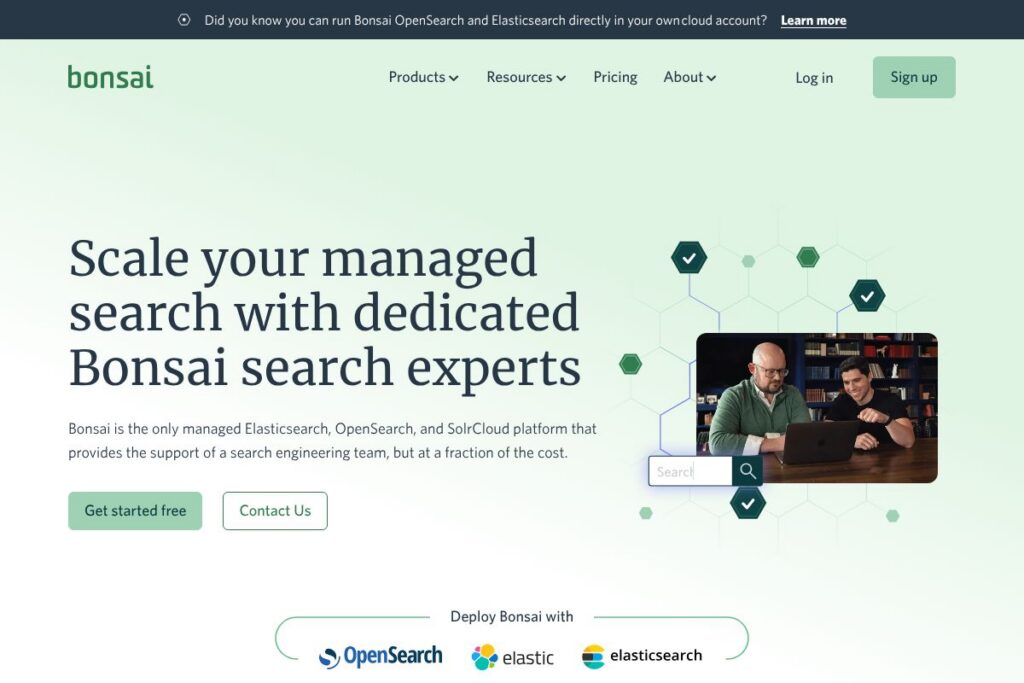
Bonsai is a fully managed hosting service for Elasticsearch and OpenSearch designed to operate production search clusters on behalf of customers. The service focuses on deployment, ongoing maintenance, proactive monitoring, backups, and security so engineering teams can rely on a managed search platform rather than managing clusters themselves.
Bonsai positions itself between self-hosted solutions and cloud vendor managed services by combining API and protocol compatibility with hands-on engineering support. Compared with Elastic Cloud, which is the vendor-hosted offering from Elastic, Bonsai emphasizes personalized operational support and playbooks rather than just platform access. Compared with Amazon OpenSearch Service, Bonsai offers a smaller, specialist provider experience with direct cluster-level expertise and tailored operational practices. Compared with more general log and observability vendors like Logz.io, Bonsai is focused specifically on search stack operations and long-term cluster health.
All of this makes Bonsai especially appropriate for engineering teams that need reliable, secure search infrastructure and prefer to outsource cluster operations to experienced search engineers. It is a practical choice for product and data teams that want Elasticsearch or OpenSearch protocol compatibility without the overhead of DevOps for search clusters.
How Bonsai Works
Bonsai provisions and manages Elasticsearch or OpenSearch clusters on behalf of customers, handling lifecycle activities such as version upgrades, security patching, snapshot backups, and performance tuning. Users interact with clusters through standard Elasticsearch/OpenSearch APIs, so existing clients and tooling continue to work without changes.
Operational responsibilities include 24/7 monitoring, alerting for cluster health and performance, automated backups, and capacity planning. Bonsai engineers also provide tailored playbooks and hands-on support, troubleshooting query performance, index design, and node-level issues to reduce downtime and operational toil.
In practice teams integrate applications by pointing their search client to Bonsai-managed endpoints, then use Bonsai for everything from initial cluster sizing to rolling upgrades. For dashboards and visual analysis you can pair Bonsai clusters with Kibana or OpenSearch Dashboards depending on the chosen engine.
Bonsai features
Bonsai packages managed cluster operations, data protection, and expert support into a single service for Elasticsearch and OpenSearch workloads. Core capabilities center on managed deployments, proactive maintenance, and operational guidance derived from long-term cluster management experience.
Managed Elasticsearch and OpenSearch
Bonsai runs, patches, and upgrades clusters so teams do not need to manage node lifecycle or compatibility details. This reduces operational risk and frees engineering time while keeping API compatibility with Elasticsearch and OpenSearch clients and plugins.
Monitoring and alerting
Built-in monitoring tracks node health, JVM, disk usage, and query latency, with proactive alerts sent to customers and operations staff. This continuous monitoring helps detect hot shards, slow queries, and resource contention before they cause service interruptions.
Automated snapshots and backups
Regular, automated snapshots provide recoverability for indices, enabling point-in-time restores and disaster recovery workflows. Snapshot schedules and retention can be configured to meet recovery objectives and compliance requirements.
Security and access controls
Bonsai applies security best practices such as TLS for transport and endpoint connections, role-based access controls, and network isolation options. The service supports secure authentication methods and can integrate with customer access policies to limit cluster access.
Expert, on-demand support
Customers get access to experienced search engineers for troubleshooting, index design reviews, and performance tuning. Bonsai supplies playbooks and operational recommendations based on managing many clusters across use cases and industries.
Scaling and capacity planning
Clusters can be resized and rebalanced as data volume and query load changes, with engineering guidance to optimize shard layout and index lifecycle management. This helps teams avoid resource waste and maintain predictable performance under growth.
With these capabilities, Bonsai’s biggest benefit is operational certainty: teams get production-ready search infrastructure backed by experienced engineers so they can focus on product features and relevance rather than node operations.
Bonsai pricing
Bonsai uses custom pricing that is typically tailored to cluster size, data volume, feature needs, and service level requirements rather than fixed public tiers. This enterprise-oriented approach allows pricing to reflect specific operational SLAs, backup requirements, and support expectations.
For the most accurate, up-to-date information on plans and cost estimates, visit the Bonsai homepage to contact sales or request a quote. Their team can provide pricing aligned to your cluster sizing, ingestion patterns, and required support level.
What is Bonsai Used For?
Bonsai is used to run production search clusters without maintaining search infrastructure in-house, covering use cases such as site search, product search, log search, analytics, and recommendation engines. Teams that need consistent search performance and data protection rely on Bonsai to handle the operational aspects of search.
It is also well suited for companies that want to stay on Elasticsearch or OpenSearch APIs while avoiding the daily maintenance tasks and learning curve associated with running distributed search nodes. Product teams, data engineers, and SREs use Bonsai to shorten time to production and reduce incident triage related to cluster operations.
Pros and cons of Bonsai
Pros
- Operational expertise: Bonsai provides hands-on engineer support and playbooks, reducing time spent on cluster maintenance and troubleshooting.
- Protocol compatibility: Managed clusters support Elasticsearch and OpenSearch APIs, allowing existing clients and tools to function unchanged.
- Proactive maintenance: Automated monitoring, backups, and performance tuning reduce the risk of outages and data loss.
- Security focus: TLS, access controls, and operational best practices help teams meet security and compliance requirements.
Cons
- Custom pricing model: Pricing is tailored and not published as simple tiers, which can make initial cost comparison harder for small teams evaluating options.
- Vendor specialization: Bonsai focuses on search stack management rather than a broader observability or logging product set, which may require additional tooling for full observability pipelines.
- Less transparent capacity pricing: Without public plan definitions, customers must engage sales for exact sizing and cost projections, adding a step to evaluation.
Does Bonsai Offer a Free Trial?
Bonsai offers demos and trial access on request rather than a public freemium plan. Prospective customers typically request a demo or temporary evaluation cluster through the Bonsai homepage to validate performance, integrations, and operational workflows before committing to a managed plan.
Bonsai API and Integrations
Bonsai exposes standard Elasticsearch and OpenSearch endpoints so any client or integration built for those APIs will work with Bonsai-managed clusters. The service leverages the same REST and transport APIs that Elasticsearch and OpenSearch provide, preserving application compatibility.
Integrations commonly used with Bonsai include visualization and analytics tools like Kibana and OpenSearch Dashboards, ingest pipelines using Logstash, Beats, or Fluentd, and downstream observability tools. For protocol and client specifics, consult the Elasticsearch documentation or the OpenSearch documentation.
10 Bonsai alternatives
Paid alternatives to Bonsai
- Elastic Cloud — Official managed Elasticsearch and Elastic Stack hosting from Elastic with direct vendor support and integrated observability features.
- Amazon OpenSearch Service — Cloud-native managed OpenSearch and legacy Elasticsearch service from AWS with deep cloud integrations and scalability options; see the Amazon OpenSearch Service documentation.
- Qbox — Managed Elasticsearch hosting with cluster operations and support tailored to production search workloads.
- Logz.io — Observability platform offering managed Elasticsearch-based stacks combined with logging and monitoring features.
- SearchStax — Managed search hosting and search optimization services with focus on reliability and specialized support.
Open source alternatives to Bonsai
- Elasticsearch — The open source search engine you can self-host for full control over configuration, upgrades, and operations.
- OpenSearch — A community-driven fork of Elasticsearch and Kibana providing a self-hosted search and analytics stack.
- Meilisearch — Lightweight, open source search engine focused on fast, relevant out-of-the-box search for product and site search use cases.
- Typesense — Open source, developer-friendly search engine designed for instant, typo-tolerant search experiences.
Frequently asked questions about Bonsai
What is Bonsai used for?
Bonsai is used to run production Elasticsearch and OpenSearch clusters without in-house operations. Teams use it to handle deployment, maintenance, backups, and performance tuning for search workloads.
Does Bonsai support OpenSearch?
Yes, Bonsai supports OpenSearch as well as Elasticsearch-compatible clusters. That lets teams choose the engine that fits their use case while keeping API compatibility.
How does Bonsai handle backups and restores?
Bonsai provides automated snapshots and backup routines managed by their operations team. These snapshots enable point-in-time restores and support disaster recovery workflows.
Does Bonsai provide an API for cluster management?
Bonsai exposes standard Elasticsearch and OpenSearch APIs for data and query operations. Cluster-level management and operational controls are handled by the Bonsai support team and management plane.
How is Bonsai priced?
Bonsai uses custom, tailored pricing rather than public fixed tiers. To get a cost estimate based on cluster size and support needs, request a quote via the Bonsai homepage.
Final verdict: Bonsai
Bonsai stands out for turning Elasticsearch and OpenSearch operations into a managed, support-driven service. Its strength is operational expertise: customers gain proactive monitoring, backups, and direct engineer access that reduce the burden of running distributed search infrastructure in production.
Compared with Elastic Cloud, which offers first-party hosting and usage-based pricing, Bonsai emphasizes hands-on operational support and customized management rather than a purely self-service platform. If you value expert engineering support and a managed operational relationship, Bonsai is a strong fit; if you prefer vendor-first tooling with transparent usage pricing, you may want to evaluate Elastic Cloud alongside Bonsai.
Overall, Bonsai is a good choice for teams that need production-grade search with predictable operations and access to search specialists, especially when maintaining internal SRE capacity for search is not desirable.