
Trullion: An Overview
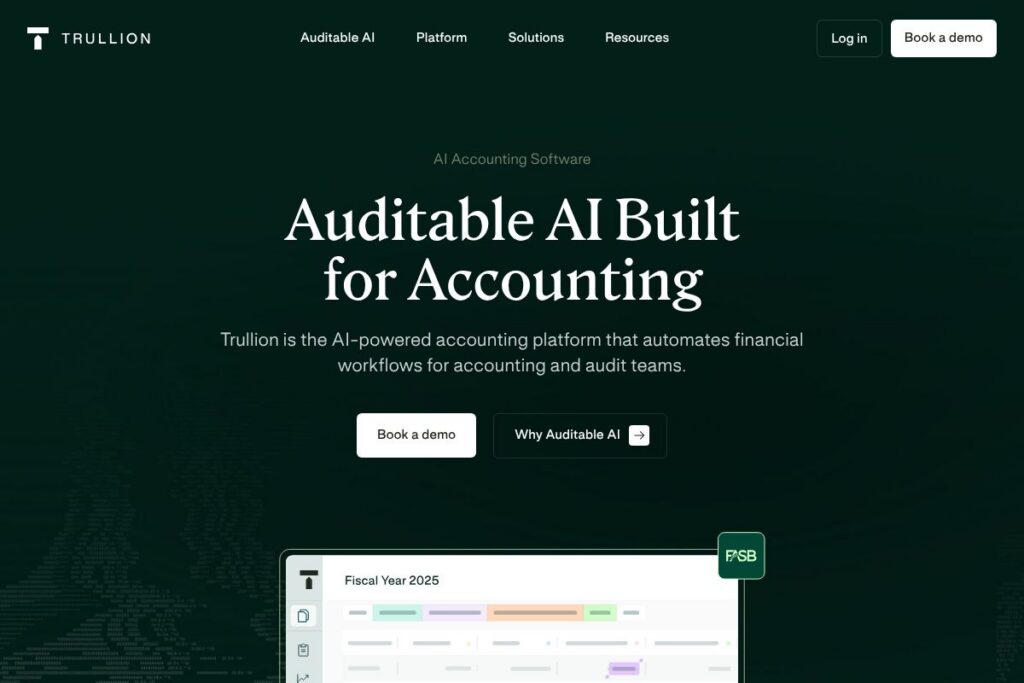
Trullion is an accounting-focused AI platform designed to automate document extraction, lease accounting, and audit workflows while maintaining traceability to source documents. The product combines an always-on assistant called Trulli, a real-time knowledge layer, and workflow tooling to reduce manual tasks and provide audit-ready outputs. Explore Trullion’s product pages for feature details and platform capabilities on the official site.
Compared with established financial control and audit platforms, Trullion emphasizes domain-specific AI and source-grounded outputs. BlackLine focuses primarily on account reconciliations and close management, while Trullion focuses on extracting structured data from contracts and creating auditable accounting entries. Workiva provides broad reporting, compliance, and workbook consolidation; Trullion complements those areas by automating underlying extraction and lease accounting that feed reporting systems. Sage Intacct and other ERPs provide transactional ledgers; Trullion sits above those ledgers to bring document intelligence and audit traceability into accounting processes.
All of this makes Trullion particularly well suited for accounting and audit teams that need explainable AI outputs tied to source documents, especially for lease accounting, contract-heavy processes, and external audit collaboration. Organizations looking to reduce manual journal entry work while preserving an auditable trail will find Trullion most relevant.
How Trullion Works
Trullion ingests accounting and contract documents from cloud storage, ERPs, and email, then uses AI to extract key terms, dates, and monetary amounts. Extracted data is mapped to accounting standards and configurable workflows that generate suggested journal entries, disclosures, and ledger adjustments.
The platform surfaces provenance for every extraction so users and auditors can trace values back to original files. Teams can review, adjust, and approve proposed entries within the platform, and outputs can be pushed to general ledgers or exported for reporting. The Trulli assistant helps surface patterns, answer documentation questions, and speed review by highlighting inconsistencies across documents.
Trullion features
Trullion’s core capabilities center on document intelligence, audit-ready automation, and a governed knowledge layer that applies accounting rules and standards. The platform recently emphasized agentic AI workflows, expanded lease accounting automation, and a tighter audit fieldwork suite to support auditor collaboration and traceability.
AI Document Extraction
Trullion automatically extracts structured data from unstructured contracts and supporting documents using models trained on accounting language. This reduces manual data entry and captures lease terms, payment schedules, and clauses that drive accounting treatment.
Lease Accounting Automation
The platform applies accounting rules to extracted lease terms and generates suggested journal entries, amortization schedules, and disclosure components. Centralized handling of lease accounting helps maintain consistency across leases and supports ASC 842 and IFRS 16 workflows.
Trulli Assistant
Trulli is an always-on assistant that surfaces answers, flags anomalies, and connects related documents in seconds. It accelerates review cycles by summarizing document contents and pointing users to the specific evidence behind an accounting decision.
Knowledge Layer and Guardrails
Trullion unifies internal policies, external accounting standards, and institution-specific guidance into a knowledge layer that informs automation decisions. This centralized logic helps enforce consistency and reduces reliance on individual judgment without oversight.
Audit Fieldwork and Collaboration
The audit fieldwork suite provides tools for auditors to review extractions, reconcile amounts, and annotate evidence while maintaining an auditable trail. These collaboration features reduce back-and-forth with external auditors and document review time.
Data Lineage and Traceability
Every data point generated by Trullion links back to source documents with timestamps and reviewer actions. That lineage supports auditability, internal controls testing, and faster responses to audit inquiries.
Integrations and Export Options
Trullion integrates with common ERPs, cloud storage providers, and reporting tools to push reconciled entries and exports into downstream systems. Integration options simplify deployment and reduce the need for manual CSV workflows.
With these capabilities, Trullion reduces repetitive accounting work while preserving transparency. The biggest benefit is auditable automation that keeps decisions grounded in source documentation and institutional controls.
Trullion pricing
Trullion uses an enterprise SaaS pricing model with custom plans tailored to organizational scope, compliance needs, and deployment preferences. Pricing is not published as standard list tiers; instead, Trullion scopes solutions by features, user seats, and integration needs.
For exact pricing and to discuss deployment options, contact Trullion’s sales team or request a tailored quote via the enterprise contact page. The team can outline deployment models, implementation timelines, and any professional services required for migration and controls alignment.
What is Trullion Used For?
Trullion is commonly used to automate lease accounting, extract contract data for financial records, and support audit fieldwork with traceable evidence. Accounting teams use it to reduce manual journal creation, standardize treatment across similar contracts, and speed monthly close activities.
Audit teams and external auditors use Trullion to review documented evidence, run consistency checks across populations of contracts, and perform substantive testing with direct links to source documents. Finance operations teams adopt the platform to reduce error-prone spreadsheet workflows and to centralize institutional knowledge about accounting treatments.
Pros and Cons of Trullion
Pros
- Purpose-built accounting AI: Trullion focuses on accounting and audit workflows, which makes its models and outputs aligned with accounting standards and professional practice.
- Auditable outputs: Every extraction and suggested entry links back to source documents, which helps with external audit requests and internal control testing.
- Lease accounting coverage: The platform automates lease extraction, calculation, and disclosure generation, reducing manual effort for ASC 842 and IFRS 16 work.
- Integrated knowledge layer: Institutional policies and external standards can be centralized to ensure consistent application of accounting treatments across teams.
- Collaboration tools for auditors: Built-in audit fieldwork tools reduce the friction between preparers and auditors and improve review efficiency.
Cons
- Enterprise-oriented pricing: The platform is positioned for medium to large organizations, which can make entry costs higher for small finance teams.
- Implementation and change management: Deploying domain-specific AI and integrating with ERPs requires project effort and governance to align controls and workflows.
- Narrower scope than full ERPs: Trullion complements ledgers and reporting systems rather than replacing a full ERP, so organizations must maintain integration and data flows.
Does Trullion Offer a Free Trial?
Trullion offers custom enterprise plans and does not publish a public free plan or trial. Prospective customers can request a demo and a tailored pilot through Trullion’s contact pages to evaluate capabilities against internal datasets and workflows.
Trullion API and Integrations
Trullion provides integration options to connect with ERPs, cloud storage, and reporting systems so extracted data and journal entries can flow into downstream finance systems. For integration details and developer resources, review Trullion’s integration and platform documentation on the product pages.
Where API access is required for automation or custom workflows, Trullion’s implementation team typically scopes connections as part of onboarding and can provide endpoints or connectors based on the deployment model. Contact the team to discuss specific ERP connectors and automation needs via the enterprise contact page.
10 Trullion alternatives
Paid alternatives to Trullion
- Workiva — Collaborative reporting and compliance platform that centralizes disclosures and streamlines control evidence for financial reporting.
- BlackLine — Focuses on account reconciliations, close automation, and financial controls with strong reconciliation and task management capabilities.
- Sage Intacct — Cloud financial management system with core accounting, lease management add-ons, and extensibility for midmarket finance teams.
- Oracle Cloud ERP — Enterprise-grade ERP with broad finance, lease, and reporting modules suited to large organizations with global needs.
- NetSuite — Cloud ERP offering accounting, lease handling via partners, and extensible integration options for growing businesses.
- FloQast — Close management and workflow automation that integrates with ERPs to standardize close tasks and reconciliations.
- OneStream — Consolidation, reporting, and financial close platform aimed at complex corporate reporting and consolidation needs.
Open source alternatives to Trullion
- Odoo — Open source ERP with accounting modules that can be extended for contract management and custom automation through its app ecosystem.
- ERPNext — Open source ERP that includes accounting and document management; requires customization to replicate Trullion-style document extraction workflows.
- Apache OFBiz — A flexible open source framework for building ERP features including accounting, best suited to teams willing to invest in significant customization.
Frequently asked questions about Trullion
What does Trullion do for lease accounting?
Trullion automates lease extraction and accounting workflows. It extracts key lease terms, applies accounting rules to generate amortization schedules and journal entry suggestions, and links outputs to source documents for review.
Does Trullion integrate with ERPs like NetSuite or Oracle?
Yes, Trullion integrates with common enterprise systems. Integration options allow export of journal entries and data feeds to ERPs and reporting systems as part of deployment planning.
Can Trullion be used by auditors during fieldwork?
Yes, Trullion provides audit fieldwork tools for collaboration. Auditors can review extractions, trace values back to evidence, and annotate findings within the platform.
Is Trullion suitable for small accounting teams?
Trullion is designed for organizations that require audit-ready automation and strong traceability. Small teams can benefit from its automation, but the platform is most cost-effective where scale, contract volume, or audit demands justify an enterprise solution.
How does Trullion ensure outputs are auditable?
Trullion attaches provenance and reviewer actions to each data point. Every suggested entry and extraction links to source documents, timestamps, and reviewer notes so explanations are available for auditors and internal controllers.
Final Verdict: Trullion
Trullion stands out for applying domain-specific AI to accounting and audit workflows with a strong focus on traceability and compliance. Its strengths are contract-level extraction, lease accounting automation, and an auditable knowledge layer that enforces consistent accounting treatments across teams.
Compared with BlackLine, which focuses on reconciliations and close management and typically follows a modular pricing approach, Trullion concentrates on document intelligence and extraction to feed accounting processes. Both vendors operate on enterprise pricing models; organizations seeking deep automation of contract-driven accounting will find Trullion’s feature set and audit collaboration tools particularly valuable.
Overall, Trullion is a practical choice for finance and audit teams that need explainable, source-grounded automation rather than generic AI tooling. For demo requests, integration details, and enterprise pricing discussions, contact Trullion via the enterprise contact page.