
ChartMogul: An Overview
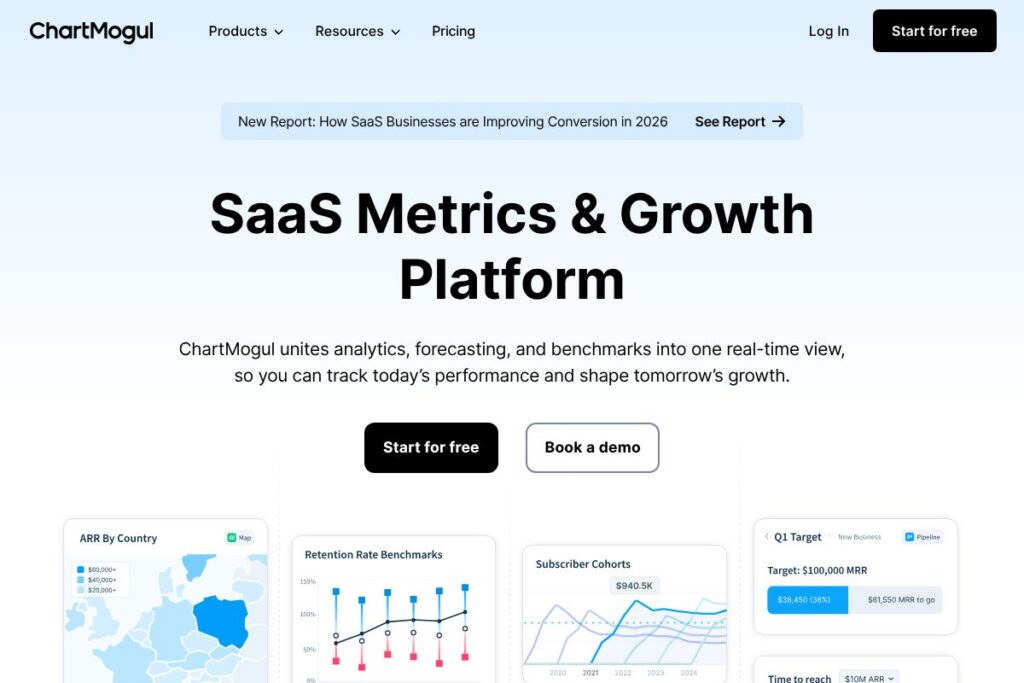
ChartMogul positions itself as a single source of truth for subscription revenue, combining MRR/ARR analytics, cohort and churn analysis, forecasting, and industry benchmarking into a single interface. The product is built to accommodate complex billing setups including multi-currency, usage and add-ons, and multiplatform billing systems so teams can report on a coherent revenue timeline.
Compared with competitors, ChartMogul focuses more on multi-system billing reconciliation and SaaS benchmarking than general-purpose analytics platforms like Mixpanel or Amplitude, which prioritize product event analytics. Against specialist alternatives such as ProfitWell and Baremetrics, ChartMogul emphasizes workflow automation and integrations with billing systems and data warehouses, making it suited for teams that want both deep subscription metrics and operational hooks. All of this makes ChartMogul especially useful for SaaS founders, revenue teams, and finance operators who need real-time clarity across billing models and customer lifecycles.
How ChartMogul Works
ChartMogul ingests subscription-related data from billing systems, payment processors, and data warehouses and normalizes it into a subscription model that powers MRR, ARR, churn, cohort, and expansion metrics. Data connectors and import tools stitch customer lifecycles across multiple billing systems so metrics reflect a single timeline even during migrations or when customers change billing arrangements.
Teams use ChartMogul to segment subscribers, build cohorts, and trigger actions from subscription events. For example, you can detect a spike in downgrades in a segment, send a workflow to customer success to intervene, and measure the impact on churn rate, all without leaving the platform. The solution also supports forecasting and benchmarking so leadership can compare performance to industry peers and run scenario analysis for growth planning.
ChartMogul features
ChartMogul centers around subscription analytics, forecasting, benchmark comparisons, and workflow automation. Core capabilities include real-time MRR/ARR reporting, cohort and churn analysis, multi-system billing reconciliation, and the ability to trigger workflows from subscription events. Recent work emphasizes automation and broader billing model support to handle trials, free seats, usage billing, and multi-currency customers.
Subscription and recurring revenue reporting
Detailed MRR, ARR, and net revenue metrics are calculated from normalized subscription timelines, with breakdowns for new, expansion, contraction, and churn. These reports let finance and revenue teams pinpoint the drivers of growth and decompose changes by customer segment, plan, or region.
Cohort and churn analysis
Cohort reporting and retention curves help teams measure how customer behavior changes over time and which cohorts drive long-term value. Easy segmentation makes it practical to compare trial-to-paid conversion, plan stickiness, and the retention impact of product changes.
Forecasting and scenario modeling
Forecasting tools project future revenue based on historical trends, churn assumptions, and expansion patterns so teams can run what-if scenarios. Forecast outputs are useful for revenue operations and finance planning and can be exported to downstream systems.
Benchmarks and industry comparisons
ChartMogul provides benchmark datasets that let companies see how their metrics compare to similar SaaS businesses by size, vertical, or region. Those comparisons help prioritize initiatives by showing whether a metric is typical or an outlier versus peers.
Multi-billing and complex pricing model support
The platform supports seat-based, tiered, add-on, usage-based, and mixed billing models, and it can reconcile subscriptions across different billing systems. That flexibility is useful for companies transitioning between billing platforms or offering multiple product lines.
Multi-currency and FX-aware reporting
Revenue is tracked across currencies with adjustments so teams can separate true expansion from currency effects. This helps global companies understand underlying performance without FX noise.
Integrations and data warehouse connectivity
ChartMogul connects to common billing systems, payment processors, and analytics tools and can push or pull data from data warehouses for centralized reporting. Those integrations reduce manual reconciliation and allow finance teams to build richer analyses combining product, marketing, and billing data.
Workflow automation and subscription-triggered actions
Real-time subscription events can trigger workflows such as alerts to sales, automated emails to at-risk customers, or CRM updates so operational teams act on revenue signals. The automation capability turns metrics into coordinated processes that target conversion and reduce churn.
With these capabilities, ChartMogul gives subscription businesses real-time visibility and operational controls that connect measurement to action.
ChartMogul pricing
ChartMogul uses a subscription pricing model with a freemium entry point for early-stage businesses and custom or enterprise pricing for larger customers. The vendor publishes a free tier for very small ARR and handles broader requirements through paid plans and sales engagement.
Free (Up to $120K ARR)
Free (Up to $120K ARR) – $0USD (Unify free trial and billing data, segment subscribers, automate workflows, invite your whole team at no extra cost)
Enterprise and Custom Plans
Enterprise – Custom pricing (Advanced billing connectors, SSO, dedicated support, data retention controls and enterprise-grade SLAs). For specifics and to compare plan limits, check the current pricing options.
If your company exceeds the free ARR threshold or needs additional features like advanced forecasting, audit logs, or premium support, ChartMogul will typically provide a tailored quote based on ARR, data volume, and required integrations. For detailed plan comparisons and onboarding options, visit the ChartMogul homepage.
What is ChartMogul Used For?
Revenue teams use ChartMogul to measure and monitor subscription metrics including MRR, ARR, churn, LTV, and expansion so they can prioritize growth initiatives and track the financial health of the business. Product and growth teams use cohort and conversion analysis to optimize trials, onboarding funnels, and usage-to-paid flows.
Finance and operations teams rely on ChartMogul for reconciled revenue reporting across billing systems, for forecasting, and for board-level dashboards. Customer success teams use segmentation and workflow triggers to identify at-risk accounts and orchestrate retention campaigns.
Pros and Cons of ChartMogul
Pros
- Strong multi-billing support: ChartMogul handles seat-based, usage, tiered, and hybrid billing models and can reconcile subscriptions across different billing systems, which reduces manual data stitching during migrations.
- Benchmarking and industry context: Built-in benchmarks help teams understand how their metrics compare to similar SaaS businesses, which speeds prioritization of growth initiatives.
- Workflow automation tied to revenue events: Real-time triggers and automation let operations teams convert metrics into actions, helping reduce churn and improve conversion without separate orchestration tools.
- Free entry point for early-stage companies: A free tier up to $120K ARR lets startups access core analytics and automation without upfront cost, enabling early adopters to instrument reporting before scaling.
Cons
- Custom pricing for larger customers: For companies beyond the free tier, pricing moves to custom plans which requires sales engagement and evaluation; this can slow procurement for smaller teams.
- Specialized focus on subscription metrics: While excellent for revenue analytics, ChartMogul is not a full product analytics suite; teams needing deep event-level behavioral analysis will still need tools like Amplitude or Mixpanel.
- Learning curve for complex billing setups: Implementing accurate timelines for heavily customized billing requires careful mapping of billing events and may need technical support or engineering time.
Does ChartMogul Offer a Free Trial?
ChartMogul offers a free plan for businesses up to $120K ARR. The free tier includes unified free trial and billing data, subscriber segmentation, workflow automation, and team access at no charge; larger businesses and enterprise customers should contact ChartMogul for tailored plans and onboarding options.
ChartMogul API and Integrations
ChartMogul provides an API and webhook support for programmatic access to subscription data and real-time subscription events. The API documentation details endpoints for importing data, querying metrics, and subscribing to webhooks.
The product integrates with common billing and payment platforms, data warehouses, and workflow tools including Stripe, Chargebee, Recurly, Braintree, Salesforce, HubSpot, Segment, Snowflake, and Google BigQuery. Integration guides and connector documentation are available on the ChartMogul site to help with setup and data exports.
10 ChartMogul alternatives
Paid alternatives to ChartMogul
- Baremetrics — Subscription analytics focused on MRR, churn, and forecasting with simple setup for Stripe and other payment providers.
- ProfitWell — Free subscription metrics with paid add-ons for retention and pricing intelligence, suited for companies that want a low-cost metrics foundation.
- Chargebee — Subscription billing and revenue operations platform that combines billing, invoicing, and analytics for mid-market SaaS.
- Zuora — Enterprise-grade subscription management and billing with complex revenue recognition and large-customer support.
- SaaSOptics — Revenue recognition and subscription management designed for B2B SaaS finance teams with audit-ready reporting.
- Paddle — Commerce and subscription platform built for SaaS sellers that includes reporting and compliance features for global sales.
- Stripe (Billing + Sigma) — Payments and billing with Sigma for custom SQL analytics, useful when combined with Stripe Billing for integrated reporting.
Open source alternatives to ChartMogul
- Metabase — Open source business intelligence and dashboarding for querying your database and building visual reports.
- Apache Superset — Open source data exploration and visualization platform for teams comfortable managing their own analytics infrastructure.
- Redash — Query-based analytics and dashboards that connect to multiple data sources and support SQL-first reporting.
- PostHog — Open source product analytics that can be used to analyze user behavior and conversion funnels alongside subscription data when coupled with billing exports.
Frequently asked questions about ChartMogul
What is ChartMogul used for?
ChartMogul is primarily used to measure and analyze subscription revenue. Teams use it for MRR/ARR reporting, churn and cohort analysis, forecasting, and benchmarking against peer SaaS companies.
Does ChartMogul integrate with Stripe and other billing systems?
Yes, ChartMogul integrates with Stripe, Chargebee, Recurly, and other billing platforms. It also supports data warehouse connections and can reconcile subscriptions across multiple billing systems.
How much does ChartMogul cost for startups?
ChartMogul offers a free tier for companies up to $120K ARR. For businesses above that threshold or requiring enterprise features, ChartMogul provides custom plans and quotes through their sales team.
Does ChartMogul provide an API for developers?
Yes, ChartMogul has a public API and webhook support. The API documentation covers endpoints for data imports, metric queries, and subscription event webhooks to integrate with internal systems.
Can ChartMogul track free trials and PLG conversion metrics?
Yes, ChartMogul supports PLG models including free trials and free-tier users. The platform tracks trial-to-paid conversions, activation cohorts, and the revenue impact of free users so teams can optimize conversion funnels.
Final Verdict: ChartMogul
ChartMogul is a focused subscription metrics platform that excels at reconciling complex billing setups, providing real-time MRR/ARR reporting, and attaching operational workflows to subscription events. Its benchmark datasets and automation capabilities make it a strong choice for SaaS companies that need both measurement and operational tooling around recurring revenue.
Compared with ProfitWell, which offers free basic metrics, ChartMogul provides a more integrated approach to multi-system billing reconciliation and workflow automation; ChartMogul also publishes a freemium tier up to $120K ARR, while larger deployments move to custom-priced plans. For teams that need enterprise-grade billing connectors, forecasting, and the ability to trigger actions from revenue events, ChartMogul is well suited; organizations that only need free visibility into core metrics may prefer ProfitWell’s free offering.
For setup guides, automation examples, and to evaluate whether ChartMogul fits your stack, review the research hub or consult the API documentation.