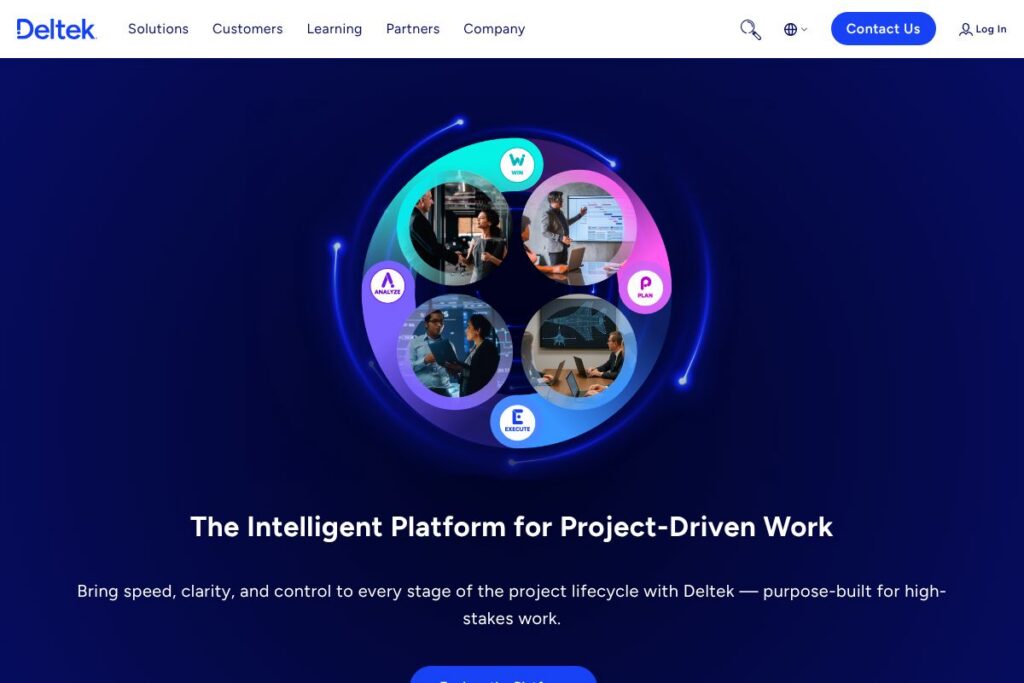

Deltek: An Overview
Deltek is an enterprise platform focused on organizations that run work as projects, including professional services, government contractors, architecture and engineering firms, and construction-heavy businesses. It brings together project accounting, resource planning, contract management, and operational reporting in a set of modules that map to the full project lifecycle.
Compared with broad ERP suites such as SAP S/4HANA and Oracle NetSuite, Deltek places greater emphasis on project billing, compliance, and program-level reporting tailored to project-centric industries. Against niche competitors like Unanet and Procore, Deltek offers a deeper ERP footprint that covers general ledger and advanced financial controls alongside project operations.
Deltek excels at connecting financial controls to project delivery, enforcing audit-ready governance, and providing industry-specific workflows for regulated and contract-driven work. All of this makes it particularly suitable for mid-market and enterprise organizations that need both project visibility and strict compliance controls.
How Deltek Works
Deltek integrates modules that mirror the project lifecycle: opportunity capture and proposal, planning and budgeting, execution and time capture, project accounting, and post-project analysis. Organizations typically configure Deltek so data flows from sales and proposals into project budgets, then into time entry and cost capture for invoicing and revenue recognition.
Implementation commonly starts with a core financial and project accounting deployment, followed by staged rollouts of resource planning, time and expense, and analytics. Teams use role-based dashboards to monitor earned value, billing milestones, and contract compliance, while administrators enforce controls through configurable approval workflows and audit logging.
Deltek features
Deltek bundles ERP, project management, and analytics focused on project-driven operations. Key capabilities include project accounting, resource planning, compliance controls, and industry-tuned intelligence, and the platform is increasingly surfaced with AI-enabled assistants to help automate routine work and surface timely insights.
Project Accounting
Project accounting links budgets, labor, expenses, and billing rules to deliver accurate revenue recognition and contract-compliant invoicing. This reduces manual reconciliation and supports complex contract types such as cost-plus and fixed-price agreements.
Resource Management
Resource planning provides skills-based resourcing, utilization tracking, and capacity forecasts so managers can align people to billable work and identify staffing shortfalls. It helps balance utilization across projects and supports scenario planning for upcoming bids.
Financial Management and ERP
Core ERP capabilities include general ledger, accounts payable, accounts receivable, contract billing, and fixed assets tailored to project financial flows. These capabilities ensure project costs roll up correctly into corporate financial statements and support multi-entity consolidations.
Compliance, Audit, and Governance
Deltek embeds controls for audit trails, contract compliance, and regulatory reporting, useful for government contractors and regulated professional services firms. Built-in reporting and configurable workflows help maintain traceability for audits and client inspections.
Industry-Tuned Intelligence and Dela
Deltek surfaces real-time insights with industry-tuned AI and an AI orchestrator named Dela that automates routine approvals, identifies schedule risks, and suggests corrective actions. These capabilities aim to reduce manual analysis and speed decision making across the project lifecycle.
Reporting and Analytics
Integrated analytics provide project-level KPIs, earned value metrics, and custom financial reports, with dashboards for executives, program managers, and project accountants. Teams can create operational and financial reports that combine time, cost, and revenue data for a single source of truth.
Partner and Implementation Ecosystem
Deltek supports a global partner network that offers implementation, industry consulting, and managed services to accelerate deployments and handle integrations. Partners often build industry templates and connectors for common adjacent systems.
With these capabilities Deltek helps project-based organizations reduce the gap between delivery and finance, supporting audit-ready project controls while providing the operational visibility teams need to manage complex work.
Deltek pricing
Deltek uses an enterprise pricing model that is typically customized to an organization’s size, required modules, deployment options, and support needs. Licensing and implementation costs vary by product suite, number of users, and the level of integration or customization required.
Because Deltek pricing is tailored for enterprise customers, organizations should contact sales or request a demo to obtain a quote that reflects their deployment needs. View Deltek’s enterprise offerings and contact options on Deltek’s contact and sales pages for current pricing and procurement guidance.
What is Deltek used for
Deltek is used to manage the full project lifecycle for organizations where projects are the primary revenue source, including proposal-to-cash processes, resource allocation, time and expense capture, and contract billing. It is a central system for combining operational data with financial controls so stakeholders can see project profitability in near real time.
Typical users include project managers tracking schedules and budgets, finance teams handling revenue recognition and compliance, resource managers coordinating staffing, and executives monitoring portfolio performance. Deltek is also used to manage compliance requirements for government contracting and regulated engagements.
Pros and cons of Deltek
Pros
- Project-first accounting and controls: Deltek ties project financials directly to time, cost, and billing rules to support complex contract types and audit-ready reporting.
- Industry-specific workflows: Many industry templates and modules are tailored to government contractors, AEC, and professional services, reducing configuration work during rollout.
- Comprehensive platform: Combines ERP, resource planning, and analytics in one platform so financial and operational data are aligned across the project lifecycle.
- Partner ecosystem: A global network of implementation partners and consultants helps with integrations, industry best practices, and managed services.
Cons
- Enterprise cost and complexity: Implementations can be time-consuming and require significant configuration, which may be heavy for smaller firms with simple needs.
- Customization can be required: Organizations with niche workflows often need partner assistance or custom development to fully align Deltek with internal processes.
- Learning curve: The breadth of functionality requires training for administrators and end users to use advanced features effectively.
Does Deltek Offer a Free Trial?
Deltek offers enterprise demos and evaluation options rather than a public free plan. Prospective customers can request product demonstrations, pilot programs, or proof-of-concept evaluations through the sales team; request options are available via Deltek’s contact and sales pages.
Deltek API and Integrations
Deltek provides APIs and integration frameworks to connect with payroll, CRM, document management, and other enterprise systems, enabling data exchange between project, financial, and HR systems. The Deltek integrations pages and developer resources describe connector options and supported endpoints for common integration scenarios.
Organizations often use the API for automated time and expense imports, syncing project and client master data with CRM systems, and integrating contract billing with third-party billing platforms. Implementation partners commonly build and maintain complex integrations when out-of-the-box connectors are not available.
10 Deltek alternatives
Paid alternatives to Deltek
- Oracle NetSuite — A broad ERP with strong financials and multi-subsidiary management, used by project-oriented businesses that want a general-purpose ERP with project modules.
- SAP S/4HANA — Enterprise-grade ERP with deep financial controls and industry modules, suitable for large organizations seeking integrated enterprise resource planning.
- Microsoft Dynamics 365 — Modular ERP and CRM platform with project operations and integrations across Microsoft products for organizations invested in the Microsoft stack.
- Unanet — Project-based ERP focused on professional services and government contracting with project accounting and time tracking optimized for mid-market firms.
- Procore — Construction management platform with strong field collaboration, project controls, and document management for builders and general contractors.
- Autodesk Construction Cloud — Combines design and construction workflows with cost and project management tools for AEC firms focused on BIM and field coordination.
Open source alternatives to Deltek
- ERPNext — An open source ERP with modules for projects, accounting, and HR that can be configured for smaller project-driven organizations and self-hosted deployments.
- Odoo (Community Edition) — Modular open source ERP with project and accounting apps, suitable for teams that want a lower-cost, configurable platform and self-managed hosting.
- Dolibarr — Lightweight open source ERP and CRM with basic project and financial modules, useful for small organizations that require a simple, self-hosted system.
Frequently asked questions about Deltek
What is Deltek used for?
Deltek is used to manage project accounting, resource planning, and contract billing for project-driven organizations. It centralizes time capture, project budgets, invoicing, and compliance reporting so teams can track project profitability.
Does Deltek integrate with other enterprise systems?
Yes, Deltek supports APIs and third-party integrations. Connectors and developer resources enable syncing with payroll, CRM, document management, and BI tools for end-to-end workflows.
How does Deltek handle compliance and audits?
Deltek includes audit trails, configurable approval workflows, and contract-compliant billing features. These controls help organizations meet regulatory and contract requirements and produce audit-ready reports.
Can Deltek scale for large enterprises?
Yes, Deltek is designed for mid-market to enterprise organizations with complex project portfolios. It supports multi-entity accounting, consolidated reporting, and partner-led deployments for large-scale rollouts.
Is Deltek cloud-hosted or available on-premises?
Deltek offers cloud-hosted deployments and has historically supported on-premises options for some products. Deployment choices and managed hosting details can be discussed with Deltek sales and implementation partners.
Final Verdict: Deltek
Deltek stands out as a purpose-built platform for organizations that run the business as projects, combining project accounting, resource management, and compliance controls in a single product family. It is one of the stronger choices when accurate project financials and audit-ready governance are critical to operations.
Compared with Oracle NetSuite, Deltek provides deeper project-specific workflows and compliance features that suit government contracting and professional services, while NetSuite offers a broader general ERP footprint and modular pricing common to cloud ERP vendors. Pricing for both is typically negotiated at the enterprise level, so organizations should evaluate feature fit and implementation effort when deciding between them.
For organizations that need project-centered financial controls and industry templates, Deltek is a robust option; firms with simpler needs or tighter budgets may prefer lighter ERP or open source alternatives to reduce implementation time and cost.