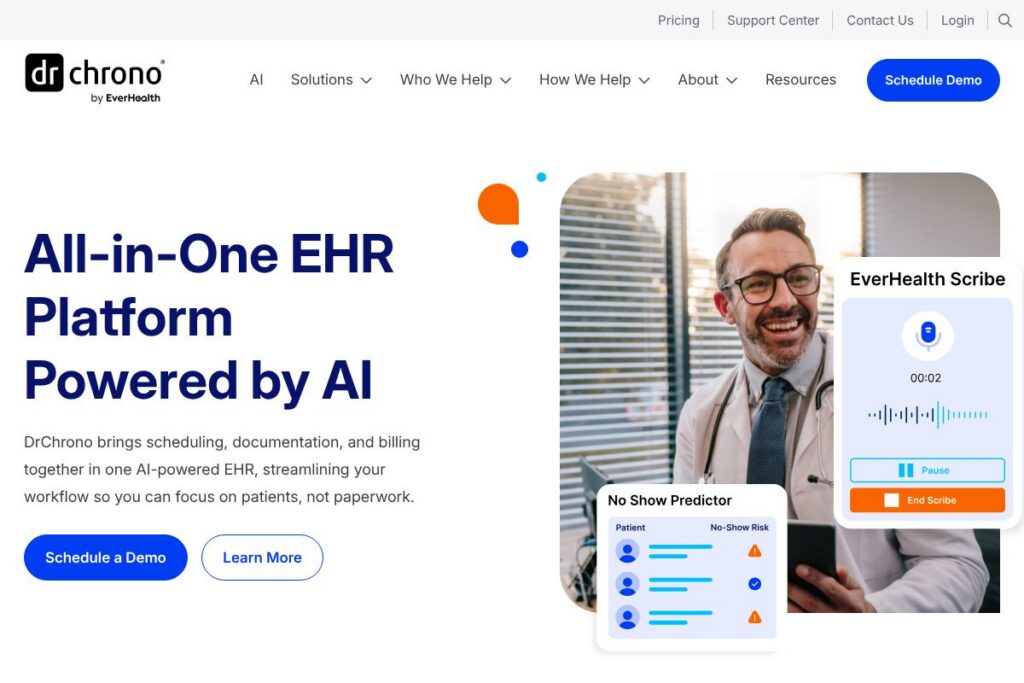

DrChrono: An Overview
DrChrono is a cloud-native EHR and practice management platform built for independent practices, clinics, and specialty providers. It combines scheduling, clinical documentation, telehealth, patient engagement, and billing in one system, with mobile-first apps for iPad and iPhone and desktop access for front-desk and billing workflows. The platform emphasizes configurable clinical templates, an integrated patient portal, and revenue cycle tools that aim to reduce administrative overhead.
Compared with enterprise-focused systems like Epic, DrChrono targets smaller practices with lighter implementation footprints and mobile capabilities, making it easier to deploy without large IT teams. Against cloud-first competitors such as athenahealth and eClinicalWorks, DrChrono stands out for its emphasis on mobile EHR and an all-in-one product that ties scheduling and billing to clinical workflows. Each of these vendors has different strengths — Epic for scale and integrations, athenahealth for networked billing services, and eClinicalWorks for broad ambulatory feature sets.
All of this makes DrChrono particularly well suited to independent physicians, small group practices, and specialty clinics that need a mobile-friendly EHR with integrated billing and telehealth. Its strength lies in combining patient-facing tools and revenue cycle functions in a single platform that is configurable for different specialties.
How DrChrono Works
DrChrono centralizes clinical and administrative workflows into a shared cloud platform so staff and clinicians work from the same patient record. Scheduling, intake, clinical charting, e-prescribing, and billing are connected to a single patient account so front-desk changes, clinical orders, and charges flow into billing without manual handoffs.
Clinicians chart using specialty-specific templates on mobile devices or desktop, launch telehealth visits from the patient record, and attach documents or consents via the OnPatient portal during intake. Billing staff use built-in coding helpers, configurable billing profiles, and claims submission tools to manage revenue cycle tasks without moving data across systems.
Practical workflows include: an intake nurse completing electronic forms in the patient portal before arrival, the clinician completing a shared encounter note on an iPad during the visit, and billing running eligibility checks and submitting electronic claims from the same account after the visit. Telehealth visits and patient communications are handled without separate third-party apps, reducing complexity for patients.
DrChrono features
DrChrono combines core EHR functionality with practice management and revenue cycle features. The platform has evolved to include AI-assisted workflows, mobile charting, telehealth built into the chart, and configurable billing profiles to accelerate coding and claims. Recent advances emphasize AI-assisted documentation, easier billing profiles for repeat visit types, and smoother telehealth experiences through the OnPatient portal.
Telehealth
Telehealth is embedded directly in the patient record, enabling clinicians to launch video visits without a separate app or complex setup. The feature ties consent and visit notes to the chart, and patients join through the OnPatient portal which reduces pre-visit friction.
Medical Billing and Revenue Cycle Management
Built-in billing tools include configurable billing profiles, claim scrubbing, ERA posting, and denial management to streamline revenue workflows. The system supports electronic claims and integrates with clearinghouses so billing teams can manage claims and payments from a single interface.
Scheduling and Patient Intake
Scheduling supports appointment templates, reminders, and online self-scheduling through the patient portal. Electronic intake forms and insurance capture reduce front-desk paperwork and feed directly into the encounter and billing record.
Clinical Documentation and Templates
DrChrono offers specialty-specific templates and customizable clinical forms that speed chart completion and standardize documentation. Templates can pre-populate common orders and link to billing profiles for faster charge capture.
Mobile EHR
Native iPad and iPhone apps provide full charting, e-prescribing, and imaging support so clinicians can document on the go. The mobile apps are optimized for touch and support voice dictation workflows to reduce typing time.
Patient Portal (OnPatient)
The OnPatient portal supports appointment booking, telehealth access, secure messaging, intake forms, and billing statements to centralize patient interactions. Portal activity appears in the chart so clinicians and staff see communications and consent history.
Reporting and Analytics
Practice-level reporting covers revenue cycle metrics, scheduling utilization, and clinical productivity to help managers monitor performance. Custom report filters let practices slice data by provider, location, or payer.
API and Integrations
DrChrono exposes APIs and integration points for labs, pharmacies, clearinghouses, and third-party apps so practices can extend workflows or connect to ancillary services. The platform supports e-prescribing, lab interfaces, and common healthcare integrations to fit into larger IT ecosystems.
With these capabilities DrChrono aims to reduce context switching for clinicians and staff by keeping scheduling, charting, telehealth, and billing within one platform, which helps small and medium practices operate with fewer disparate systems.
DrChrono pricing
DrChrono uses a subscription and service pricing model tailored to practice size, specialty, and deployment needs, with options for integrated billing services and add-on features. Pricing is not presented as a single public rate because packages vary by functionality and support level.
For current plan options, deployment details, and quotes contact the company or review the platform features on the official DrChrono website. Sales and support can provide custom pricing for software-only subscriptions, bundled billing services, and enterprise deployments.
What is DrChrono Used For?
DrChrono is commonly used to run ambulatory practices end to end, handling patient scheduling, electronic charting, e-prescribing, telehealth, and claims submission from a single record. Practices use it to replace paper workflows, reduce duplicate data entry, and centralize patient communication through the OnPatient portal.
Specialty clinics such as urgent care, family medicine, and behavioral health use DrChrono for quick mobile charting and telehealth visits, while billing teams use its configurable billing profiles and claims tools to accelerate revenue capture. Small groups that need a compact, mobile-first EHR often choose DrChrono for faster deployments and lower operational complexity.
Pros and Cons of DrChrono
Pros
- Mobile-first EHR: The native iPad and iPhone apps provide a full-featured clinical experience that supports charting, e-prescribing, and image capture on mobile devices, which benefits clinicians who move between exam rooms or clinics.
- Integrated billing workflows: Configurable billing profiles and built-in claim submission reduce manual coding steps and help billing staff manage revenue cycle tasks from the same platform.
- Embedded telehealth and patient portal: Telehealth visits, intake forms, and secure messaging are tied to the patient chart through the OnPatient portal, lowering patient setup friction and centralizing documentation.
- Customization for specialties: Specialty templates and configurable encounter flows allow practices to adapt the system to common visit types and specialty-specific orders.
Cons
- Limited public pricing transparency: Pricing is tailored and not posted as a single public rate, which can make initial budget comparisons slower compared with vendors that list per-user pricing.
- Advanced reporting depth: Practices with complex analytics needs may find reporting less sophisticated than large enterprise analytics suites without additional configuration or third-party reporting tools.
- Implementation support variability: Smaller practices benefit from a lighter implementation, but those migrating large data sets or with custom interfaces may need more consultative services to complete integrations.
- Feature parity with enterprise EHRs: Large hospital systems requiring deep interoperability and highly customized workflows may prefer enterprise EHRs such as Epic for broader inpatient and cross-organization feature sets.
Does DrChrono Offer a Free Trial?
DrChrono offers demos and trial or pilot programs through its sales team. Prospective customers can schedule a live demonstration and request trial access or a pilot deployment to evaluate charting, billing, and telehealth workflows before committing to a subscription. Contact the vendor through the official DrChrono website to arrange a demo or pilot.
DrChrono API and Integrations
DrChrono provides a developer API for integrating clinical and practice management data with custom applications and third-party services. The DrChrono API documentation outlines endpoints for patient records, scheduling, billing, and clinical data to support automation and integrations.
Key integrations include e-prescribing, lab interfaces, clearinghouses for electronic claims, and common practice tools so practices can connect ancillary services to the EHR and maintain end-to-end workflows.
10 DrChrono alternatives
Paid alternatives to DrChrono
- Epic – Enterprise-grade EHR used by large health systems, strong interoperability and deep feature set for inpatient and ambulatory care.
- athenahealth – Cloud-based EHR and revenue cycle services with a focus on network-enabled billing and care coordination.
- eClinicalWorks – Ambulatory EHR with broad clinical features, population health add-ons, and integrated patient engagement tools.
- NextGen Healthcare – EHR and practice management with specialty-specific workflows and population health capabilities.
- Kareo – Practice management and billing software aimed at small practices, with integrated clearinghouse and billing services.
- AdvancedMD – Cloud practice management and EHR with strong scheduling and billing capabilities for multi-provider practices.
- Practice Fusion – Cloud EHR for small practices offering core charting and clinical workflows.
Open source alternatives to DrChrono
- OpenEMR – Widely used open source EHR with medical practice management, scheduling, and billing modules that can be self-hosted and customized.
- OpenMRS – Modular medical record system designed for global health implementations and customizable clinical workflows.
- GNU Health – An open source health and hospital information system focused on clinical management and public health needs.
- Oscar EMR – Open source primary care EHR platform with a focus on flexible clinical templates and community-driven development.
Frequently asked questions about DrChrono
What is DrChrono used for?
DrChrono is used as a cloud EHR and practice management system. It covers scheduling, charting, telehealth, patient engagement, and billing for ambulatory and specialty practices.
Does DrChrono support telehealth visits?
Yes, DrChrono includes embedded telehealth functionality. Telehealth sessions are launched from the patient chart and accessed via the OnPatient portal without separate software downloads for patients.
Can DrChrono integrate with billing clearinghouses?
Yes, DrChrono supports electronic claims and clearinghouse integration. Practices can submit claims, post ERAs, and manage denials within the platform or use bundled billing services.
Does DrChrono provide an API for developers?
Yes, DrChrono provides a developer API. The API exposes endpoints for scheduling, patients, clinical data, and billing to enable custom integrations and automation; see the DrChrono API documentation for details.
Is DrChrono suitable for small independent practices?
Yes, DrChrono is well suited to independent and small group practices. Its mobile-first apps, integrated billing tools, and configurable templates address the needs of practices that prefer compact, all-in-one systems.
Final Verdict: DrChrono
DrChrono excels as a mobile-first, cloud EHR that unifies scheduling, documentation, telehealth, and billing for independent practices. Its strengths are the integrated patient portal, configurable billing profiles that reduce repetitive billing work, and native mobile apps that let clinicians document from tablets and phones while keeping front-desk, clinical, and billing teams aligned.
Compared with athenahealth, DrChrono focuses on mobility and tight integration between clinical and billing workflows with practice-tailored pricing handled through sales, while athenahealth emphasizes network-enabled billing services and broader enterprise connectivity. Practices choosing between the two should weigh mobile and specialty-specific needs against centralized billing networks and enterprise integration requirements.
Overall, DrChrono is a practical choice for small to mid-sized practices and specialty clinics that need an all-in-one cloud EHR with strong mobile functionality and built-in revenue cycle tools. For pricing, demos, and specific deployment options contact the vendor through the official DrChrono website.