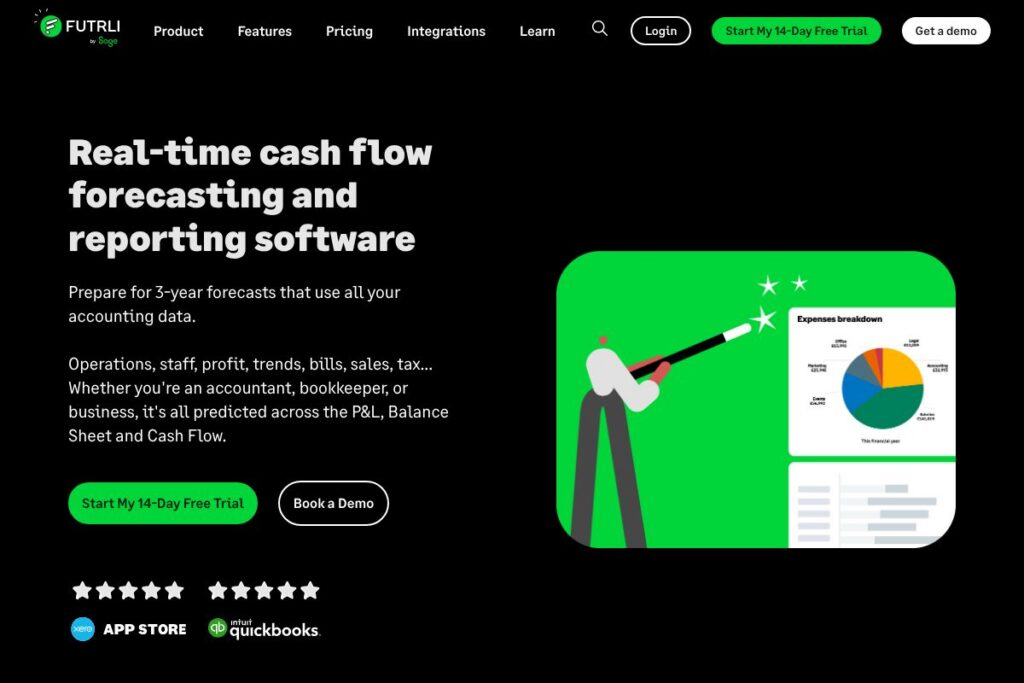

What is Futrli
Futrli is a forecasting and reporting platform built to help accountants, bookkeepers, and small businesses model cash flow, predict profitability, and run scenario planning. It connects to major accounting systems such as Xero, QuickBooks, and Sage to import live financial data and turn it into forecasts and management reports.
Compared with Fathom and Spotlight Reporting, Futrli places more emphasis on forward-looking cash flow modelling and scenario testing rather than purely retrospective performance dashboards. Fathom focuses on KPI analysis and visual storytelling, while Spotlight Reporting targets consolidated group reporting and board packs; Futrli combines scenario planning, budgets, and advisor-focused workflows to support advisory services.
All of this makes Futrli particularly strong for accounting practices and advisory teams who need repeatable forecasting processes, client-ready reports, and the ability to run what-if scenarios quickly. It is well suited to firms that want to scale advisory work across many clients while keeping tight control over cash flow and budget variance analysis.
How Futrli Helps Accountants
Futrli works by syncing client ledgers from your accounting platform, then applying forecasting rules and assumptions to create rolling cash flow and profit forecasts. Users can adjust receipts, payments, payroll, and tax dates to see immediate impacts and run multiple scenarios side-by-side for comparison.
In practice, accountants use Futrli to prepare monthly management reports, run stress tests on cash positions, and present scenario-driven advice to clients. Workflows typically include importing a client’s accounting data, creating a baseline forecast, building alternate scenarios, then exporting or sharing branded management reports directly with stakeholders.
What does Futrli do?
Futrli focuses on forecasting, cash flow clarity, scenario modelling, and management reporting, with tools designed specifically for accounting firms and advisory services. Recent product emphasis has been on improving automated budgets, consolidated views for multi-entity clients, and tightening the pathway from data to client-ready reports.
Key functionality includes:
Forecasting and Predictive Cash Flow
Futrli generates rolling cash flow forecasts using historical transaction patterns and user-defined rules, helping teams identify future shortfalls and timing risks. Forecasts update when accounting data changes and can be adjusted manually to reflect upcoming contracts or one-off events.
Scenario Planning and What-if Analysis
Users can create multiple scenarios to model best case, worst case, or management-approved plans and compare outcomes side-by-side. Scenario inputs are granular, covering revenue timing, expense changes, and capital outlays, which makes advisory conversations more evidence-based.
Budgets and Variance Analysis
Futrli supports budget creation and automated variance reporting, showing differences between actuals and budgets across periods. Integrated charts and variance tables make it easier to explain performance to clients and board members.
Management Reporting and Dashboards
The reporting module produces professional, customizable reports and dashboards tailored for stakeholders such as owners, boards, or investors. Reports are designed for quick compilation, sharing, and ongoing reuse across clients.
Performance Insights and KPIs
Performance area tools surface instant insights on cash, revenue, margins, and other KPIs relevant to advisors and business owners. Custom KPIs can be configured and used within reports and dashboards to align with advisory goals.
Multi-Entity Consolidations
Futrli can consolidate data from multiple entities to provide group-level forecasts and reports, reducing manual consolidation work for firms that manage clients with several trading companies. Consolidated views help with cash pooling, intercompany timing, and board reporting.
Integrations with Accounting Platforms
Futrli offers direct integrations with major accounting platforms so that forecasts and reports reflect the latest ledger data. It supports data syncs with systems such as Xero, QuickBooks, and Sage which streamlines onboarding and reduces manual imports.
Alerts and Automated Workflows
Custom alerts notify users of cash shortfalls, forecast breaches, and approaching deadlines so teams can act before issues materialize. Automation reduces repetitive tasks and keeps advisory work proactive rather than reactive.
With these capabilities Futrli helps firms move from compliance-focused bookkeeping to proactive business planning, delivering forecasts and reports that support client decision making.
Futrli pricing
Futrli uses a subscription-based pricing model with plans tailored to accountants, advisory teams, and small businesses; pricing is tiered by features and scale rather than a single flat fee. For up-to-date plan details and any promotional offers, check Futrli’s plans and pricing on Futrli’s homepage.
What is Futrli Used For?
Futrli is used to prepare cash flow forecasts, test scenarios, and create management reports that support advisory services and strategic planning. Accountants deploy it for monthly client reviews, stress testing, and to convert bookkeeping engagements into higher-value advisory conversations.
Small business owners use Futrli to understand short-term cash timing, run budget comparisons, and visualise the financial impact of hiring, investment, or sales changes. The platform helps both advisors and owners make data-driven decisions about cash, profitability, and growth.
Pros and Cons of Futrli
Pros
- Strong scenario modelling: Futrli makes it easy to build and compare multiple future outcomes, which supports advisory recommendations and contingency planning.
- Accounting integrations: Direct connections to major accounting systems reduce manual data handling and keep forecasts in sync with live ledgers.
- Advisor-focused reports: Reporting templates and dashboards are designed for client conversations and board-level presentations, saving preparatory time.
- Consolidation support: Group-level forecasting and consolidated reports reduce the complexity of multi-entity clients for accounting firms.
Cons
- Learning curve for advanced features: Mastering scenario logic, consolidation, and custom KPIs can take time for teams new to forecasting workflows.
- Customization limits for some report styles: While highly flexible, extremely bespoke report layouts may still require export and manual formatting in a separate tool.
- Dependence on quality of source data: Forecast accuracy depends on clean, well-categorized accounting data, so firms must invest in good bookkeeping processes.
Does Futrli Offer a Free Trial?
Futrli offers a free trial for new users. The trial typically provides access to core forecasting, reporting, and scenario planning features so teams can evaluate fit and workflows; check Futrli’s signup or trial information on Futrli’s homepage for exact trial length and any limitations.
Futrli API and Integrations
Futrli integrates natively with major accounting platforms such as Xero, QuickBooks, and Sage to import transactions and chart of accounts for forecasting and reporting. These integrations streamline onboarding and ensure forecasts use current ledger data.
For automation and custom workflows, Futrli provides developer-facing capabilities and integration resources; see Futrli’s integrations and developer information for endpoints and connection options. Integration details and available connectors are listed on Futrli’s integrations pages.
10 Futrli alternatives
Paid alternatives to Futrli
- Float — Cash flow forecasting focused on visual, easy-to-understand cash calendars and scenario testing, often used by agencies and SMEs.
- Fathom — KPI-driven performance analysis and management reporting that pairs well with advisory services and investor reporting.
- Spotlight Reporting — Board packs, consolidated reporting, and presentation-ready reports for multi-entity groups and advisory firms.
- Dryrun — Scenario and cashflow planning with a focus on AR/AP modelling and rolling cash forecasts for small businesses.
- Jirav — Financial planning and analysis platform that combines budgeting, forecasting, and reporting with driver-based models.
- Planful — Enterprise-focused FP&A tool offering budgeting, forecasting, and consolidation for larger organisations.
- Plecto — Dashboard and performance reporting with real-time data visualisation suited to sales and operations teams.
Open source alternatives to Futrli
- ERPNext — Open source ERP with accounting, budgeting, and reporting modules that can be adapted for basic forecasting and cash management.
- Odoo (Community) — Community edition of Odoo offers accounting and reporting modules that developers can extend for custom forecasting workflows.
- Ledger/Beancount tools — Double-entry accounting systems and associated visualization tools that can be used with custom scripts to generate forecasts and reports.
Frequently asked questions about Futrli
What does Futrli integrate with?
Futrli integrates with major accounting platforms including Xero, QuickBooks, and Sage. These direct connections allow forecasts and reports to reflect live ledger data without manual exports.
Can Futrli handle multi-entity consolidations?
Yes, Futrli supports consolidated group reporting and forecasting. Firms can combine multiple entities into a single consolidated view for cash flow and management reporting.
Does Futrli offer scenario planning for cash flow?
Yes, Futrli includes scenario modelling and what-if analysis. Users can build alternate scenarios to test the impact of different revenue, expense, or timing assumptions.
How does Futrli help accountants scale advisory services?
Futrli provides repeatable forecasting templates, automated reports, and client sharing features. These tools reduce manual work and allow firms to deliver advisory outputs consistently across many clients.
Is there API access for Futrli integrations?
Futrli offers developer and integration capabilities for automation and custom workflows. Integration documentation and connector details are available through Futrli’s integration resources.
Final Verdict: Futrli
Futrli excels at turning accounting data into forward-looking cash flow forecasts, scenario plans, and client-ready reports that support advisory conversations. Its strengths lie in scenario modelling, consolidation support, and templates designed for accountants, making it a practical choice for firms that want to scale advisory offerings and improve cash clarity for clients.
Compared with Fathom, Futrli leans more heavily into cash flow testing and scenario modelling while Fathom focuses on KPI dashboards and profitability analysis. Pricing approaches differ by vendor; Futrli uses tiered subscriptions aimed at advisory teams and SMEs while competitors may offer simpler per-company fees, so firms should compare plan scopes on Futrli’s plan pages to match features and budget needs. For more details on capabilities and to review current plans, visit Futrli’s homepage or the Futrli integrations pages.