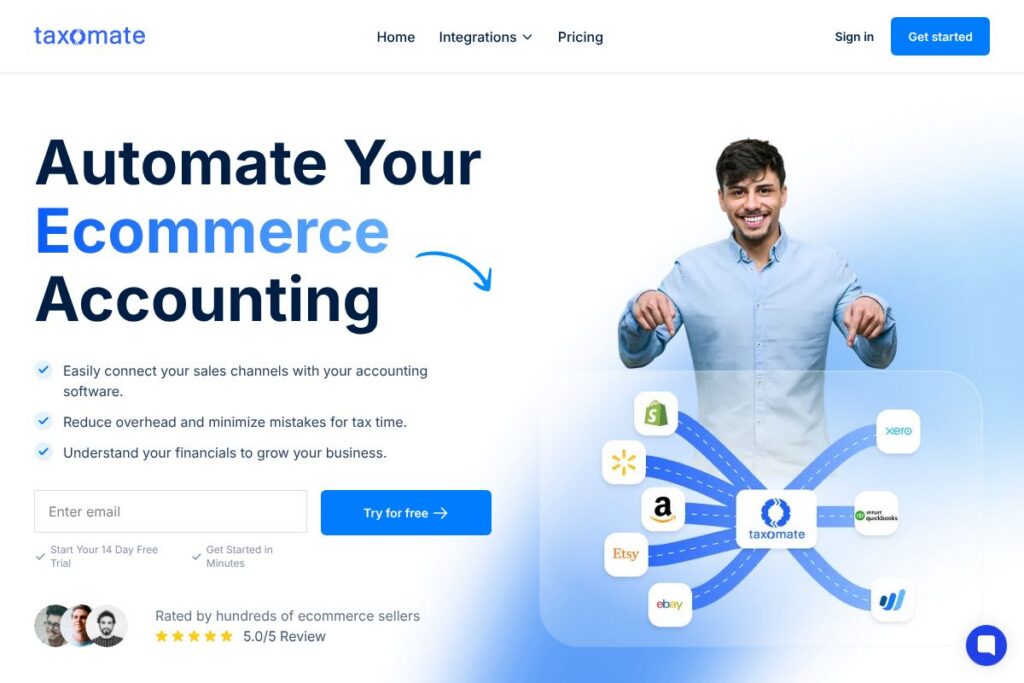

Taxomate: An Overview
Taxomate is a bookkeeping automation tool that pulls transaction and payout data from marketplaces like Amazon, eBay, Walmart, Shopify, and Etsy and converts that data into accounting-ready entries for QuickBooks, Xero, and Wave. It focuses on matching marketplace payouts to summarized invoices, breaking out fees, taxes, shipping, and advertising so accounts reconcile cleanly against bank deposits.
Compared with competitors such as A2X and Link My Books, Taxomate puts emphasis on flexible mapping rules and easy setup for bookkeepers who manage multiple marketplaces and accounting platforms. While A2X is known for detailed Amazon-specific reconciliation and published per-account pricing, and Link My Books targets straightforward multi-marketplace syncs, Taxomate balances broad marketplace coverage with customizable rules and exports that suit accountants who support many clients.
All of this makes Taxomate particularly useful for ecommerce sellers and their accountants who need accurate payout-matching, reduced manual entry, and clearer tax reporting across multiple sales channels.
How Taxomate Works
Taxomate connects directly to marketplaces using the marketplace APIs or storefront credentials, imports payout and order-level records on a scheduled basis, and aggregates those records into summarized entries that map to accounting ledger accounts. Users define mapping rules for fees, shipping, taxes, advertising, and COGS so each summarized invoice matches exactly to the deposit amount found in a bank feed or accounting system.
Typical workflows include connecting a marketplace, selecting the target accounting platform, configuring account mappings and product cost rules, and enabling daily or weekly payouts processing. After setup, Taxomate creates invoices or journal entries in QuickBooks, Xero, or Wave that reconcile with the merchant’s payouts, and provides reports and exports for tax or bookkeeping review.
Taxomate features
Taxomate is organized around automated data ingestion, payout reconciliation, and accounting exports. Core capabilities include multichannel marketplace connections, summarized invoice creation, fee and tax breakdowns, mapping rules, and exports to QuickBooks, Xero, and Wave. The platform has earned marketplace app recognition and aims to reduce manual bookkeeping time.
Let’s talk Taxomate’s Features
Multichannel marketplace connections
Taxomate supports major marketplaces and storefronts such as Amazon, Shopify, eBay, Walmart, and Etsy, pulling order, fee, and payout data to centralize bookkeeping across sales channels. This reduces the need to download and merge CSVs from multiple portals and enables consistent accounting across channels, which benefits sellers with multiple storefronts.
Accounting platform exports
Taxomate exports summarized invoices and journal entries to QuickBooks, Xero, and Wave, mapping marketplace components to ledger accounts so entries match bank deposits and payouts. This direct export reduces reconciliation work and keeps accounting systems aligned with marketplace cash flows, which is useful for bookkeepers who manage client books at scale.
Payout matching and summarization
The platform aggregates marketplace transactions into payout-matching summaries that reflect the net deposit amount, including fees, refunds, and adjustments. By aligning entries to actual payouts, Taxomate simplifies bank reconciliation and reduces discrepancies between marketplace reports and bank statements.
Fee, tax, and cost breakdowns
Taxomate breaks out marketplace fees, sales tax collected, shipping, advertising costs, and other line-item adjustments so each cost type posts to the correct accounting account. This level of detail helps sellers analyze profitability by channel and simplifies quarterly and year-end tax preparation.
Mapping rules and automation
Users can create rules to map SKUs, sales channels, and fee types to specific accounts or classes, and apply automated cost-of-goods-sold calculations based on SKU-level cost inputs. Rules allow consistent bookkeeping across multiple clients or stores and reduce the need for repetitive manual configuration.
Refund and adjustment handling
The platform handles refunds and negative adjustments by recording them against the original invoice or creating offsetting entries, which preserves accurate revenue and refund tracking. Proper handling of refunds ensures tax reporting and financial statements reflect real activity.
With Taxomate you get consistent, reconciled bookkeeping for multichannel ecommerce. The biggest benefit is the reduction in manual entry and reconciliation time, enabling sellers and bookkeepers to focus on analysis and tax readiness rather than data cleanup.
Taxomate pricing
Taxomate uses a subscription SaaS pricing model and provides a trial period for new users, but detailed plan prices are not presented on a dedicated pricing page in the provided materials. For current plan tiers, trial conditions, and any available discounts, check the Taxomate homepage for the most up-to-date pricing information and plan descriptions.
What is Taxomate Used For?
Taxomate is used to automate bookkeeping tasks for ecommerce sellers who sell across multiple marketplaces and need their sales, fees, taxes, refunds, and payouts accurately reflected in accounting software. Bookkeepers and accountants use it to standardize client books, reduce reconciliation errors, and prepare cleaner financials for tax filings.
Other uses include channel-level profitability analysis, preparing summarized reports for lenders or investors, and automating recurring bookkeeping for clients so firms can scale without increasing manual data entry. Taxomate is well suited to sellers with frequent payouts, multiple sales channels, and those who need accurate quarterly or year-end tax reporting.
Pros and Cons of Taxomate
Pros
- Multichannel coverage: Taxomate pulls data from Amazon, Shopify, eBay, Walmart, and Etsy so businesses with diverse sales channels can centralize bookkeeping without manual CSV merging.
- Payout-matching accuracy: The platform aggregates transactions into payout-matching summaries, which reduces reconciliation discrepancies and simplifies bank reconciliation.
- Flexible mapping rules: Custom account and SKU mapping rules let bookkeepers apply consistent bookkeeping presets across clients and stores, saving setup time.
- Accounting exports: Native exports for QuickBooks, Xero, and Wave mean entries are posted directly to accounting ledgers, reducing manual data entry and errors.
Cons
- Public pricing details limited: Without a dedicated public pricing page in the provided materials, buyers need to review the homepage or contact sales for exact plan costs and capacity limits.
- Learning curve for complex rules: Creating detailed mapping rules and COGS setups can be time-consuming for users who have very customized accounting requirements.
- Marketplace API dependencies: Functionality relies on marketplace API access and any changes on marketplace sides can require updates or reauthorization from users.
Does Taxomate Offer a Free Trial?
Taxomate offers a 14-day free trial. The trial lets new users connect sales channels and accounting software to test data ingestion, mapping rules, and export functionality; after the trial, businesses select a subscription plan through the Taxomate signup flow on the Taxomate homepage.
Taxomate API and Integrations
Taxomate provides prebuilt integrations with major marketplaces and accounting platforms; core connectors include Amazon, Shopify, eBay, Walmart, Etsy, QuickBooks, Xero, and Wave. These integrations are the primary route for automating data flows from marketplaces into accounting systems and are documented in the platform’s setup guides.
For developer or partner needs, Taxomate offers integration documentation and partner support; view the QuickBooks App Store listing or the Xero App Store listing for information about the platform’s accounting integrations and app approvals.
10 Taxomate alternatives
Paid alternatives to Taxomate
- A2X — Automates marketplace accounting with detailed Amazon and Shopify payout reconciliation and per-account subscription pricing that targets accountants and sellers with high-volume stores.
- Link My Books — Connects multiple marketplaces to accounting software with a focus on simple setup, automatic summarization, and straightforward reconciliation for small to mid-size sellers.
- Webgility — Offers ecommerce accounting automation plus inventory and order management, geared toward sellers who need broader ERP-style features alongside bookkeeping.
- OneSaas — Provides multichannel integrations between ecommerce platforms and accounting systems, useful for teams managing multiple app-to-accounting workflows.
- SellersAccounting — Specializes in ecommerce bookkeeping services and automation tools for sellers looking for combined software and service solutions.
Open source alternatives to Taxomate
- Odoo — An open source ERP with accounting, inventory, and e-commerce connectors; requires self-hosting or a managed service to replicate Taxomate-style automation.
- ERPNext — Includes accounting and e-commerce modules that can be extended to import marketplace data; suited to teams able to customize and self-host solutions.
- Dolibarr — Modular open source ERP and accounting system that can be adapted to connect to marketplaces via custom integrations.
Frequently asked questions about Taxomate
What platforms does Taxomate support?
Taxomate supports Amazon, Shopify, eBay, Walmart, and Etsy as sales channels and connects to QuickBooks, Xero, and Wave for accounting exports. Those integrations enable automated ingestion of payouts, fees, and order data into the accounting workflow.
Does Taxomate integrate with QuickBooks and Xero?
Yes, Taxomate integrates with QuickBooks, Xero, and Wave for direct export of summarized invoices and journal entries. Integration setup guides and app listings are available through the respective app stores and Taxomate’s onboarding flow.
How long is the Taxomate free trial?
Taxomate offers a 14-day free trial. The trial allows connecting sales channels and testing mapping and export workflows before committing to a paid subscription.
Can Taxomate handle refunds and adjustments?
Yes, Taxomate records refunds and marketplace adjustments and applies them to the original summaries or creates offsetting entries. This helps preserve accurate revenue reporting and simplifies tax preparation.
Does Taxomate support multi-currency transactions?
Taxomate supports multi-currency marketplaces and handles payout currencies when configured for the target accounting platform. Currency handling includes mapping deposits to the appropriate accounts and tracking exchange-related adjustments where applicable.
Final verdict: Taxomate
Taxomate is focused on converting marketplace complexity into accounting clarity, making it easier for ecommerce sellers and bookkeepers to reconcile payouts, break out fees and taxes, and produce accounting-ready exports. Its core strengths are multichannel coverage, payout-matching accuracy, and flexible mapping rules that adapt to varied bookkeeping setups.
Compared with A2X, which is often chosen for deep Amazon reconciliation and has publicly stated per-account pricing, Taxomate presents a broader marketplace focus and a guided setup for bookkeepers and accountants; pricing details for Taxomate are provided through the vendor’s signup flow and homepage while A2X publishes pricing tiers per account. For sellers who need multichannel reconciliation and a bookkeeping-first export model, Taxomate is a practical option that reduces manual reconciliation work and improves tax readiness.