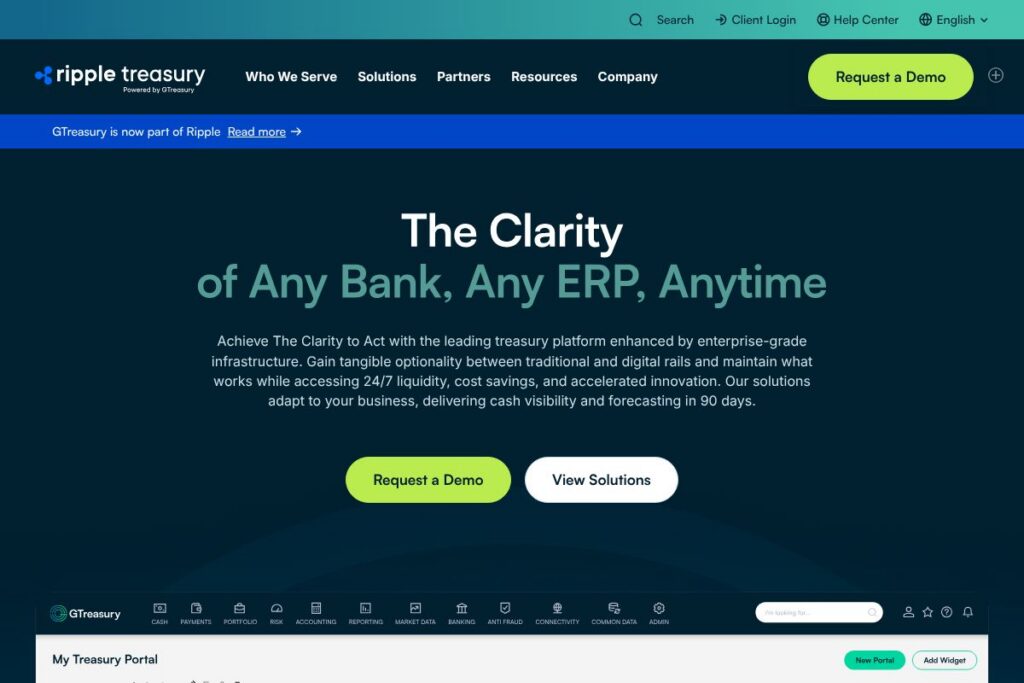

GTreasury: An Overview
GTreasury is a treasury management system designed to give finance leaders centralized visibility into global cash, forecasting, and risk exposure. The platform bundles bank connectivity, payments processing, cash forecasting, hedge accounting, and treasury analytics into a modular architecture so organizations can pick the capabilities they need while integrating with existing ERPs and banks.
Compared with competitors, GTreasury emphasizes modularity and relatively fast implementations. Kyriba offers a similarly broad SaaS treasury suite with strong cloud-native network capabilities and a large partner ecosystem, while Reval (now part of ION) is known for deep hedge accounting and risk analytics aimed at large corporates. For organizations focused narrowly on forecasting and AR collections, CashAnalytics provides a lighter, forecasting-first alternative with faster time to value.
GTreasury works well for mid-market and enterprise finance organizations that need a single source of truth for cash and risk, require multiple bank and ERP connections, and prefer a configurable platform rather than a fixed workflow. Its modular design makes it appropriate for treasuries that want to start with cash visibility and forecasting and then add payments, netting, or hedging as needs evolve.
How GTreasury Works
The platform aggregates position and transaction data from banks, ERPs, and trading systems to build a unified cash position across currencies and entities. Data ingestion uses secure bank file feeds, host-to-host connections, SWIFT messaging, and prebuilt ERP connectors so cash balances and transactions refresh automatically into the system.
Once data is centralized, GTreasury applies business rules and mapping to normalize accounts and currencies, then produces rolling cash forecasts, liquidity reports, and exposure views. Treasury teams can run what-if scenarios, schedule payments, execute netting runs, and create hedge strategies from the same dataset, reducing reconciliation work and manual spreadsheets.
Implementation is delivered as a combination of the SaaS platform and professional services; GTreasury highlights a rapid path to cash visibility, often achieved within 90 days through focused data onboarding and standard templates. Administrators manage users, permissions, and workflows inside the application while operations staff use dashboards and automated alerts to monitor intraday liquidity.
GTreasury features
GTreasury’s feature set centers on cash visibility, forecasting, payments, and risk management, with recent emphasis on automation and AI-assisted analytics. The platform is modular, so organizations typically implement core cash and forecasting first, then add payments, netting, and hedge accounting. GTreasury also provides professional services for implementation and ongoing support.
Total cash visibility
Centralized dashboards consolidate global bank balances, account hierarchies, and intraday positions so treasury can see liquidity across entities and currencies in one place. The visibility layer supports drill-downs to transaction detail and reconciles balances against ERP records to reduce manual variance investigations.
Cash flow forecasting
GTreasury creates rolling forecasts using historical cashflows, receivables/payables integration, and scenario-driven adjustments, enabling short-term and medium-term liquidity planning. Forecasts can be run at multiple levels of granularity, exported to stakeholders, and used to trigger funding or investment actions.
Risk management and hedging
The platform supports FX and interest rate exposure tracking, valuation, and hedge accounting to implement and document hedging strategies. Integrated analytics show exposures by currency or counterparty, and the system can generate hedge recommendations tied to policy rules.
Payments and bank connectivity
GTreasury centralizes payment initiation and supports multiple formats, host-to-host channels, and SWIFT integration to standardize payment flows and improve control. Payment workflows include approvals, segregation of duties, and audit trails to strengthen controls across treasury operations.
Netting and intercompany cash management
Automated netting reduces transaction volume and banking fees by consolidating counterparty flows across entities, while in-house banking features help centralize funding and intercompany lending. Netting runs can be scheduled and reconciled within the platform to simplify settlement.
GSmart AI and analytics
AI-assisted capabilities accelerate anomaly detection, forecast adjustments, and scenario analysis by highlighting patterns and suggesting adjustments based on historical data. Analytics modules produce reports and KPIs that help CFOs monitor liquidity efficiency and forecast accuracy.
Reporting, audit, and compliance
Prebuilt and configurable reports support treasury accounting, regulatory reporting, and audit readiness with exportable ledgers and transaction histories. The platform includes role-based access controls, logging, and encryption to support governance and compliance programs.
With these capabilities GTreasury helps treasury teams reduce manual work, shorten forecast cycles, and centralize control. The biggest benefit is a single, auditable source of cash and exposure data that supports treasury decision making at scale.
GTreasury pricing
GTreasury uses an enterprise subscription pricing model with modular licensing and implementation services tailored to company size, required modules, and integration complexity. Pricing is not published as fixed per-seat tiers; instead costs are structured around selected modules, number of legal entities, bank connections, and professional services for onboarding.
For details on licensing options, module scope, and to discuss a subscription that matches your treasury footprint, contact GTreasury through their site via the request a demo page or review the platform overview on GTreasury’s website.
What is GTreasury Used For?
Treasury teams use GTreasury to centralize cash data and produce accurate, auditable forecasts that inform short-term funding and investment decisions. The platform is commonly deployed to replace spreadsheet processes, aggregate balances from multiple banks, and standardize payment controls across jurisdictions.
Finance leaders also use GTreasury for managing FX and interest rate risk, automating netting and in-house bank operations, and streamlining hedge accounting documentation. Organizations with multiple ERPs, extensive bank networks, or complex intercompany flows find the modular approach useful for phased rollouts.
Pros and Cons of GTreasury
Pros
- Comprehensive cash visibility: Centralizes bank balances, transactions, and forecasts to reduce reliance on manual spreadsheets and improve intraday liquidity monitoring.
- Modular implementation: Allows teams to start with core cash and forecasting modules and expand into payments, netting, and hedging as needs grow, avoiding unnecessary features at launch.
- Strong bank connectivity: Supports host-to-host feeds, SWIFT, and file-based integrations to automate balance and payment data across multiple banking partners.
- Professional services and rapid onboarding: Implementation and services are geared toward fast time to value, with many customers achieving initial cash visibility within a short timeframe.
Cons
- Enterprise focus and cost: Geared toward mid-market and enterprise organizations, which can make total cost higher for small companies compared with lighter forecasting or accounting tools.
- Customization can increase complexity: Heavy customization or complex integrations may extend implementation timelines and require additional professional services.
- No public pricing tiers: Pricing is custom, which requires direct contact with sales to get an estimate and compare options.
Does GTreasury Offer a Free Trial?
GTreasury is a paid enterprise solution and does not provide a public free plan. Prospective customers can request product demonstrations, pilot programs, or proof-of-concept engagements through GTreasury’s request a demo page to validate fit and timelines before committing to a subscription.
GTreasury API and Integrations
GTreasury provides APIs and a range of integration methods for data ingestion and actioning, including secure file transfer, host-to-host feeds, and SWIFT connectivity. The platform integrates with major ERPs, bank networks, and treasury counterparties to automate balance updates and payment flows; see GTreasury’s integration capabilities for connector details.
For developer access and automation, GTreasury exposes endpoints and integration guides via its technical documentation for customers under contract; connection patterns typically include scheduled pulls, push notifications, and secure token-based authentication.
10 GTreasury alternatives
Paid alternatives to GTreasury
- Kyriba — A cloud-native treasury platform offering cash management, payments, and risk capabilities with a broad network of bank integrations and a large partner ecosystem.
- Reval — Focused on treasury and risk management with deep hedge accounting and valuation tools, typically used by large corporates with sophisticated risk workflows.
- FIS Quantum — An established treasury and payments solution that supports treasury operations, liquidity management, and corporate banking connectivity.
- TreasuryXpress — A modular, API-first treasury platform that targets faster deployments for treasury payments, cash visibility, and bank connectivity.
- CashAnalytics — Forecasting-first solution that provides advanced cash forecasting and AR insights; suitable for teams prioritizing forecast accuracy and collections visibility.
- ION Treasury (Openlink) — Enterprise treasury and energy trading systems with strong risk and trading features for corporates and financial institutions.
Open source alternatives to GTreasury
- Odoo — An open source ERP with accounting and cash management modules that can be extended to cover simple treasury workflows through community apps and custom integrations.
- ERPNext — An open source ERP that includes cash management, multi-currency support, and bank reconciliation features suitable for smaller treasuries or startups.
- Tryton — A modular open source business platform with accounting and payments modules that can be configured to handle basic treasury tasks and reporting.
Frequently asked questions about GTreasury
What is GTreasury used for?
GTreasury is used to centralize cash visibility, forecasting, payments, and risk management for corporate treasury teams. Organizations deploy it to reduce manual reconciliation, automate payments, and support hedge accounting.
Does GTreasury integrate with ERP systems?
Yes, GTreasury integrates with major ERP systems through prebuilt connectors and secure file or API-based feeds. These integrations allow automated posting of cash transactions and reconciliation with ledger balances.
Can GTreasury manage foreign exchange hedging?
Yes, GTreasury supports FX exposure management and hedge accounting workflows. The system tracks exposures, valuations, hedge documentation, and accounting treatment to align with treasury policies.
How much does GTreasury cost?
GTreasury uses enterprise, modular licensing and custom pricing based on selected modules, bank connections, and implementation services. To obtain a quote and discuss scope, contact the sales team via GTreasury’s request a demo page.
Is GTreasury suitable for mid-market companies?
GTreasury is suitable for both mid-market and enterprise organizations, particularly those with multiple bank relationships or complex cash flows. Mid-market companies that require modular rollout options can start with core cash visibility and add modules over time.
Final verdict: GTreasury
GTreasury is a robust, modular treasury platform that excels at centralizing cash visibility, automating payments, and supporting hedge accounting for organizations with multi-bank and multi-entity complexity. Its strengths are bank connectivity, modular licensing, and a focus on getting to reliable cash forecasting quickly, which reduces reliance on spreadsheets and manual reconciliation.
Compared with Kyriba, GTreasury follows a similar enterprise subscription model with modular add-ons, but GTreasury emphasizes configurable workflows and rapid onboarding to initial cash visibility. Pricing for both platforms is custom and tied to module selection and integration scope, so the choice often turns on specific feature depth, partner network, and implementation preferences rather than list prices.
For treasury teams that need a single source of truth for liquidity and risk and that plan phased adoption across payments, netting, and hedging, GTreasury is a strong candidate. Request a demo on GTreasury’s website to evaluate fit and timelines.