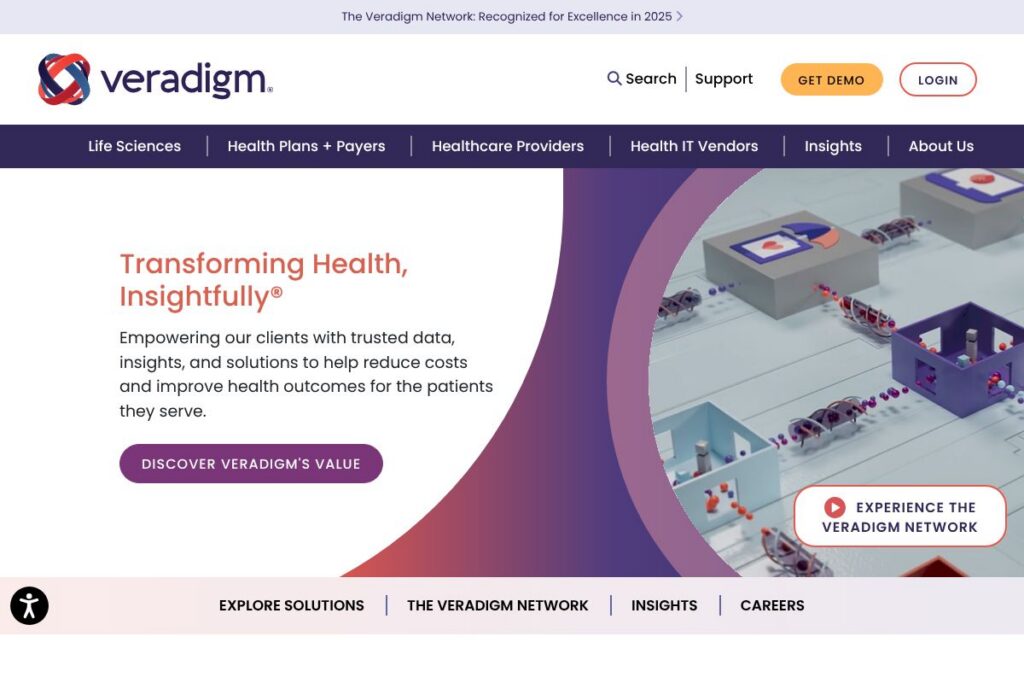

Veradigm: An Overview
Veradigm is a healthcare technology company that combines electronic health record capabilities, practice management, patient engagement, and a large clinical data network to deliver analytics and operational tools for providers, payers, and life sciences organizations. The platform focuses on validated, longitudinal clinical data and tools for reporting, quality management, clinical decision support, and research-ready datasets.
Compared with major EHR and data vendors, Veradigm sits between full enterprise EHR vendors like Epic and analytics-first companies such as FHIRX or niche RWD platforms. Compared to Epic, Veradigm emphasizes modular data products and analytics rather than a hospital-grade inpatient EHR; compared to Athenahealth, Veradigm places heavier emphasis on curated data assets and life sciences integrations. All of this makes Veradigm well suited for organizations that need scalable, analytics-driven solutions and data access without replacing large hospital EHR systems.
Veradigm performs particularly well when used to standardize clinical data for quality programs, build cohort definitions for research, and operationalize patient engagement for ambulatory settings. The platform is aimed at health systems, payers, clinical researchers, and vendors seeking access to a broad clinical data network and packaged analytics tools. For specific product details and demos, explore the Veradigm homepage or learn about the Veradigm Network for partner and data ecosystem information.
How Veradigm Helps Healthcare Organizations
Veradigm ingests clinical and claims data from its EHR platforms and partner networks, normalizes that information into standard models, and exposes analytics, reporting, and data extracts for downstream use. Teams can run quality measurement, create registries, and generate real-world evidence from consolidated datasets without building a data lake from scratch.
Implementation typically involves mapping local data to Veradigm schemas, configuring dashboards or reports for specific quality metrics, and setting up data feeds for research or care management. Clinical teams use embedded workflows in practice management and patient engagement modules to close care gaps, while analytics teams access deidentified datasets or managed services for cohort discovery and outcomes analysis.
What does Veradigm do?
Veradigm’s product family combines EHR and practice management capabilities with a suite of data and analytics products. Core capabilities include clinical documentation, revenue cycle tools, population health workflows, real-world data sets for research, and partner integrations through the Veradigm Network.
The platform includes several powerful capabilities worth highlighting:
Clinical and practice management
Clinical and practice management modules support outpatient documentation, scheduling, billing, and patient messaging, helping practices manage day-to-day operations and revenue cycle tasks in an integrated environment.
Data normalization and clinical datasets
Veradigm curates large, longitudinal clinical datasets from its own EHR products and partners, applying normalization and deidentification so organizations can use consistent fields for quality measurement, analytics, and research.
Quality measurement and reporting
Built-in quality measurement tools and configurable reports let organizations track performance against payer or regulatory metrics, generate registry exports, and automate parts of quality improvement workflows.
Population health and care management
Population health features enable risk stratification, gap closure, and care management workflows that help teams identify high-risk patients, manage outreach, and monitor intervention outcomes.
Real-world evidence and life sciences support
Data products tailored for life sciences customers include cohort discovery, longitudinal outcomes, and data extracts suitable for observational research, comparative effectiveness, and post-market surveillance.
Partner ecosystem and APIs
The Veradigm Network connects third-party solutions, analytics partners, and AI tools, enabling customers to extend capabilities through validated integrations and partner applications.
With these capabilities, Veradigm is positioned to deliver clinical-grade data and packaged analytics that reduce the work of assembling, cleaning, and operationalizing healthcare data across multiple use cases.
Veradigm pricing
Veradigm uses a commercial enterprise pricing model with custom quotes tailored to product scope, data access, deployment needs, and support. Pricing is not published as standard list tiers; organizations engage sales to define scope, licensing, and implementation costs.
For specifics on licensing models and to request a quote, contact Veradigm through their contact page or review service descriptions on the Veradigm solutions pages for product-level guidance.
What is Veradigm Used For?
Veradigm is commonly used to run ambulatory clinical workflows, manage practice administration, and provide patient engagement tools for outpatient practices. Its EHR and practice management modules are oriented toward physician groups, clinics, and ambulatory networks that need integrated documentation and billing support.
On the analytics side, Veradigm is used for quality reporting, population health management, and real-world data extraction for research and life sciences programs. Payers and research organizations use the curated datasets to build cohorts, measure outcomes, and support value-based care initiatives.
Pros and Cons of Veradigm
Pros
- Broad clinical dataset access: Veradigm curates longitudinal EHR data that supports quality reporting, cohort discovery, and real-world evidence generation, which reduces the time researchers spend preparing data.
- Integrated ambulatory tooling: Practice management, clinical documentation, and patient engagement tools are bundled, which helps smaller health organizations avoid integrating multiple point solutions.
- Partner ecosystem: The Veradigm Network connects third-party analytics, AI, and specialty solutions, which can accelerate deployment of niche capabilities without custom development.
Cons
- Enterprise engagement required: Many Veradigm offerings are delivered through custom contracts and professional services, which can increase procurement lead times and implementation cost for small practices.
- Limited inpatient focus: Organizations seeking a full hospital inpatient EHR will find Veradigm oriented toward ambulatory and data products rather than large-scale inpatient clinical systems.
Does Veradigm Offer a Free Trial?
Veradigm offers enterprise demos and custom evaluation arrangements rather than a public free plan. Prospective customers typically request a demo or pilot through the contact page to evaluate fit, data extracts, and reporting capabilities before contracting.
Veradigm API and Integrations
Veradigm provides integration options and developer-facing interfaces to connect with third-party applications and the Veradigm Network. The platform supports data exports, HL7 and FHIR-based connectivity, and partner integrations for analytics and AI tools.
Developers and integrators can review integration capabilities and partner programs via the Veradigm Network overview or request technical documentation and API access through Veradigm’s contact resources.
10 Veradigm alternatives
Paid alternatives to Veradigm
- Epic: Enterprise EHR with deep inpatient and ambulatory functionality, extensive analytics and population health modules used by large health systems.
- Cerner (now part of Oracle Health): Integrated EHR and data platform with strong hospital and revenue cycle capabilities and large-scale data services.
- Athenahealth: Cloud-native ambulatory EHR and practice management with marketplace integrations and revenue cycle services aimed at physician groups.
- eClinicalWorks: Ambulatory EHR and practice management with population health and patient engagement features for medium to large practices.
- NextGen Healthcare: EHR and RCM solutions focused on ambulatory settings with configurable specialty workflows and analytics.
- eMDs: Practice management and EHR solutions oriented to ambulatory practices with integrated billing and reporting.
- Meditech: Hospital and ambulatory EHR platform used by health systems that require integrated inpatient and outpatient workflows.
Open source alternatives to Veradigm
- OpenEMR: Community-supported EHR and practice management system that can be self-hosted and extended for data extraction and reporting.
- OpenMRS: A modular medical record system widely used in global health and research projects, with a strong developer community for data models.
- GNU Health: An open source health and hospital information system that includes patient management, public health, and reporting modules.
- Oscar EMR: Open source EHR used primarily in primary care settings, with data export capabilities for secondary use.
Frequently asked questions about Veradigm
What does Veradigm do for providers?
Veradigm supplies EHR, practice management, and patient engagement tools for ambulatory care. Providers use these modules to document care, schedule visits, handle billing, and manage patient communications.
Does Veradigm provide data for research and life sciences?
Yes, Veradigm offers curated clinical datasets and services for real-world evidence and cohort discovery. Life sciences teams use those datasets for observational studies, outcomes research, and post-market surveillance.
How does Veradigm price its products?
Veradigm uses custom enterprise pricing rather than public list tiers. Organizations should contact sales through the contact page to discuss licensing, data access, and implementation costs.
Can Veradigm integrate with other EHRs and third-party tools?
Yes, Veradigm supports integrations through standard interfaces and the Veradigm Network. Connectivity options include HL7, FHIR, and partner APIs to enable data exchange and third-party analytics.
Who should consider using Veradigm?
Health systems, payers, and life sciences organizations that need curated clinical data and ambulatory-focused EHR capabilities should evaluate Veradigm. It is particularly relevant when the priority is access to standardized datasets and packaged analytics rather than replacing large inpatient EHR systems.
Final Verdict: Veradigm
Veradigm combines ambulatory EHR and practice management with a strong emphasis on curated clinical datasets and analytics, making it a practical choice for organizations focused on outpatient workflows, quality measurement, and real-world evidence. Its Network and partner ecosystem simplify access to specialty analytics and AI tools without building integrations from scratch.
Compared with Epic, which targets large health systems with full inpatient and ambulatory suites and typically requires substantial implementation investment, Veradigm offers modular data and analytics products with custom enterprise pricing that can be more accessible to ambulatory organizations and research teams. To evaluate fit and obtain pricing, request a demo or quote through the Veradigm contact page.