Amplitude: An Overview
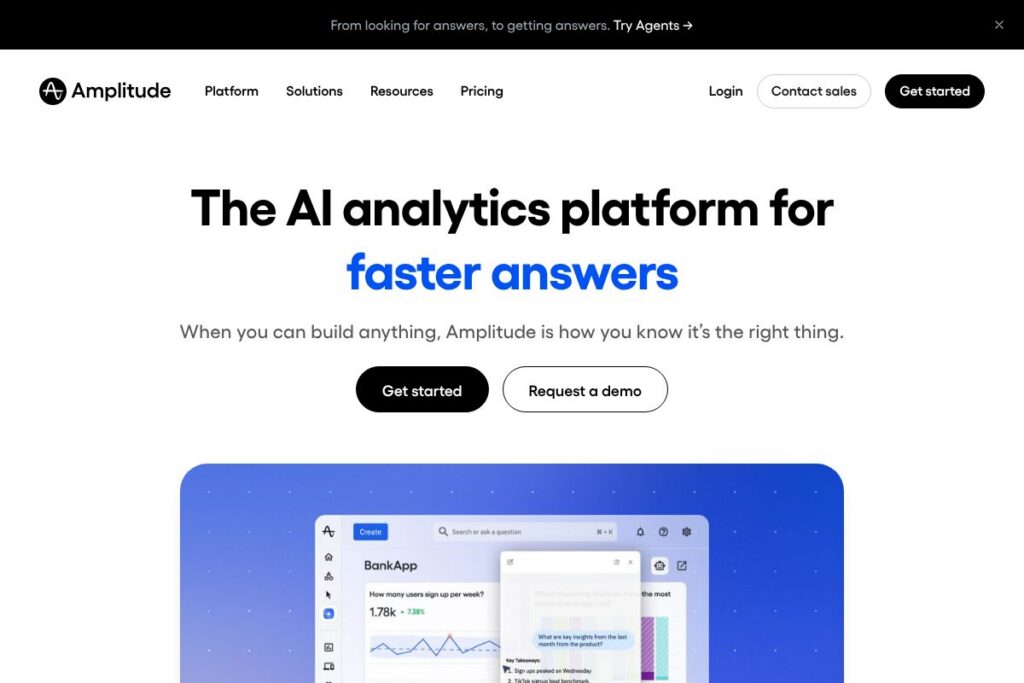
Amplitude is a product analytics platform designed to help teams measure user behavior, identify retention and conversion drivers, and run feature experiments. It combines event-level analytics, behavioral reporting, session replay, and experimentation tools in a single platform so product and growth teams can test ideas and validate outcomes without stitching multiple tools together. Explore Amplitude’s capabilities on the Amplitude website for product pages and team resources.
Amplitude competes directly with analytics and experimentation vendors such as Mixpanel, Google Analytics 4, and Pendo. Compared with Mixpanel, Amplitude places more emphasis on behavioral modeling, complex cohort analysis, and a consolidated experimentation workflow. Compared with Google Analytics 4, Amplitude focuses on product-centric event modeling and behavioral funnels rather than web-traffic-oriented metrics. Against Pendo, Amplitude’s strength is its analytics and experimentation depth, while Pendo centers on in-app guidance and onboarding flows.
All of this makes Amplitude particularly strong for product teams that need deep behavioral insights and integrated experimentation. It works well for organizations that manage multiple digital products or need consolidated analytics and experimentation across web and mobile applications.
How Amplitude Works
Amplitude collects event data via SDKs for web, iOS, Android, and server-side sources, as well as through data pipelines and tag managers. Events are modeled around user actions and properties, enabling funnels, retention, and cohort analysis built on a unified event schema.
Data is processed in near real time so teams can build dashboards, run segmentation, and kick off experiments quickly. The platform pairs analytics with experimentation, allowing teams to define feature flags, route variants, and measure treatment effects using the same event dataset.
Typical workflows include instrumenting events for a new feature, creating a funnel to identify drop-off, segmenting users into behavioral cohorts, and launching an experiment to validate a hypothesis. Results feed back into product decisions, roadmap prioritization, and follow-up experiments.
Amplitude features
Amplitude’s platform centers on behavioral analytics, experimentation, and data governance. Core capabilities include product analytics, real-time funnels, cohort analysis, session replay, feature experimentation, web experimentation, guides and surveys, and enterprise integrations. The product continuously adds features around behavioral modeling and data controls to support scaling analytics across teams.
Product Analytics
Product analytics provides event-based reporting, conversion funnels, retention analysis, and behavioral cohorting designed for product teams rather than purely marketing metrics. It helps teams identify where users drop off and which behaviors correlate with long-term retention.
Web Analytics
Web analytics in Amplitude focuses on user journeys and event-driven metrics for web products, including path analysis and conversion tracking that tie directly into product KPIs. Teams can compare web behavior across segments and product versions.
Session Replay
Session replay lets teams watch user sessions to contextualize quantitative findings, reproduce issues, and validate UX changes. Replays are searchable by events or cohorts to link behavioral signals to real sessions.
Feature Experimentation
Feature experimentation integrates feature flagging and A/B testing with the analytics dataset so results are measured against the same events used for product reporting. This reduces instrumentation gaps between experiments and analytics and simplifies measuring lift or regressions.
Web Experimentation
Web experimentation offers targeted variant delivery and measurement for browser-based experiences, with built-in metrics and statistical analysis to assess impact. The setup ties directly into conversion funnels and cohort reports.
Guides and Surveys
Guides and surveys enable in-app messaging, onboarding flows, and micro-surveys to collect qualitative feedback and drive targeted experiences. Responses can be joined with behavioral data to enrich segmentation and experiment targeting.
Data Governance
Data governance features focus on event schema management, access controls, and lineage so organizations can scale analytics with consistent instrumentation. Governance tools help reduce fragmentation as multiple teams instrument events and create reports.
Integrations
Amplitude integrates with data warehouses, customer data platforms, collaboration tools, and marketing systems to operationalize analytics across the stack. Common integrations include Snowflake, Segment, Salesforce, Looker, and analytics pipelines so teams can sync events or export results for deeper analysis.
With these features, the biggest benefit is a product-focused analytics workflow where measurement, experimentation, and governance live in one platform. That reduces context switching and produces more reliable, repeatable insights for product decisions.
Amplitude pricing
Amplitude offers enterprise-grade pricing that is tailored to organizational needs rather than published flat-rate plans. Commercial customers are typically offered self-serve tiers and custom enterprise contracts depending on event volume, feature set, and support needs; for exact terms and available plans, visit the Amplitude website to contact sales or request a demo.
Enterprise
Enterprise – Custom pricing and contract terms, including advanced data governance, single sign-on, dedicated support, and SLAs; pricing is determined based on event volume, feature usage, and deployment needs.
Self-Serve and Starter Options
Self-Serve – Amplitude provides self-serve options and a free plan for teams getting started, with upgrade paths to paid tiers and add-on experimentation features; contact the team via the Amplitude signup and demo pages for specific details and guidance.
What is Amplitude Used For?
Amplitude is commonly used to measure product adoption, map user journeys, and uncover the behaviors that lead to retention and conversion. Product managers and growth teams use funnels, retention charts, and cohort analysis to prioritize roadmap work and measure feature impact.
It is also used to run experiments and feature rollouts, where the same event model feeds both analytics and A/B testing to reduce discrepancies. Data teams use Amplitude to standardize event schemas and to integrate product data with downstream BI and data warehouses.
Amplitude’s Strengths and Weaknesses
Pros
- Behavioral-first analytics: Amplitude’s event model and behavioral reports make it easier to surface the actions that drive retention and engagement.
- Integrated experimentation: Combining analytics and feature experimentation reduces instrumentation mismatches and speeds up the validate-and-iterate cycle.
- Enterprise-grade governance: Schema controls, role-based access, and data lineage tools help large organizations scale consistent measurement across teams.
- Rich integrations: Native connectors to warehouses and data platforms allow teams to operationalize product insights across BI and customer systems.
Cons
- Custom pricing model: Enterprise-focused pricing means smaller teams may need to evaluate the free or self-serve tiers carefully before committing to paid plans.
- Learning curve for instrumentation: Achieving reliable event schemas and high-quality behavioral analysis requires disciplined instrumentation and governance work.
- Platform consolidation trade-offs: Teams that prefer best-of-breed point solutions for session replay, experimentation, or CDP capabilities may need to supplement Amplitude with specialist tools.
Is Amplitude Free to Try?
Amplitude offers a free plan and self-serve signup options. The free tier provides basic product analytics and a path to try core reporting and limited experimentation, while demo and trial access to enterprise capabilities can be arranged through the Amplitude contact and signup pages.
Amplitude API and Integrations
Amplitude provides developer APIs and SDKs for event ingestion, user management, and export operations; the Amplitude developer documentation details available endpoints, SDKs, and examples for common languages. These APIs let teams send events from backend services, mobile and web clients, or ETL pipelines.
Amplitude also lists connectors for warehouses and analytics tools, including Snowflake, Segment, Looker, Salesforce, and collaboration platforms to route data into downstream reporting and activation systems. See Amplitude’s integration guides on the product integrations pages for setup instructions.
10 Amplitude alternatives
Paid alternatives to Amplitude
- Mixpanel — Product analytics with event-driven funnels and retention tools that scale from startups to large teams; often selected for simpler onboarding and clear self-serve tiers. See Mixpanel‘s pricing and plans at the Mixpanel pricing pages.
- Heap — Automatic event capture and retroactive analysis reduce upfront instrumentation, useful for teams that want quick insights without detailed event planning.
- Pendo — Combines product analytics with in-app guides and messaging, favored by teams focused on onboarding and user education.
- Adobe Analytics — Enterprise web analytics with deep customization and attribution capabilities, typically chosen by very large organizations with advanced analytics needs.
- FullStory — Session replay and UX analytics with robust search and debugging tools, often paired with other analytics platforms for behavioral context.
- Google Analytics 4 — Web and app analytics with a free tier and wide adoption; less focused on product experimentation but useful for cross-channel measurement.
- Snowplow Insights — Offers managed analytics and behavioral modeling capabilities with an emphasis on raw event data control and custom pipelines.
Open source alternatives to Amplitude
- PostHog — Open source product analytics and feature flags that can be self-hosted, with event-based dashboards and session insights.
- Matomo — Privacy-focused web analytics platform that can be self-hosted or cloud-hosted, suitable for teams that need full data ownership.
- Snowplow — Provides open-source collectors and processors for event-level data collection, enabling custom analytics stacks on top of raw events.
- Plausible — Lightweight, privacy-respecting web analytics that is open source and easy to self-host for basic web metrics.
Frequently asked questions about Amplitude
What is Amplitude used for?
Amplitude is used for product analytics, behavioral reporting, and experimentation. Teams use it to measure user journeys, run A/B tests, and analyze retention drivers.
Does Amplitude offer an API for event ingestion?
Yes, Amplitude provides SDKs and APIs for sending events and exporting data. See the Amplitude developer documentation for SDKs and API endpoints.
Can Amplitude replace separate experimentation tools?
Amplitude can handle both analytics and feature experimentation within the same platform. That integration helps reduce discrepancies between experiment instrumentation and analytics reporting.
How does Amplitude integrate with data warehouses?
Amplitude supports connectors to warehouses such as Snowflake and BigQuery. These integrations let teams export event data for custom analysis and BI workflows; check the integration guides for setup steps.
Is Amplitude suitable for small product teams?
Amplitude works for small teams and scales to enterprises, but small teams should evaluate the free and self-serve tiers to confirm feature coverage and cost before adopting paid plans.
Final Verdict: Amplitude
Amplitude excels at behavioral analytics and offers a unified path from event capture to experimentation and governance, which helps product teams make confident, data-informed decisions. Its strong cohort analysis, funnel reporting, and feature experimentation features make it a solid choice for organizations that prioritize product-led growth and repeatable measurement.
Compared with Mixpanel, which often provides more transparent self-serve pricing and simpler onboarding for small teams, Amplitude delivers deeper behavioral modeling and enterprise governance at scale. If your team needs consolidated analytics and experimentation for multiple products and values robust data controls, Amplitude is a strong candidate; teams primarily seeking a lighter, lower-cost entry point may find Mixpanel or single-purpose tools more appropriate.