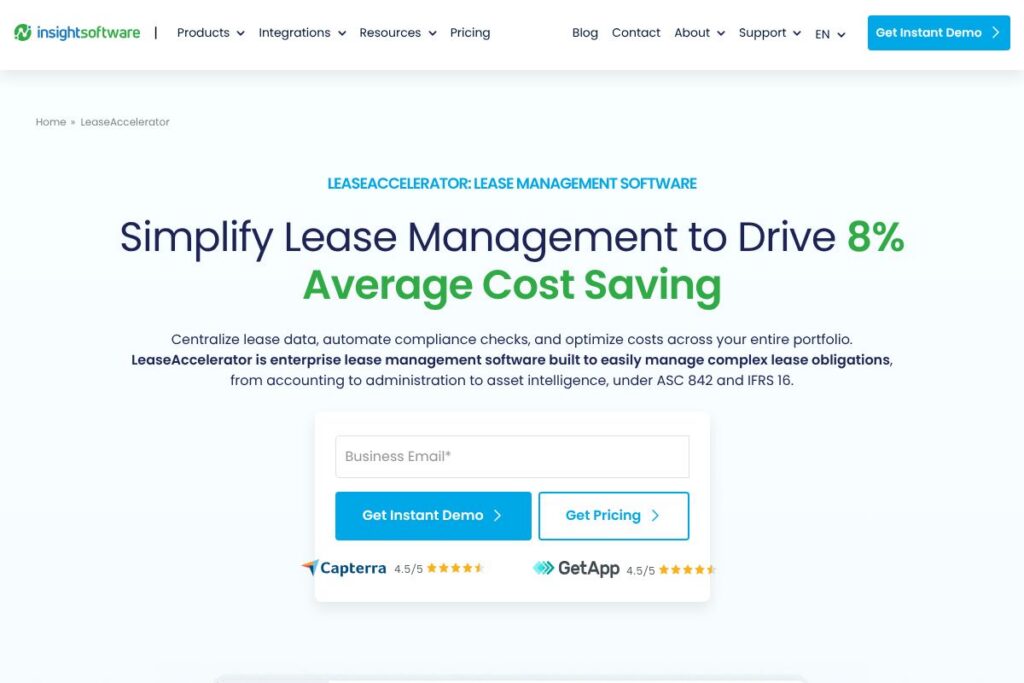

LeaseAccelerator: An Overview
LeaseAccelerator combines lease accounting, lease administration, and asset lifecycle intelligence into a single platform built for continuous compliance. The system provides a full lease sub-ledger, automated classification and validation, roll-forward analytics with drill-down transparency, and bidirectional ERP integrations to ensure accounting integrity and reduce manual close work. For organizations facing complex portfolios and audit scrutiny, LeaseAccelerator centralizes contracts, schedules, and events so finance can treat leasing as a managed function rather than a spreadsheet exercise.
Compared with other lease software, LeaseAccelerator is broader in scope. LeaseQuery targets mid-market teams with strong lease accounting and reporting, but LeaseAccelerator emphasizes sub-ledger protection and lifecycle analytics that scale for large, distributed portfolios. Visual Lease focuses on lease administration and operational workflows, while LeaseAccelerator consolidates both administration and accounting into one purpose-built system. Nakisa offers strong enterprise capabilities for large deployments, yet LeaseAccelerator is often chosen for its combination of accounting automation and decisioning features such as lease-vs-buy analysis and end-of-term recommendations.
All of this makes LeaseAccelerator particularly well suited to finance and accounting teams at larger organizations that require continuous ASC 842 and IFRS 16 compliance, extensive ERP connectivity, and asset-level visibility to support strategic leasing decisions.
How LeaseAccelerator Works
LeaseAccelerator ingests lease contracts and related documents, extracts key terms, and creates a centralized lease sub-ledger that feeds accounting schedules and events. The platform applies automated classification rules and accounting calculations, producing system-calculated amortization, interest accretion, right-of-use balances, and lease liabilities that align with ASC 842 and IFRS 16.
Automated workflows route approvals, handle modifications and remeasurements, and generate journal entries that post to ERPs via secure integrations. The system maintains roll-forward analytics with drill-down explanations so month-over-month changes are transparent, and lifecycle intelligence surfaces renewal, termination, and disposal decision points for asset-level management.
LeaseAccelerator features
LeaseAccelerator is organized around continuous lease compliance, centralized administration, and lifecycle intelligence. Core capabilities include a full lease sub-ledger, automated classification and validation, ERP integrations, roll-forward analytics, and decisioning tools that go beyond compliance reporting. The platform also automates recurring accounting tasks to accelerate closes and reduce manual errors.
Let’s talk LeaseAccelerator’s Features
Lease sub-ledger
The platform maintains a complete lease sub-ledger that preserves transaction-level detail and protects the general ledger from manual adjustments. This separation supports auditability, enables automated journal generation, and simplifies reconciliations with ERP systems.
Automated accounting and classification
LeaseAccelerator applies built-in validation rules and automated classification logic to determine accounting treatment, then calculates amortization schedules, interest accretion, right-of-use asset balances, and lease liabilities in accordance with ASC 842 and IFRS 16. Automation reduces manual rework and helps ensure consistent treatment across a portfolio.
Roll-forward analytics and drill-down reporting
Roll-forward analytics display period-over-period movements with explanations and supporting transaction detail, enabling fast month-end closes and clearer variance analysis. Finance teams can drill from summary balances into individual contract events and journal entries for audit-ready transparency.
ERP integrations and journal automation
Deep integrations with major ERPs enable automated, secure posting of journal entries and reconciliations, removing repetitive manual uploads and reducing interface errors. Integration capabilities include mappings for common GL accounts, cost centers, and multi-entity deployments to fit enterprise accounting structures.
Lease administration and lifecycle intelligence
LeaseAccelerator centralizes contracts, critical dates, payment schedules, and asset-level metadata so operational teams can manage renewals, options, and end-of-term decisions in one place. Built-in decisioning tools like lease-vs-buy analysis and end-of-term recommendations help turn lease data into actionable financial insight.
Audit readiness and controls
Standardized workflows, role-based access controls, and an auditable transaction history make it easier to prepare for internal and external audits. The platform supports documented change trails for modifications, impairments, and renewals to satisfy scrutiny from auditors and regulators.
With these capabilities, the biggest benefit is continuous compliance plus lifecycle visibility: organizations get both reliable accounting and operational lease intelligence in a single system, which shortens closes and improves decision quality. Explore the platform overview and the capabilities page for more technical detail.
LeaseAccelerator pricing
LeaseAccelerator uses a custom enterprise pricing model that is tailored to portfolio complexity, deployment scope, and required integrations. Pricing is typically provided via custom quotes rather than fixed public plans, reflecting the need to size implementations for large or distributed lease portfolios.
For current pricing details and to request a tailored quote, view LeaseAccelerator’s enterprise pricing and contact options on the official site.
What is LeaseAccelerator Used For?
LeaseAccelerator is used to centralize lease contracts, automate lease accounting, and maintain audit-ready schedules and journals across the lease lifecycle. Teams use it to ensure continuous compliance with ASC 842 and IFRS 16 while reducing manual work during month-end closes.
It is also used to support operational lease administration and strategic decisions, including lease renewal planning, lease-vs-buy analysis, and asset-level tracking, making it useful for finance, real estate, procurement, and fleet teams that manage leased assets.
Pros and Cons of LeaseAccelerator
Pros
- Comprehensive lease accounting: LeaseAccelerator provides a full lease sub-ledger and automated calculations that reduce manual close activity and improve auditability.
- Lifecycle intelligence: The platform combines accounting with lease-vs-buy analysis, end-of-term decisioning, and asset-level visibility for operational and strategic use.
- Enterprise integrations: Deep ERP connectivity and configurable mappings allow secure journal automation and scalable deployments across large organizations.
- Continuous compliance: Automated handling of modifications, remeasurements, and renewals helps maintain compliance after initial adoption.
Cons
- Enterprise focus: The platform is designed for mid-market and larger enterprises, so smaller organizations with simple portfolios may find it more functionality than needed. This can translate to longer implementation times and higher total cost of ownership compared with lightweight tools.
- Custom pricing approach: Because pricing is custom, prospective buyers must engage sales to obtain quotes, which can slow initial evaluation for teams seeking immediate per-user pricing comparisons.
Does LeaseAccelerator Offer a Free Trial?
LeaseAccelerator offers custom enterprise engagements rather than a public free plan or trial. Prospective customers can request a demo or pilot through the vendor to evaluate functionality; contact options and demo requests are available via the vendor’s contact page.
LeaseAccelerator API and Integrations
LeaseAccelerator provides API and connector-based integration options to synchronize data with major ERPs and enterprise systems, supporting secure journal exports and data imports for contracts and payments. Common integrations include SAP, Oracle, NetSuite, and Workday, plus bespoke mappings for multi-entity accounting structures.
See the vendor’s information on ERP integrations and connectors for technical details and integration guides. For developer-focused inquiries, contact sales or implementation teams to access API documentation and sandbox options.
10 LeaseAccelerator alternatives
Paid alternatives to LeaseAccelerator
- LeaseQuery – Lease accounting software focused on mid-market finance teams, with clear reporting and audit tools tailored to ASC 842 and IFRS 16.
- Visual Lease – A lease administration and accounting platform that emphasizes operational workflows and centralized lease records for real estate and equipment portfolios.
- Nakisa – Enterprise lease and asset management platform with strong capabilities for large, global deployments and complex accounting scenarios.
- CoStar Real Estate Manager – Real estate and lease administration software that supports portfolio management, accounting, and real estate operations at scale.
- IBM TRIRIGA – An enterprise property and lease management solution within a broader facilities and real estate portfolio management suite.
- ProLease – Lease administration and accounting software that combines operational lease management with reporting and vendor tracking.
- Consilio (formerly Visual Lease for some markets) – Provides lease lifecycle management and audit support for global portfolios.
Open source alternatives to LeaseAccelerator
- ERPNext – Open source ERP with asset and accounting modules that can be extended for basic lease tracking and reporting for smaller organizations.
- Odoo – Modular open source ERP where leasing and asset modules can be configured or extended to manage contracts and payments in a centralized system.
- OpenMAINT – Open source solution focused on asset and facility management that can be adapted for lease-related asset tracking and lifecycle records.
Frequently asked questions about LeaseAccelerator
What is LeaseAccelerator used for?
LeaseAccelerator is used to automate lease accounting and centralize lease administration for continuous ASC 842 and IFRS 16 compliance. Organizations use it to manage contracts, generate journal entries, and streamline month-end lease accounting close tasks.
Does LeaseAccelerator integrate with SAP and Oracle?
Yes, LeaseAccelerator includes deep integrations with major ERPs such as SAP and Oracle. Integrations support automated journal exports, mapping of accounting structures, and reconciliation workflows to the general ledger.
Can LeaseAccelerator handle lease modifications and remeasurements?
Yes, the platform automates modifications, remeasurements, and impairment treatment to maintain ongoing compliance. Built-in validation rules and workflows reduce manual errors when contract terms change.
How does LeaseAccelerator support audit readiness?
LeaseAccelerator provides an auditable sub-ledger, change history, and roll-forward analytics with drill-down detail. These features make it simpler to produce documentation and reconciliations required by internal and external auditors.
Is LeaseAccelerator suitable for large global portfolios?
Yes, LeaseAccelerator is designed for mid-market to enterprise deployments and scales to large, multi-entity portfolios. Its ERP integrations, configurable mappings, and lifecycle intelligence support complex and distributed leasing environments.
Final verdict: LeaseAccelerator
LeaseAccelerator excels at combining lease accounting, centralized administration, and asset lifecycle intelligence into one platform that supports continuous compliance and strategic decisioning. Its full lease sub-ledger, automated accounting, and deep ERP integrations make it a strong fit for finance teams managing complex portfolios and facing audit scrutiny.
Compared with competitors like LeaseQuery, which targets mid-market buyers with transparent pricing and a focus on accounting, LeaseAccelerator targets larger organizations that need enterprise-grade integrations and lifecycle analytics. Pricing for LeaseAccelerator is typically custom to the deployment, while some competitors offer published mid-market plans; evaluate both feature needs and implementation scope when comparing options. For more on capabilities and to request pricing, consult LeaseAccelerator’s capabilities page and the contact page.