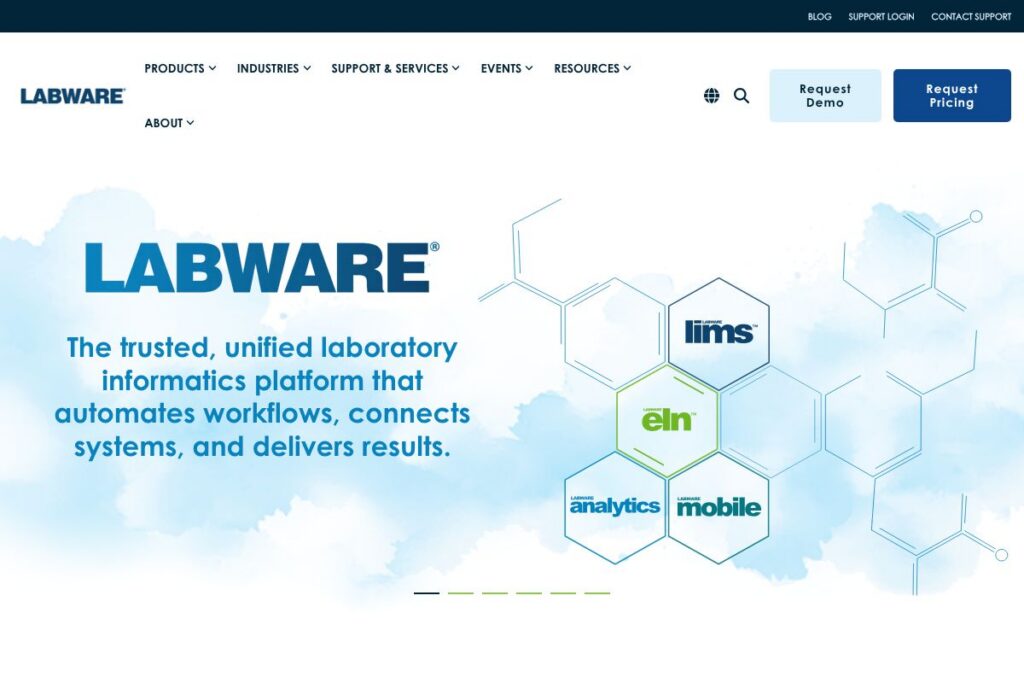

What is LabWare
LabWare is an enterprise LIMS and ELN suite used to manage samples, tests, workflows, and laboratory data across regulated and research environments. It combines sample tracking, electronic records, audit trails, and reporting tools to help labs meet quality and compliance requirements while increasing throughput.
LabWare competes directly with other enterprise LIMS and ELN vendors such as Thermo Fisher SampleManager LIMS, LabVantage, and STARLIMS, but it is often chosen for its broad configurability and long history in highly regulated industries. Compared with Thermo Fisher SampleManager LIMS, LabWare emphasizes deep workflow configurability and an extensive partner ecosystem. Against LabVantage, LabWare typically matches or exceeds in instrument connectivity and customization options, while STARLIMS can be positioned similarly for certain regulated sectors.
All of this makes LabWare well suited for large laboratories and organizations that require comprehensive process control, robust reporting, and strict compliance support. It is particularly relevant for pharmaceutical, biopharma, environmental, food and beverage, and clinical testing labs that need enterprise-grade LIMS and ELN capabilities.
How LabWare Works
LabWare models laboratory operations around configurable sample and test workflows that map to a facility’s SOPs. Users define sample types, test methods, and approval steps; the system then enforces those processes through electronic worksheets, signatures, and role-based access controls.
Instrument integration and data capture are handled through connectivity modules that ingest results directly into the LIMS, reducing manual transcription. Results feed into reporting and analytics modules so labs can consolidate, search, and trend data, and automatically generate final reports such as certificates of analysis.
Implementation typically involves a discovery phase to capture requirements, configuration of workflows and data models, instrument and ERP integrations, validation and user training, and then go-live with ongoing support and upgrades. Many organizations work with LabWare professional services or certified partners for deployment and validation.
What does LabWare do?
LabWare’s platform is organized around sample management, workflow automation, ELN functionality, and compliance controls. Core capabilities include electronic records and signatures, instrument connectivity, configurable workflows, and reporting that supports COA generation and trend analysis.
Let’s talk LabWare’s Features
Robust Reporting
Reporting tools consolidate test results and metadata into searchable tables and trend charts and support automated final reports such as certificates of analysis. This helps quality teams produce regulatory submissions and customer-facing documents with consistent format and traceability.
Reduced Costs
Process automation reduces manual entry, minimizes rework, and shortens turnaround times which together lower operational costs and increase lab productivity. Configurable workflows allow teams to remove redundant steps and standardize resource usage across sites.
Quality & Compliance
The platform enforces defined operating procedures using electronic records, signatures, audit trails, and versioned documentation, supporting compliance with standards such as FDA 21 CFR Part 11 and ISO guidelines. Role-based access and secure recordkeeping simplify inspections and audits.
Instrument Integration
Instrument connectivity modules and drivers enable direct import of analytical data into the LIMS, improving data integrity and reducing transcription errors. Integrations typically include chromatography, mass spectrometry, spectrophotometers, and custom instruments via standard protocols.
Sample and Workflow Management
Comprehensive sample lifecycle tracking includes sample intake, chain of custody, storage location, test assignment, and disposal. Workflow engines route tasks, trigger notifications, and capture approvals to maintain consistent process control.
Security and Enterprise Scalability
LabWare supports multi-site deployments with centralized configuration, user provisioning, and enterprise authentication options. Security controls, backup strategies, and audit capabilities support high-availability and large-scale lab operations.
With these capabilities, LabWare helps labs reduce manual work, maintain regulatory compliance, and generate the documentation required for quality assurance and customer reporting.
LabWare pricing
LabWare uses a custom enterprise pricing model rather than publicly listed subscription tiers. Pricing depends on deployment choices, number of users and sites, required modules such as ELN or instrument connectivity, and options for implementation and validation services.
For tailored cost estimates and information about licensing models and deployment options, contact LabWare through their official site and request a consultation or demo via LabWare’s contact page for pricing and deployment guidance.
What is LabWare Used For?
LabWare is commonly used for regulated laboratory operations where traceability, auditability, and electronic records are required. Typical applications include pharmaceutical stability testing, clinical labs, environmental monitoring, food safety testing, and R&D labs that need structured experiment documentation.
Teams use LabWare to centralize sample inventories, automate test assignments, enforce SOPs, integrate instrument outputs, and produce regulatory and customer-facing reports. It is especially useful for organizations that operate multiple sites or need to harmonize processes across divisions.
Pros and cons of LabWare
Pros
- Extensive configurability: LabWare can be tailored to complex workflows and industry-specific requirements, enabling labs to map their exact processes into the system.
- Comprehensive compliance features: Electronic signatures, audit trails, and documentation controls provide strong support for regulated environments and inspections.
- Strong instrument and system connectivity: Native and partner integrations make it practical to capture instrument output and connect with ERP or LIMS ecosystems, reducing manual steps.
Cons
- Enterprise implementation complexity: Deployments can require significant planning, validation, and professional services which increases time to value for smaller teams.
- Custom pricing and licensing model: Because pricing is tailored, it can be difficult for buyers to estimate total costs without engaging sales and services discussions.
Does LabWare Offer a Free Trial?
LabWare requires contacting sales for licensing and does not provide a public free tier or self-serve trial. Prospective customers can request a demo or engage with LabWare professional services to access a guided evaluation that maps to their processes and validation needs; reach out through LabWare’s contact page to schedule a demo.
LabWare API and Integrations
LabWare provides integration capabilities for instrument connectivity, LIMS-to-ERP exchange, and data import/export; these are typically implemented via standard protocols and vendor-specific drivers. For developers and integrators, consult LabWare’s integration resources and partner pages on their site for technical guidance and supported connectors.
Many deployments use LabWare alongside laboratory automation, middleware, and enterprise systems to create connected workflows; integration planning is a standard part of implementation and can be discussed with LabWare or certified partners through LabWare’s solutions pages.
10 LabWare alternatives
Paid alternatives to LabWare
- Thermo Fisher SampleManager LIMS — An enterprise LIMS with strong support for regulated labs and deep analytics and reporting capabilities.
- LabVantage — A configurable LIMS and ELN platform aimed at large-scale labs with emphasis on data management and integrations.
- STARLIMS — A laboratory informatics system used in clinical, public health, and regulated testing environments.
- Benchling — Cloud-native R&D and ELN platform popular with biotech and life sciences teams for experiment planning and data capture.
- LabKey Server — Platform for managing, integrating, and analyzing biomedical research data with collaboration features.
- Labguru — Lab management and ELN software suited to academic and small-to-medium biotech labs with inventory and protocol management.
Open source alternatives to LabWare
- Bika LIMS — An open-source LIMS tailored for clinical and analytical laboratories with community-driven modules.
- LabKey Server — Provides an open-source platform for biomedical data integration and collaboration, with optional commercial support.
- OpenELIS — An open-source laboratory information system focused on public health and diagnostic lab workflows.
Frequently asked questions about LabWare
What is LabWare used for?
LabWare is used to manage laboratory workflows, samples, and data across regulated and research labs. It centralizes sample tracking, enforces electronic records, and supports reporting and instrument connectivity for enterprise operations.
Does LabWare support instrument integration?
Yes, LabWare supports instrument connectivity and data capture. Integrations use drivers, middleware, and standard protocols to import analytical results directly into the LIMS and reduce manual transcription.
How does LabWare handle compliance requirements?
LabWare provides electronic records, signatures, audit trails, and role-based access control to support regulatory compliance. These features help labs meet standards such as FDA 21 CFR Part 11 and related quality guidelines.
Can LabWare be deployed across multiple sites?
Yes, LabWare is designed for multi-site and enterprise deployments. Centralized configuration and scalable architectures enable harmonized workflows and data visibility across locations.
Is there a public price list for LabWare?
LabWare uses custom enterprise pricing rather than a public price list. Organizations should contact LabWare through LabWare’s contact page to request a tailored quote and deployment estimate.
Final verdict: LabWare
LabWare excels at delivering enterprise-grade LIMS and ELN capabilities with strong emphasis on configurable workflows, compliance controls, and instrument connectivity. It is well suited for large and regulated laboratories that need to harmonize processes across multiple sites and produce audited, traceable records and reports.
Compared with a direct competitor such as LabVantage, LabWare takes a similarly enterprise-focused approach with custom pricing and implementation services. Both require discussions with sales for accurate cost estimates, but LabWare stands out for its long history in instrument connectivity and deep workflow customization, making it a solid choice for organizations prioritizing integration and compliance.
For an evaluation or detailed pricing discussion, request a demo or contact LabWare via LabWare’s contact page to discuss modules, validation, and deployment options tailored to your lab’s needs.