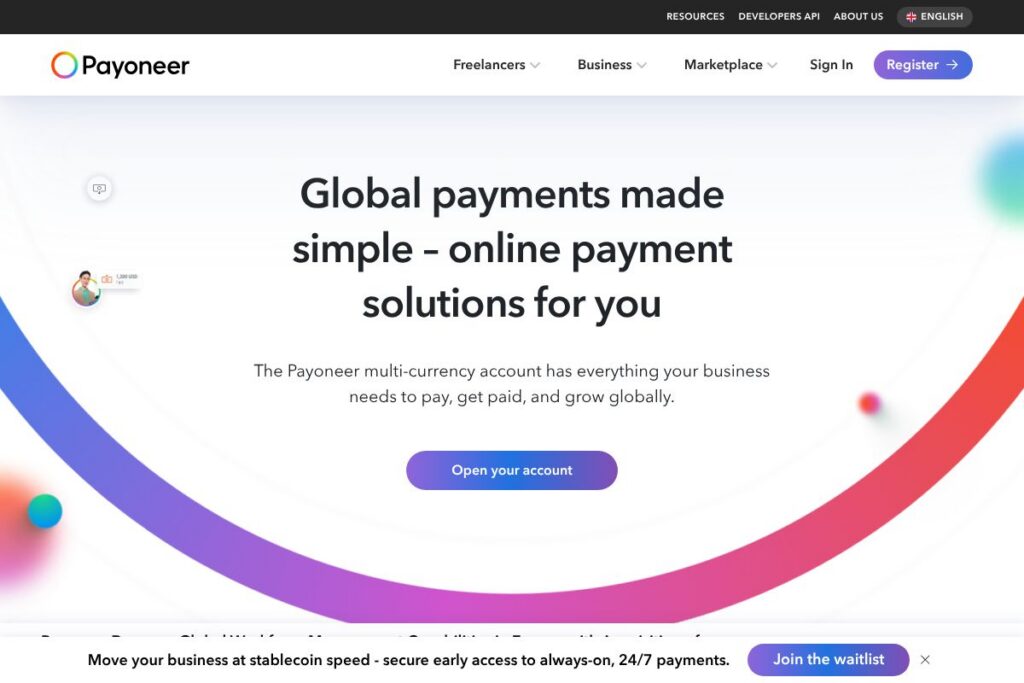

Payoneer: An Overview
Payoneer provides cross-border payment and payout services for businesses, marketplaces, freelancers, and remote teams. The platform combines multicurrency receiving accounts, global payout rails, commercial and prepaid Mastercard options, and funding products to support international commerce and payroll.
Compared with competitors, Payoneer focuses on marketplace and freelancer payouts as well as B2B mass payments. For example, Wise emphasizes low-cost bank transfers and transparent FX for individuals and SMEs, Stripe centers on card processing and developer tools for platform commerce, and PayPal offers consumer-facing payments and merchant services with broad consumer adoption. Payoneer stands out where marketplaces, affiliate networks, and international payroll require multicurrency receiving accounts and mass payout capability.
Payoneer does well at simplifying many cross-border workflows: receiving funds in multiple currencies, paying global contractors, and integrating with marketplaces. This makes it suitable for companies that need consolidated global payout rails, marketplace operators, and businesses hiring distributed workforces.
How Payoneer Works
Users create a Payoneer account and obtain multicurrency receiving accounts or connect their marketplace or platform to Payoneer for payouts. Funds received can be held in multicurrency balances, withdrawn to local bank accounts, sent as global payouts, or spent with a Payoneer commercial card.
Marketplaces and platforms connect via integrations or the Payoneer mass-payout API to automate recurring and batch payments to global payees. Businesses can schedule single, batch, or recurring payments, apply local payout methods, and track transactions in the Payoneer dashboard.
For teams and payroll, Payoneer supports onboarding, compliance checks, and localized disbursements across many jurisdictions so HR or finance teams can handle contractor or employee payments without managing multiple local banking relationships.
Payoneer features
The platform groups payment, payout, funding, and account management features for cross-border business. Core capabilities include multicurrency receiving accounts, global payouts, commercial cards, workforce management tools, stablecoin settlements, and embedded funding options.
Stablecoin Payments
Stablecoin settlements let businesses move value 24/7 with faster settlement than traditional banking hours, reducing settlement delays for time-sensitive workflows. This is useful for companies that need continuous liquidity without waiting for bank processing windows.
Commercial Cards
Payoneer issues commercial and prepaid Mastercard options to manage team spending, set custom limits, and reconcile card transactions against business accounts. Cards work for in-store, online, and recurring vendor payments where Mastercard is accepted.
Workforce Management
Workforce features cover hiring, onboarding, and paying contractors across many countries with built-in compliance and local payout options. This simplifies paying distributed teams while centralizing records and approvals for finance teams.
Multicurrency Accounts
Users can receive payments in multiple currencies via local receiving accounts and hold balances to manage FX timing. That reduces the friction of converting funds immediately and lets businesses invoice or accept marketplace payouts as local transfers.
Global Payments (Single, Batch, Recurring)
Payoneer supports one-off payments, scheduled recurring disbursements, and batch mass payouts, which helps platforms and finance teams scale payment operations without manual processing. Automated scheduling and batch uploads reduce operational overhead when sending to many recipients.
Business Funding
Payoneer offers access to working capital and prequalified funding options inside the platform to help businesses smooth cash flow or seize growth opportunities. Funding is presented as an integrated option tied to account activity and eligibility.
Marketplace Integrations and Connectivity
The platform integrates with leading marketplaces and e-commerce platforms to receive payouts and reconcile transactions automatically, enabling sellers and service providers to collect revenue without separate banking setups. These connections expand reach into existing marketplace ecosystems.
With these capabilities, Payoneer helps teams receive and move money across borders, manage spend with cards, and reduce friction for marketplace and workforce payments. The biggest benefit is a consolidated global business wallet that combines receiving accounts, payout rails, and spend controls in one platform.
Payoneer pricing
Payoneer uses a mix of transaction and service fees that vary by product, payment method, and country; pricing is product-specific and may differ for receiving accounts, currency conversions, card transactions, and mass payouts. For current rates, eligibility criteria, and any regional differences, consult the official Payoneer fee information on the Payoneer official site.
What is Payoneer Used For?
Payoneer is commonly used to receive global revenue in local currencies, pay contractors and vendors abroad, and operate marketplace payout systems without maintaining local bank accounts in every market. It is well suited to marketplaces, digital agencies, freelancers, and export-oriented sellers who need efficient cross-border payment rails.
Finance and operations teams use Payoneer to streamline batch payroll and contractor payments, manage multicurrency balances, and centralize expense management through commercial cards. Startups and SMBs use the platform to access working capital and to accept payments from international clients and platforms.
Pros and cons of Payoneer
Pros
- Wide global reach: Payoneer supports payouts and accounts in many countries, helping businesses receive and send money internationally without multiple local bank accounts. This facilitates global expansion and marketplace participation.
- Marketplace and mass-payout focus: Native integrations and mass-payout capabilities reduce manual work for platforms and marketplaces by automating recurring and batch disbursements. This is useful for platforms that pay thousands of recipients.
- Multicurrency flexibility: Holding balances and receiving local transfers in multiple currencies reduces immediate conversion costs and gives finance teams control over FX timing. This can improve cash flow management for exporters and sellers.
- Commercial cards and spend controls: Issuing cards and setting custom limits streamlines vendor payments and team spend monitoring while keeping reconciliation centralized.
Cons
- Fee variability: Transaction and conversion fees differ by currency, method, and region, which can complicate cost forecasting for global operations. Businesses should review fee conditions for their specific countries and payment types.
- Product availability by jurisdiction: Not all Payoneer products are available in every country and eligibility restrictions apply for cards and certain services. This can limit functionality for users in restricted jurisdictions.
- Less focus on card processing for merchants: For sites primarily seeking card acquiring and checkout solutions, dedicated payment processors like Stripe or Adyen may offer deeper merchant-processing features.
Does Payoneer Offer a Free Trial?
Payoneer offers free account signup with transaction-based fees for services. Creating an account is free and lets you receive payments and access account features, while specific products such as cards, currency conversions, payouts, or funding are subject to fees and eligibility checks. For details on what is free and which services incur charges, review the Payoneer account and fees information.
Payoneer API and Integrations
Payoneer provides developer APIs and partner integrations for mass payouts, payout scheduling, and marketplace connectivity; the Payoneer developer API documentation describes endpoints for integrating payouts and account management into platforms. Integrations with major marketplaces and platforms are commonly used so sellers and platforms can automate settlements and reconciliation.
Common integrations include e-commerce marketplaces, affiliate networks, and global freelancer platforms, enabling funds to flow into Payoneer balances or be paid out directly to recipients without manual entry. For platform and developer teams, API access is the primary route to automate large-scale payout workflows.
10 Payoneer alternatives
Paid alternatives to Payoneer
- Wise — International transfers and multicurrency accounts with transparent FX and emphasis on low-cost bank-to-bank transfers for individuals and businesses.
- PayPal — Consumer and merchant payments with broad global acceptance, buyer protection, and merchant checkout solutions.
- Stripe — Developer-focused payment processing, marketplace tools, and embedded finance features for online businesses and platforms.
- Adyen — Enterprise payment platform offering global acquiring, settlement, and risk tools for merchants at scale.
- WorldRemit — Consumer-focused international remittance service with local delivery options in many countries.
- Skrill — Digital wallet and payout services used for online sellers, affiliate networks, and gaming platforms.
- TransferGo — Fast international transfers geared toward individuals and SMEs with simplified pricing and local payout methods.
Open source alternatives to Payoneer
- Kill Bill — Open source billing and payment orchestration platform for managing subscriptions, invoicing, and payment gateway integrations. Useful for teams building custom payment flows.
- Payum — PHP payment processing library that provides integrations with multiple payment gateways and can be used to build bespoke payout and processing systems.
- Solidus — Open source e-commerce platform with payment gateway extensions for custom marketplace and payout implementations.
- Magento Open Source — E-commerce platform that supports multiple payment gateway plugins and can be extended to manage seller payments and invoices.
Frequently asked questions about Payoneer
What is Payoneer used for?
Payoneer is used for cross-border payments, receiving in multiple currencies, and mass payouts. Businesses and freelancers use it to collect international revenue, pay global contractors, and manage multicurrency balances.
Does Payoneer support paying international contractors?
Yes, Payoneer supports contractor and supplier payouts in many countries. The platform offers batch payments, scheduled disbursements, and local payout methods to streamline global payroll and contractor payments.
Can Payoneer issue a commercial card to my business?
Payoneer may provide commercial Mastercard options subject to eligibility and jurisdictional availability. Card issuance, features, and terms vary by country and customer eligibility.
Does Payoneer offer an API for marketplaces?
Yes, Payoneer provides developer APIs for mass payouts and marketplace integrations. Developer documentation outlines endpoints for automating payouts, onboarding recipients, and reconciling transactions.
Is Payoneer suitable for small businesses selling internationally?
Payoneer is a strong fit for small businesses that sell on international marketplaces or invoice clients abroad. The multicurrency accounts, receiving options, and payout features reduce the need to maintain multiple local bank accounts.
Final verdict: Payoneer
Payoneer is a comprehensive option for companies that need reliable cross-border receiving and payout capabilities, especially marketplaces, freelance platforms, and businesses hiring global contractors. Its combination of multicurrency accounts, mass-payout tools, commercial cards, and embedded funding caters to operations that move money across jurisdictions frequently.
Compared with Wise, Payoneer offers deeper marketplace and mass-payout integrations and more business-focused card and funding features, while Wise often emphasizes lower-cost bank transfers and very transparent FX pricing. Organizations should weigh Payoneer when they need integrated payout rails and marketplace connectivity, and consider Wise or Stripe when transparent transfer fees or card processing features are the primary requirement.
For product details, integration guides, and service availability in your country, consult the Payoneer official site or the Payoneer developer API documentation for technical integration information.