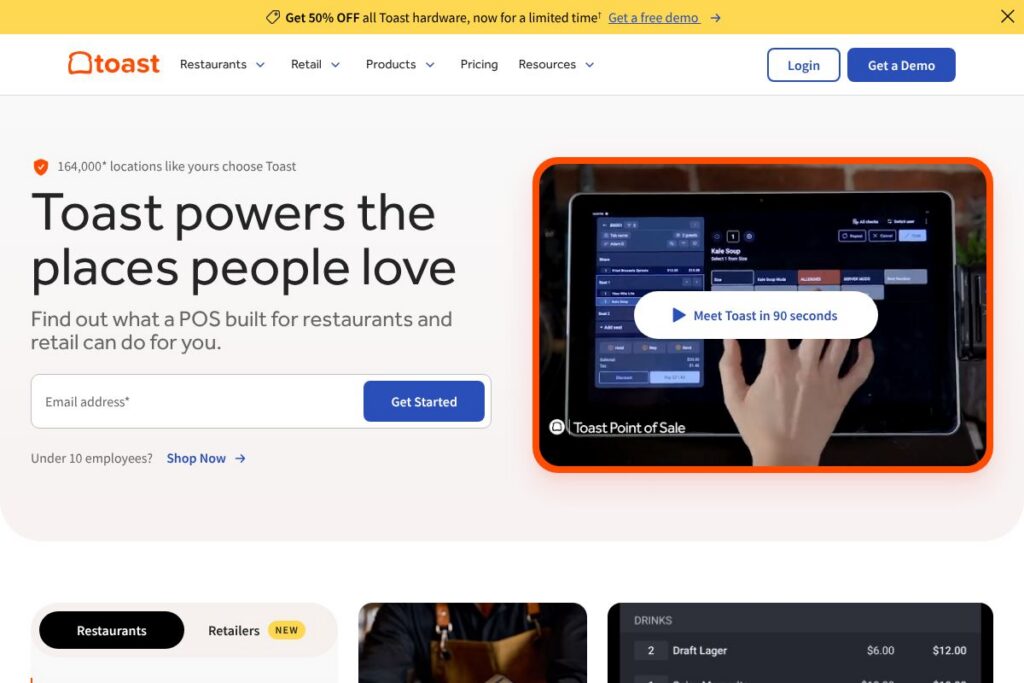

Toast: An Overview
Toast is a point of sale platform designed specifically for restaurants and retail locations, combining POS, payments, online ordering, staff management, and reporting in one product. The platform targets full-service, quick-service, and multi-location operators and includes restaurant-grade hardware, offline reliability, and integrations with payroll, marketing, and delivery partners.
Compared with general-purpose POS options like Square, Toast places more emphasis on restaurant workflows such as table management, kitchen display integrations, and labor optimization. Against Lightspeed and Clover, Toast is positioned around end-to-end restaurant operations with prebuilt integrations to common restaurant services and a hardware lineup tested for kitchen environments.
Toast does well at consolidating front-of-house and back-of-house operations for operators who need an industry-specific solution. That focus makes it suitable for independent restaurants, regional chains, and multi-location groups that need a single platform for payments, ordering, and workforce management.
How Toast Works
The core of Toast is a cloud-connected POS that runs on dedicated restaurant hardware or mobile devices and syncs sales, menu changes, and reporting to a central account. Restaurants configure menus, modifiers, taxes, and payment options from an online management console, and changes propagate to terminals and online ordering channels.
Payments are processed through integrated card readers and payment terminals, with offline mode available so the system continues to accept orders when internet connectivity is interrupted. Additional modules such as payroll, marketing, and delivery can be added to centralize operations and reduce manual reconciliation.
What does Toast do?
Toast organizes restaurant operations around POS transactions, guest ordering, staff and inventory management, and reporting. Core capabilities include a cloud POS, integrated payments, online ordering and delivery channels, labor and payroll add-ons, and a marketplace of integrations; the product emphasizes hardware reliability and 24/7 support for live operations.
Let’s talk Toast’s Features
POS and Payments
The POS supports order entry, table management, and split checks with workflows tuned to hospitality environments, and it accepts card-present, contactless, and mobile payments through integrated terminals. This reduces steps at peak service times and centralizes payment reporting for finance teams.
Online Ordering and Delivery
Toast includes integrated online ordering and can route orders to kitchen printers or display systems while syncing with third-party delivery providers via the integrations marketplace. This helps restaurants capture direct online sales and reduce order entry errors compared with manual phone or third-party-only workflows.
Reporting and Analytics
Built-in reporting aggregates sales, menu performance, labor costs, and payment data into dashboards for managers and owners to monitor profitability and trends. Scheduled and on-demand reports help operators make pricing and staffing decisions based on actual traffic and ticket patterns.
Hardware and Reliability
Toast supplies restaurant-grade terminals, handheld devices, and kitchen display hardware designed to withstand high-heat and high-impact environments while offering offline mode for continued operation during network outages. The hardware lineup is paired with regular software updates for security and feature improvements.
Inventory and Labor Management
Inventory tracking connects sales to ingredient-level usage, which assists purchasing and waste control, while labor modules cover scheduling, timekeeping, and payroll integrations to reduce manual payroll reconciliation. These features are useful for tightening margins in high-volume kitchens.
Integrations and Marketplace
Toast connects to more than 200 partners for tasks like accounting, reservations, delivery, and loyalty, enabling data to flow between the POS and third-party services. The integrations directory allows restaurants to add services such as payroll, marketing, and accounting to centralize operations.
Offline Mode and Support
When connectivity drops, Toast’s offline mode allows continued order entry and local transaction capture so service can continue uninterrupted, with data syncing once the connection is restored. The product also offers 24/7 support with real people available for urgent operational issues.
With Toast you get a single platform that covers payments, ordering, staff, and back-of-house needs while offering hardware and integrations tailored to restaurants.
Toast pricing
Toast uses a flexible, add-on pricing model tailored to restaurant size, service model, and hardware needs; pricing factors typically include terminal counts, optional software modules, and payment processing. The platform advertises a starter option and custom pricing for larger or multi-location deployments, and operators are encouraged to review plan details and hardware bundles.
Starter and Entry Options
Starter – $0 entry point advertised for basic access to core POS functionality and online demo options; this typically covers basic software access while hardware and payment processing are additional costs.
Enterprise and Custom Pricing
Enterprise – Custom pricing (advanced features, multi-location support, SSO, dedicated onboarding, and priority support) tailored to larger operators and chains; contact sales for a quote.
For a complete breakdown of modules, hardware bundles, and payment processing structures, see Toast’s product site for current plan details and to request a personalized quote.
What is Toast Used For?
Toast is used to run daily front-of-house and back-of-house restaurant operations, including order entry, payments, kitchen routing, and guest-facing ordering channels. Managers use Toast for scheduling, time tracking, and payroll, while owners use sales and profit reports for strategic decisions.
It is also commonly used for online ordering and delivery integration, allowing restaurants to accept direct online orders and manage fulfillment through the same system that handles in-person sales. Multi-location groups and franchise operators use Toast to centralize menu management and reporting across sites.
Pros and cons of Toast
Pros
- Restaurant-specific workflows: The POS and management features are designed around hospitality needs, reducing friction for servers and kitchen staff and improving order accuracy.
- Comprehensive integrations: A marketplace of over 200 partners connects payments, payroll, delivery, and accounting to reduce manual data entry and reconciliation.
- Resilient hardware and offline mode: Restaurant-grade terminals and offline transaction capture minimize downtime during network interruptions.
- Operational add-ons: Payroll, marketing, and online ordering modules extend the POS into a platform for broader business operations.
Cons
- Costs can scale with add-ons: Hardware, payment processing, and optional modules add to the total cost, which may be significant for small independent operators with tight margins.
- Platform complexity for small operations: The breadth of features and configuration options may require more setup and training than a lightweight POS solution.
- Vendor lock-in for full stack: Using Toast for payments, POS, ordering, and payroll centralizes operations but can make switching vendors more complex if one component is tightly integrated.
Does Toast Offer a Free Trial?
Toast offers a free demo and a $0 starter option. Restaurants can schedule a personalized online demo with no credit card required, and the platform advertises a $0 entry-level option for basic POS access while hardware and processing fees are separate.
Toast API and Integrations
Toast provides integration options and an API surface for partners and developers to connect ordering, payments, and reporting; third-party developers can consult the Toast developer documentation for endpoints and integration guidelines. The platform also maintains an integrations directory where restaurants can find partners for accounting, delivery, loyalty, and workforce management at Toast’s integrations directory.
10 Toast alternatives
Paid alternatives to Toast
- Square — A broadly adopted POS with a free starter POS app and integrated payments, suited to small restaurants and cafes that prefer a lightweight setup.
- Lightspeed — Cloud POS with strong inventory and multi-location features aimed at restaurants and retail stores needing advanced inventory controls.
- Clover — An all-in-one POS ecosystem with hardware and app marketplace for restaurants and small businesses seeking turnkey hardware options.
- TouchBistro — A restaurant-focused POS that emphasizes table management, floor plans, and menu customization for full-service venues.
- Revel Systems — An enterprise-capable POS with deep reporting and customization, targeted at multi-location chains and higher-volume operators.
- Upserve — A restaurant management platform combining POS with analytics and guest insights, focused on improving service and average check size.
Open source alternatives to Toast
- Odoo POS — A module within the larger Odoo ERP suite that offers POS capabilities and can be self-hosted or run through managed Odoo providers.
- uniCenta — An open source POS system with support for multiple terminals, receipts, and basic inventory functionality suitable for budget-conscious operators.
- Floreant POS — A community-driven restaurant POS with basic order routing and kitchen printing, often used by small independent restaurants.
- Chromis POS — A fork of UniCenta with similar functionality and a focus on lightweight deployments for small cafes and food trucks.
Frequently asked questions about Toast
What is Toast used for?
Toast is used to operate restaurant point of sale, payments, online ordering, and staff management. Operators rely on Toast for order routing, payment capture, scheduling, and reporting across single and multi-site restaurants.
Does Toast integrate with accounting and payroll systems?
Yes, Toast integrates with common accounting and payroll partners through its integrations marketplace. Restaurants can connect to services for bookkeeping and payroll to reduce manual reconciliation and automate payroll exports.
How much does Toast cost to start?
Toast advertises a starter entry point at $0 and custom pricing for larger deployments. Hardware, payment processing, and optional software modules are additional costs that vary by location and configuration.
Can Toast work when the internet goes down?
Yes, Toast includes an offline mode that keeps order entry and local transaction capture functioning until connectivity is restored. Data will sync to the cloud when the network is back online.
Does Toast offer developer APIs?
Yes, Toast provides developer APIs and documentation for partners and integrations. Developers can review the Toast developer documentation to learn about available endpoints and integration requirements.
Final Verdict: Toast
Toast is a purpose-built restaurant platform that combines POS, payments, online ordering, hardware, and operational add-ons into a single ecosystem prioritized for hospitality workflows. Its strengths include restaurant-focused features, resilient hardware, an extensive integrations marketplace, and 24/7 support aimed at keeping service running during peak hours.
Compared with a generalist competitor like Square, Toast offers deeper restaurant-specific features and hardware options while Square tends to offer a simpler entry path and a pay-as-you-grow model. Organizations that need comprehensive restaurant operations, kitchen integrations, and multi-location controls will find Toast’s stack better aligned to those needs, while smaller cafes or newly launched venues may prefer a lighter POS with fewer bundled services.
Overall, Toast is a strong choice for restaurants and retail locations that require an integrated platform from front of house to back of house and value hardware reliability and industry-specific workflows. For demos, hardware bundles, and tailored quotes, request a personalized demo or visit Toast’s product site.