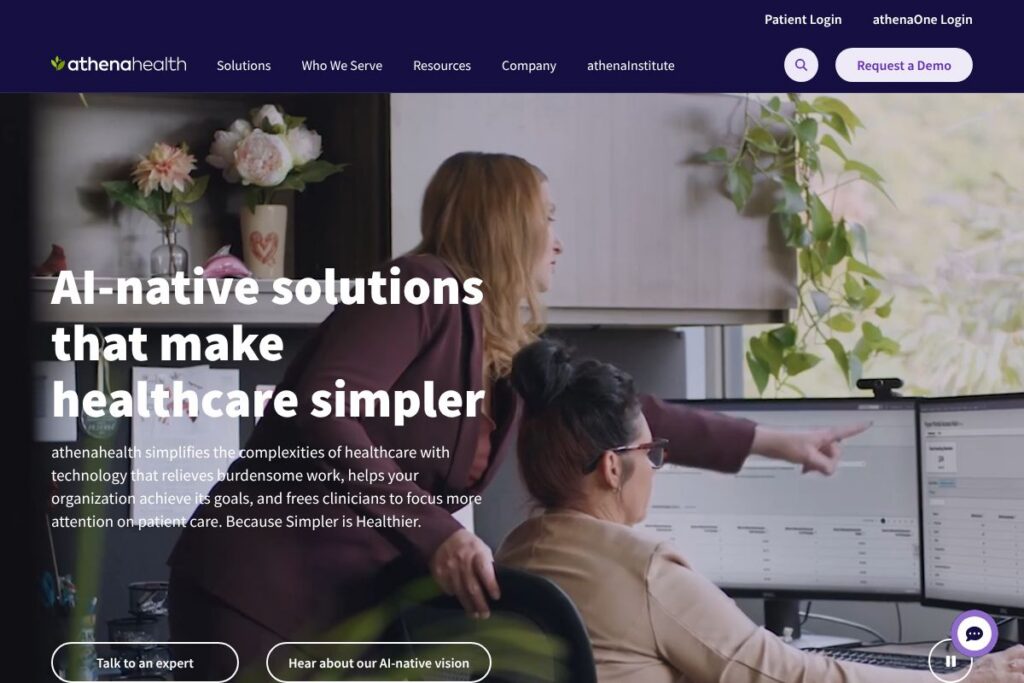

athenahealth: An Overview
athenahealth is a cloud-native platform focused on ambulatory care, combining an electronic health record (EHR), practice management, and revenue cycle management (RCM) with network-enabled services. The platform centers on a connected clinician network that shares anonymized data and workflows to improve billing accuracy, clinical documentation, and operational efficiency. Explore the athenaOne product pages to see how clinical and administrative tools are packaged for practices.
Compared with enterprise inpatient vendors like Epic and traditional on-premises suites such as Cerner, athenahealth emphasizes a SaaS delivery model and subscription-based deployment that reduces internal IT overhead. Against ambulatory-focused competitors like eClinicalWorks, athenahealth places more emphasis on network services, external RCM options, and specialty-specific workflows. All of this makes athenahealth most appropriate for independent practices, multispecialty groups, and community health organizations seeking integrated ambulatory solutions that minimize local infrastructure and administrative burden.
How athenahealth Works
athenahealth operates as a cloud service where clinical workflows, scheduling, billing, and analytics run through a single platform called athenaOne. Users access the system via web and mobile interfaces while data and processing are handled in athenahealth’s managed environment, which reduces the need for local servers and on-site upgrades. The platform combines automated claims routing, payer rules engines, and denial management with clinical tools such as charting templates and specialty workflows to keep both front-office and clinical teams aligned.
Implementation typically follows a phased onboarding: practice assessment, data migration, workflow configuration, staff training, and go-live support. Many practices integrate athenahealth with labs, imaging, payer feeds, and third-party telehealth or patient engagement tools during onboarding to create a single operational environment. The company also offers ongoing managed services for revenue cycle tasks when practices prefer to outsource billing and collections.
What does athenahealth do?
athenahealth centralizes ambulatory care operations around three core domains: EHR documentation and clinical workflows, revenue cycle management for payer and patient collections, and practice operations including scheduling and reporting. Recent emphasis includes AI-assisted documentation and an ambient documentation solution that reduces transcription time and administrative burden; this capability was highlighted in industry recognition for innovation. For a closer look at specialty support and clinical workflows, visit the athenaOne specialty pages.
Let’s talk athenahealth’s Features
Electronic Health Record (EHR)
The EHR provides structured clinical documentation, customizable templates for specialty care, and problem-list management that aligns with ambulatory workflows. It is designed to reduce click burden through specialty-specific templates and integrated clinical decision support tools, helping clinicians maintain more complete patient charts.
Revenue Cycle Management (RCM)
RCM combines automated claims submission, payer rules engines, denial reduction workflows, and analytics to monitor collections and claim performance. Practices that adopt athenaOne often report improvements in collections and reductions in denial rates through automated insurance selection and rules-driven workflows.
Practice Management and Scheduling
Practice management tools handle appointment booking, eligibility verification, patient check-in, and front-desk workflows in a single interface. Scheduling is integrated with billing and clinical documentation, which reduces double-entry and helps keep patient-facing and back-office teams synchronized.
Ambient Clinical Documentation
An embedded ambient documentation solution captures clinical encounters and produces draft notes to reduce physician documentation time. This feature is positioned to free clinician time for patient care and lower charting-related burnout through voice-assisted workflows and natural language processing.
Analytics and Network Insights
Network-enabled analytics aggregate de-identified data across the clinician network to surface benchmarking, payer performance metrics, and operational insights. These analytics help practices identify revenue opportunities, track productivity, and prioritize process improvements based on peer comparisons.
Specialty Workflows and Templates
athenahealth includes specialty-specific charting, order sets, and workflow configurations for common ambulatory specialties, enabling faster chart completion and cleaner coding for claims. Specialty templates reduce configuration time and align documentation with billing requirements for different clinical areas.
With these capabilities, athenahealth focuses on reducing administrative overhead across clinical and billing functions while leveraging network data to improve performance and payer interactions.
athenahealth pricing
athenahealth uses a custom enterprise pricing model rather than public fixed-price tiers; subscription and service fees are tailored to practice size, specialty, scope of managed services, and implementation requirements. For a practice-level estimate or a tailored service package, request a demo or contact sales through the athenaOne product and demo pages.
What is athenahealth Used For?
athenahealth is commonly used to run ambulatory clinics end-to-end: scheduling patients, documenting visits, submitting claims, and managing collections. Its RCM services are often adopted by practices that want to outsource complex billing tasks while keeping clinical control of charting and patient care.
The platform is also used by specialty clinics that need tailored templates and by multi-site practices that want centralized reporting and a single vendor for EHR plus billing. It suits organizations looking to reduce local IT burden and leverage network-level analytics for benchmarking and payer negotiation.
Pros and Cons of athenahealth
Pros
- Integrated cloud platform: Combines EHR, practice management, and RCM so teams work from a single system and avoid redundant data entry. This reduces administrative complexity for ambulatory practices.
- Network-enabled insights: Access to aggregated network data provides benchmarking and payer performance visibility that smaller practices could not generate on their own. These insights support denial reduction and revenue optimization strategies.
- Specialty-focused workflows: Prebuilt specialty templates and configurable workflows speed implementation and improve documentation completeness for outpatient specialties.
- Ambient documentation support: Embedded ambient and voice-assisted documentation reduces clinician charting time and can help address burnout by lowering per-visit documentation load.
Cons
- Custom pricing and contracts: Pricing is tailored and not listed publicly, which can make direct cost comparisons harder during initial evaluation. Practices should request detailed quotes to compare total cost of ownership.
- Less fit for large inpatient systems: For large hospital systems requiring deep inpatient functionality, enterprise inpatient vendors like Epic may offer broader inpatient features and integrated modules across acute care settings.
- Implementation and change management: As with any EHR replacement, staff training and workflow redesign require time and resources, and smaller practices should plan for a measurable onboarding period.
Does athenahealth Offer a Free Trial?
athenahealth offers demos and custom pricing rather than a public free plan or self-serve free trial. Practices can request a personalized athenaOne demo or contact sales to evaluate features and discuss implementation timelines through the athenaOne demo request page.
athenahealth API and Integrations
athenahealth provides developer APIs and supports industry standards such as FHIR to enable integrations with labs, imaging, patient engagement tools, and third-party telehealth or billing partners. The athenahealth API documentation describes available endpoints, authentication, and example integrations.
In practice, organizations commonly connect athenahealth to laboratory feeds, payer portals, HIEs, patient portals, and practice productivity tools to streamline data flows and reduce manual handoffs. Integration options support both turnkey connectors and custom development when needed.
10 athenahealth alternatives
Paid alternatives to athenahealth
- Epic: Enterprise-grade EHR with deep inpatient and ambulatory functionality, widely used by large health systems and academic medical centers.
- Cerner: Comprehensive clinical and revenue systems for hospitals and ambulatory practices with strong interoperability options for large organizations.
- eClinicalWorks: Ambulatory-first EHR and practice management suite focused on independent physicians and clinics.
- NextGen Healthcare: Offers EHR, practice management, and RCM with a focus on ambulatory and specialty practices.
- Allscripts: Provides EHR and practice management solutions for ambulatory and larger provider networks with multiple deployment models.
- Practice Fusion: Cloud-based ambulatory EHR aimed at smaller practices and clinics that need a simple, lower-cost option.
- CareCloud: Cloud-native practice management and EHR platform with integrated revenue and analytics features.
Open source alternatives to athenahealth
- OpenEMR: A widely used open source EHR and practice management platform with a large community and multi-language support. It requires self-hosting or a managed provider for production use.
- OpenMRS: An open source medical record system designed for flexibility and customization, often used in low-resource and research settings.
- GNU Health: An open source health and hospital information system with modules for clinical management and public health reporting.
- Oscar EMR: An open source clinical system originally developed in Canada, suited for primary care workflows and customizable deployment.
Frequently asked questions about athenahealth
What does athenahealth offer for ambulatory practices?
athenahealth provides EHR, practice management, and revenue cycle management service bundled into a cloud-based platform. The offering includes specialty workflows, network analytics, and optional managed billing services tailored to ambulatory providers.
Does athenahealth provide APIs and developer access?
Yes, athenahealth offers developer APIs and FHIR support. Developers can consult the athenahealth API documentation to build integrations for labs, patient portals, and third-party apps.
How much does athenahealth cost for a small practice?
athenahealth uses custom pricing and does not publish standard list prices. Small practices should request a personalized quote or demo through the athenaOne product pages to evaluate cost based on scope and services.
Can athenahealth help reduce claim denials?
Yes, athenahealth includes payer rules engines and automated insurance selection workflows aimed at reducing claim denials. Practices using these features typically see improvements in claim accuracy and reductions in patient insurance-related denials.
Is athenahealth suitable for specialty clinics?
Yes, athenahealth supports specialty-specific templates and workflows. The platform includes configurable charting and order sets designed to match the needs of a wide range of ambulatory specialties.
Final verdict: athenahealth
athenahealth is a strong choice for ambulatory practices that want a cloud-hosted EHR and an integrated approach to revenue cycle and practice operations backed by a large clinician network. Its strengths are network-enabled analytics, specialty workflows, and built-in RCM capabilities that reduce claims complexity and administrative overhead.
Compared with Epic, which is often deployed via multi-year licensing and significant on-premises investment, athenahealth offers a subscription-based cloud model with lower infrastructure demands and faster time to value. If your organization is an independent or multisite ambulatory practice prioritizing managed services, network benchmarking, and specialty-focused templates, athenahealth is worth evaluating via a personalized demo on the athenaOne pages.