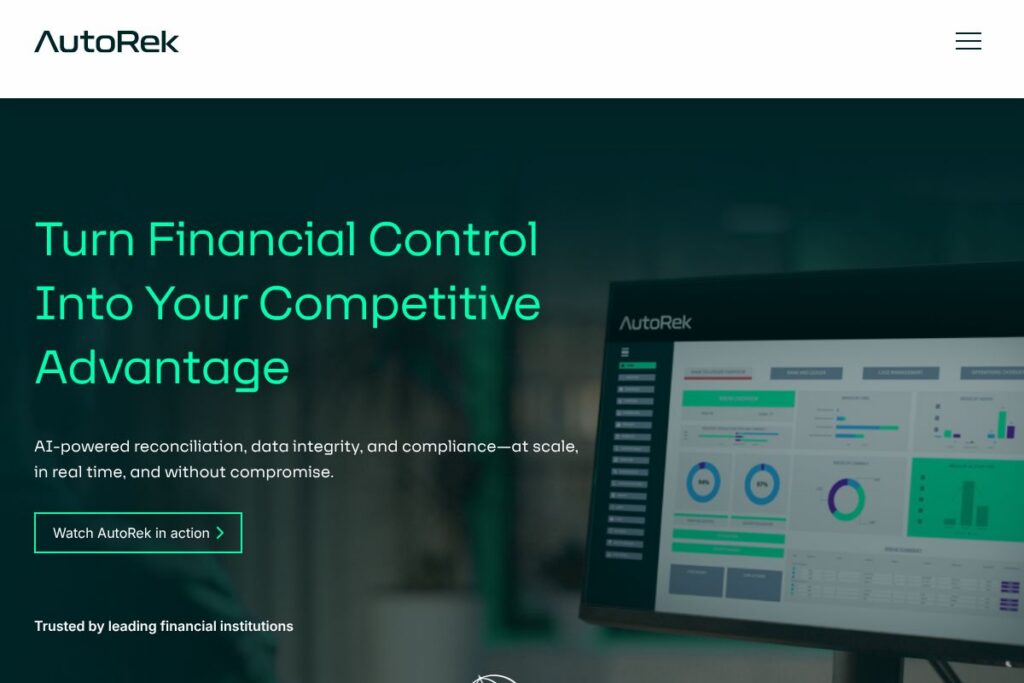

What is AutoRek
AutoRek is a unified, AI-enabled platform for reconciliation, data control, and regulatory compliance aimed at financial institutions. It centralizes ingestion of transaction data, applies automated matching and exception workflows, and produces transparent, audit-ready outputs that reduce manual effort and operational risk.
Compared with established reconciliation vendors like BlackLine, Trintech, and ReconArt, AutoRek emphasizes AI matching and no-code rulebooks that let operations teams configure controls without engineering intervention. BlackLine is known for close-management and accounting automation, Trintech focuses on financial close and internal controls, and ReconArt provides flexible reconciliation engines; AutoRek positions itself around high-volume, real-time reconciliation plus embedded regulatory frameworks.
All of this makes AutoRek a powerful option for financial operations teams that need to scale reconciliation, maintain strict audit trails, and support complex regulatory reporting. It performs particularly well where institutions need rapid onboarding of new feeds, cross-system data unification, and configurable controls owned by operations rather than IT.
How AutoRek Works
AutoRek ingests transactional and reference data from any format, including flat files, feeds, SWIFT messages, and direct database connections. The platform normalizes disparate data into a common model, applies configurable rulebooks, and runs AI-assisted matching to pair records and surface exceptions.
When matches cannot be resolved automatically, exception workflows route items to users with contextual data, suggested matches, and workflow tracking for resolution. Built-in audit trails and reporting capture every decision, making regulatory submissions and internal audits straightforward.
Typical implementations start with mapping high-volume feeds from core systems, building a library of matching rules, and then iterating with operations on exceptions to improve match rates. For M&A or integrations, AutoRek standardizes incoming datasets, which accelerates onboarding and reduces reconciliation backlogs.
AutoRek features
AutoRek bundles reconciliation, data management, and compliance features into a single platform so teams can automate matching, monitor data integrity, and produce regulator-ready outputs. The product emphasizes no-code configuration, AI-assisted matching, and real-time oversight designed to scale across high-volume financial operations.
Reconciliation & Controls
Automated matching engines compare ledgers, bank statements, and transactional feeds at scale, applying configurable tolerance rules and matching logic. This reduces manual reconciliations, accelerates exception resolution, and enforces consistent controls across teams.
AI-Powered Matching
Machine learning suggests probable matches for ambiguous records and ranks exceptions by likelihood, which reduces human review time and improves match rates. Teams can review, accept, or override suggestions while the system learns from outcomes to improve future accuracy.
Data Management & Oversight
A data ingestion layer accepts CSV, XML, SWIFT, APIs, and other formats, then normalizes and enriches records for unified processing. Real-time visibility dashboards provide status on feeds, match rates, and outstanding exceptions so teams can act quickly.
Regulatory Reporting & Compliance
Built-in reporting templates and audit trails support regulator-ready submissions and demonstrate control effectiveness. Rulebooks can be configured to meet jurisdictional requirements and to produce evidence for audits.
No-code Configuration
Business users can build and maintain matching rules, exception workflows, and reporting logic via a visual interface that avoids custom code. This shifts ownership to operations and shortens deployment and change cycles.
Real-time Dashboards & Alerts
Operational dashboards show match rates, exception backlogs, and processing latency, with threshold alerts to drive SLA adherence. Role-based access controls ensure teams see relevant information without exposing sensitive data unnecessarily.
Rulebook Library
A library of pre-built rules and templates helps teams adopt common controls for payments, IBA reconciliations, and asset management workflows. Organizations can extend or customize rulebooks to align with internal policies and regulator expectations.
With these capabilities AutoRek reduces manual effort, consolidates controls, and delivers transparent outputs for compliance and decision-making. The biggest benefit is combining real-time reconciliation with audit-ready controls that operations teams can manage without heavy IT dependency.
AutoRek pricing
AutoRek follows an enterprise, custom-pricing model tailored to organization size, data volumes, and deployment requirements. Pricing is typically based on factors such as processed transaction volume, number of feeds, integration complexity, and required service levels.
For detailed, up-to-date pricing and to discuss licensing or deployment options, contact AutoRek via AutoRek’s homepage and request a tailored proposal through their sales or contact channels.
What is AutoRek Used For?
AutoRek is used to automate high-volume reconciliations across banking, asset management, payments, and insurance operations. Teams rely on it to replace spreadsheet-driven workflows, reduce manual errors, and scale oversight as transaction volumes grow.
Common scenarios include cash and bank reconciliations, client money and IBA reconciliations, clearing and settlement matching, and regulatory reporting for capital markets. It is also used during M&A to standardize disparate finance systems quickly and to support onboarding of new counterparties or payment rails.
Pros and Cons of AutoRek
Pros
- High match accuracy: AutoRek combines AI-assisted matching with configurable rules to achieve high automated match rates and reduce manual review time.
- No-code configuration: Business and operations teams can build rulebooks and workflows without engineering, shortening deployment cycles and enabling faster change management.
- Audit-ready controls: Built-in reporting, rule libraries, and traceable workflows produce outputs suitable for regulators and internal audit teams.
Cons
- Enterprise focus: Pricing and deployment are oriented toward mid-market and large financial institutions, which may be costly for very small teams.
- Integration effort for legacy systems: While AutoRek supports many formats, connecting highly bespoke legacy systems can still require professional services and mapping work.
- Dependence on data quality: As with any reconciliation platform, upstream data quality issues must be resolved for optimal automation, which may add pre-processing work.
Does AutoRek Offer a Free Trial?
AutoRek is offered as a paid, enterprise solution with custom pricing. Organizations typically engage with AutoRek for demos, proof-of-concept work, or pilot projects coordinated through sales; to request a trial or pilot, contact the vendor via AutoRek’s contact page.
AutoRek API and Integrations
AutoRek provides APIs and connectors to ingest data from enterprise systems, file stores, cloud platforms, and payment messaging formats. The platform supports REST APIs, SFTP, SWIFT/MT formats, flat files, and common ERP and treasury systems to create continuous data pipelines.
For a list of pre-built connectors and technical integration guidance, review the resources on AutoRek’s integrations page or contact their technical team to discuss specific endpoints and API documentation.
10 AutoRek alternatives
Paid alternatives to AutoRek
- BlackLine — Cloud accounting and reconciliation platform focused on period close automation and financial controls for finance teams.
- Trintech — Financial close and reconciliation software with strong capabilities around reconciliation, compliance, and close orchestration.
- ReconArt — Reconciliation engine that offers flexible matching rules and modular deployment for banks and corporates.
- FIS — Broader financial technology provider with reconciliation and treasury modules integrated into larger banking platforms.
- OneStream — Corporate performance management solution that includes financial consolidation and reconciliation features for complex enterprises.
- Oracle Financials Cloud — Enterprise ERP with modules and integrations that address reconciliation and treasury workflows as part of a broader finance suite.
Open source alternatives to AutoRek
- Apache NiFi — Dataflow automation tool for ingesting and routing financial feeds, useful as a building block for reconciliation pipelines.
- Pentaho Data Integration — ETL/ELT platform that can be used to normalize and prepare transaction data for reconciliation processes.
- LedgerSMB — Open-source accounting system that covers core ledger functions and can be extended for basic reconciliation tasks.
Frequently asked questions about AutoRek
What does AutoRek do for banks?
AutoRek automates bank and payments reconciliations at scale. It ingests high-volume transaction feeds, applies matching rules, and provides exception workflows and reporting tailored to banking requirements.
Does AutoRek integrate with ERP and treasury systems?
Yes, AutoRek supports integrations with ERPs, treasury systems, and common file formats. The platform offers connectors and APIs to connect feeds from SAP, Oracle, and other financial systems; see AutoRek’s integrations page for examples.
How does AutoRek help with regulatory compliance?
AutoRek provides audit-ready controls and reporting frameworks. Pre-built rulebooks and traceable workflows help demonstrate compliance and streamline regulator submissions.
Can AutoRek handle large transaction volumes in real time?
Yes, AutoRek is designed for hyper-scale, real-time reconciliation. The platform processes high-throughput feeds and delivers near real-time visibility on match status and exceptions.
How is AutoRek priced for enterprise customers?
AutoRek uses enterprise, custom pricing tailored to data volumes and deployment needs. For a tailored quote and to discuss pilots or licensing options, contact AutoRek through AutoRek’s homepage.
Final verdict: AutoRek
AutoRek stands out for combining AI-assisted matching, no-code rulebooks, and audit-ready reporting in a single platform that targets financial institutions with high-volume reconciliation needs. Its strengths are rapid onboarding of new feeds, operational ownership of rules, and built-in compliance frameworks that reduce manual effort and improve transparency.
Compared with BlackLine, both vendors follow enterprise pricing models and provide strong reconciliation capabilities; AutoRek differentiates by emphasizing real-time, AI-driven matching and flexible rule libraries that operations can configure without engineering support. For organizations prioritizing automated match rates and a platform that scales with complex regulatory demands, AutoRek is a strong candidate; evaluate both vendors with a pilot to compare fit, integration effort, and total cost of ownership.