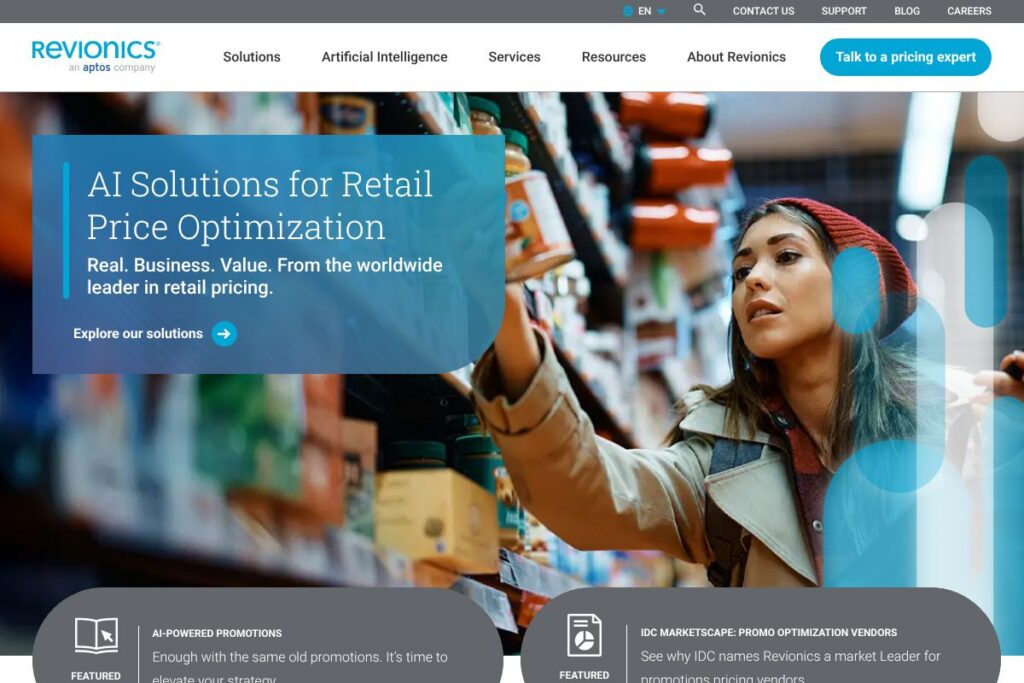

Revionics: An Overview
Revionics is a retail-focused pricing and promotion optimization platform that applies machine learning and proprietary retail science to recommend prices, promotions, and markdown strategies. The platform is built to handle high-volume retail data, account for cross-item effects such as cannibalization and affinity, and produce price recommendations aligned with a retailer’s strategic objectives.
Compared with competitors like Pricefx, PROS, and Wiser, Revionics emphasizes retail-specific models and experienced pricing teams rather than a generic pricing engine. Compared to Pricefx, which emphasizes fast configurability and cloud-native pricing workflows, Revionics is frequently chosen for deep demand-science, lifecycle pricing, and complex promotion scenarios. Against PROS, Revionics is often stronger for goods retailers with long product catalogs, while Wiser competes more on competitive intelligence and price tracking rather than full lifecycle optimization.
All of this makes Revionics well suited for mid-market to enterprise retailers who need granular, localized pricing recommendations across channels. It is particularly useful when retailers require sophisticated demand models, promotion optimization, and operational guidance from pricing experts to implement recommended actions.
How Revionics Works
Revionics consumes retail master data, sales history, inventory, competitor price feeds, and promotional calendars to build demand models and price elasticity estimates. The platform runs scenario simulations that quantify shopper response to price changes, promotions, and markdowns, then recommends prices that align with margin, revenue, or market-share targets.
Implementation typically involves data integration with POS, ERP, and e-commerce systems, calibration through a pilot or phased rollout, and operationalization using automated price publishing or integration with price management workflows. Pricing teams can use built-in governance controls to restrict automated changes, schedule promotions, and set constraints such as margin floors and competitive rules.
Revionics features
The platform centers on lifecycle pricing and analytics, combining demand forecasting, elasticity modeling, promotion optimization, and automated price publishing. Recent product work focuses on improved AI explainability, localized price optimization, and expanded connectors for retail systems.
Price Optimization Engine
The core engine estimates demand elasticity at product and location levels to recommend optimal prices for specified business objectives. This helps retailers balance margin and revenue across assortments and store clusters, and supports both everyday pricing and promotional tactics.
Promotion and Markdown Optimization
Revionics models promotional lift and cannibalization to recommend promotional depths, timing, and duration that maximize total category results. The platform simulates overlapping promotions and suggests markdown sequences for long-lifecycle items to reduce inventory risk while protecting margin.
Localized Pricing and Price Zones
Retailers can optimize prices at store or region level to reflect local competition and demand differences. Localized recommendations make it possible to apply targeted pricing strategies without breaking governance or brand rules.
Demand and Elasticity Modeling
The system uses historical sales, seasonality, and external signals to build statistically robust elasticity models that capture cross-item interactions. These models drive scenario analysis and help explain the expected shopper response to price moves.
Price Simulation and What-If Analysis
Built-in scenario simulation lets pricing teams test candidate strategies and compare outcomes on revenue, margin, and unit sales before committing changes. Simulations support executive-level decision making and help validate proposed pricing actions.
Automation and Price Publishing
Automation capabilities include rule-based or model-driven price publishing to POS and e-commerce systems, with governance controls and approval workflows. This reduces manual updates and improves execution speed across large assortments.
Analytics, Reporting, and Explainability
Dashboards and reports surface the drivers behind recommendations, historical performance, and key KPIs so pricing teams can monitor impact and refine strategy. Explainability features help stakeholders trust model outputs by showing contributing signals.
With these capabilities, Revionics helps retailers replace manual pricing spreadsheets with a data-driven, repeatable process that scales across assortments and channels.
Revionics pricing
Revionics follows an enterprise pricing model with custom quotes tailored to retailer size, data scope, deployment complexity, and required services. Pricing is typically structured around platform access, implementation services, and optional managed services or expert guidance.
Because Revionics does not publish standard list plans, most engagements start with a discovery phase and a proposal; retailers can review commercial options and implementation approaches by contacting Revionics directly via the Revionics homepage or the Revionics solutions page. For enterprise buyers, expect pricing to reflect seat counts, integration needs, and the selected level of professional services.
What is Revionics Used For?
Revionics is used to set optimal prices and promotions across stores and online channels, reduce markdown risk, and simulate the financial impact of pricing decisions. Pricing teams use it to move from heuristic or rule-based pricing to demand-informed recommendations that align with business goals.
Typical users include retail pricing analysts, category managers, revenue managers, and merchandising teams at grocery, pharmacy, big-box, and specialty retailers. It is also used during category resets, promotional planning cycles, and inventory clearance to determine the best pricing actions for desired commercial outcomes.
Pros and Cons of Revionics
Pros
- Retail-focused demand science: The platform’s models are built specifically for retail use cases, incorporating cross-item cannibalization and promotion lift to produce actionable recommendations. This reduces the need for heavy customization when modeling typical retail behaviors.
- Lifecycle and localized pricing: Revionics supports long-lifecycle item strategies and store-level price differentiation, enabling retailers to tailor pricing to local market conditions and inventory realities. That capability improves competitiveness and margin capture at a granular level.
- Operational support and services: The vendor pairs the software with experienced pricing professionals who guide strategy, pilot deployments, and change management, which helps shorten time-to-value for complex rollouts.
Cons
- Enterprise focus and cost: The solution is designed for larger retailers with complex assortments and data needs, so it may be less cost-effective for very small merchants. Smaller retailers should evaluate expected ROI against implementation and service costs.
- Integration and implementation effort: Full value typically requires integration with POS, ERP, and e-commerce systems plus historical data cleansing, which can add time and project effort. Retailers should budget for integration and pilot phases.
Does Revionics Offer a Free Trial?
Revionics offers custom evaluations and pilot programs rather than a standard free plan. Retailers commonly engage through a proof-of-value or pilot deployment that validates recommendations on a subset of stores or categories before scaling to full production.
Revionics API and Integrations
Revionics provides APIs and connectors to integrate with POS, ERP, e-commerce, and master-data systems so recommendations can be operationalized across channels. For integration details and supported connectors, see the Revionics integrations information or contact their technical team for API documentation.
The platform also ingests competitor price feeds, promotional calendars, and inventory signals to enrich demand models and enable omnichannel price execution.
10 Revionics alternatives
Paid alternatives to Revionics
- Pricefx — Cloud pricing platform that offers configuration, rebate management, and price optimization workflows suited to B2B and B2C use cases. Good fit when rapid SaaS deployment and global pricing rules are priorities.
- PROS — Revenue and price optimization platform focused on B2B and B2C revenue management, with strong configurability for complex pricing and quoting scenarios. Often chosen for dynamic pricing in technical sales environments.
- Wiser — Focuses on competitive pricing intelligence and dynamic repricing, combining price monitoring with execution tools for retailers and online sellers.
- Vendavo — Enterprise price and margin optimization suite with emphasis on B2B commerce, price segmentation, and profitability analytics.
- Competera — Retail pricing platform that balances competitive pricing intelligence and demand analytics, used by omnichannel retailers for dynamic pricing and promo optimization.
- Pricemoov — Price management and optimization platform that emphasizes price strategy, simulation, and centralized price execution across channels.
- Zilliant — Offers price optimization and guidance for B2B and industrial firms with a focus on price segmentation and deal-level optimization.
Open source alternatives to Revionics
- Odoo — Open-source ERP with pricing rule capabilities, tiered pricing, and promotional modules; suitable for smaller retailers that want a self-hosted, extensible platform.
- ERPNext — An open-source ERP that includes pricing lists, customer-specific pricing, and promotional features that can be adapted for basic price management workflows.
- Apache OFBiz — Open-source e-commerce and ERP framework with pricing and promotion components that can be customized into a pricing solution for technically capable teams.
- Saleor — Open-source e-commerce platform that supports product pricing and promotions and can be extended with custom pricing logic for headless commerce setups.
Frequently asked questions about Revionics
What is Revionics used for?
Revionics is used for retail price and promotion optimization to improve margin, revenue, and inventory outcomes. Organizations apply it to set localized prices, plan promotions, and simulate pricing scenarios across channels.
Does Revionics integrate with POS and ERP systems?
Yes, Revionics integrates with common POS, ERP, and e-commerce systems. Integrations allow recommendations to be published to operational systems and keep models fed with the latest sales and inventory data.
Can Revionics handle localized pricing for stores?
Yes, Revionics supports store-level and region-level pricing strategies. The platform optimizes price zones and can recommend differentiated prices based on local demand and competition.
Does Revionics provide a trial or proof-of-value?
Revionics typically runs pilot programs or proofs-of-value rather than offering a standard free trial. These pilots validate model outputs and business impact on a subset of stores or categories before a full rollout.
How does Revionics use AI in pricing?
Revionics applies machine learning and proprietary retail algorithms to estimate elasticity, forecast demand, and simulate promotional impact. The AI models feed price recommendations and allow what-if analysis to quantify expected shopper response.
Final verdict: Revionics
Revionics stands out for retail-specific pricing science, lifecycle optimization, and expert services that guide implementation. Its strengths are in handling complex retail phenomena such as cannibalization, localized demand, and promotion overlap, making it a strong match for large retailers with diverse assortments.
Compared to Pricefx, Revionics leans more heavily on retail-focused algorithms and managed services, while Pricefx is often chosen for configurable SaaS workflows and rapid cloud deployments. On pricing, both vendors typically use enterprise custom quotes, so the deciding factors are model depth, services, and fit to the retailer’s operating model.
If your primary need is deep retail demand science combined with hands-on pricing expertise and lifecycle optimization, Revionics is a robust choice. For teams prioritizing quick configuration or broader commercial pricing features outside retail, evaluating alternatives like Pricefx and PROS is recommended.