
Getting to Know Rootstock
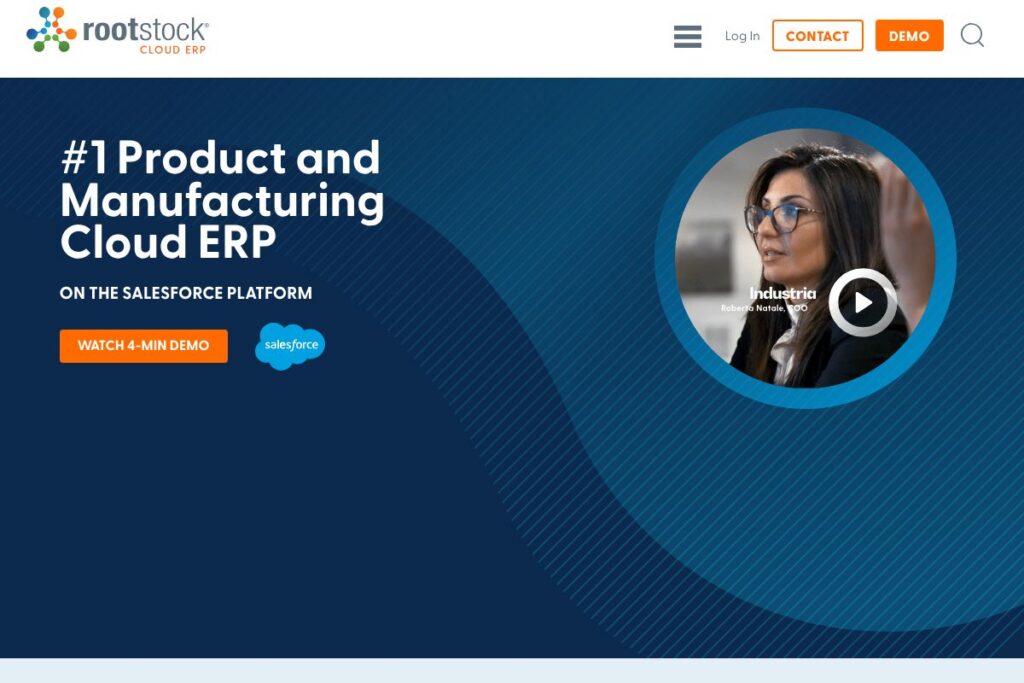
Rootstock is an enterprise cloud ERP focused on discrete, mixed-mode, and process manufacturing workflows. Built natively on the Salesforce Platform, it uses the same data model as Salesforce CRM to give manufacturers a unified view of customers, orders, and operations while enabling mobile, analytics, and AI capabilities.
Compared with broader cloud ERPs, Rootstock emphasizes manufacturing-specific processes and shop-floor integration. For example, NetSuite is a generalist cloud ERP with broad financial and commerce capabilities, Microsoft Dynamics 365 offers deep integrations for organizations already native to Microsoft stacks, and Epicor provides strong on-premise and hybrid ERP options tailored to traditional manufacturers. Rootstock stands out when teams want native Salesforce CRM connectivity and a manufacturing-first feature set.
All of this makes Rootstock particularly well suited to mid-market and enterprise manufacturers that already use Salesforce CRM or plan to adopt a Salesforce-centric technology stack. It is aimed at companies that need production planning, inventory and supply chain coordination, quality traceability, and an extensible platform for apps and AI-driven decisioning.
How Rootstock Works
Rootstock runs on the Salesforce Platform which means data lives in the same cloud and is accessible through the same security and user model. Orders entered in Salesforce CRM can flow directly into Rootstock as sales orders that drive inventory reservation, production orders, and shipping, without batch exports or separate data lakes.
The typical workflow starts with order capture in CRM, moves to material planning and production scheduling with Rootstock’s MRP engine, continues through shop-floor execution and quality checks, and ends with invoicing and financial close. Administrators can extend processes using clicks-not-code configuration, AppExchange apps, or developer APIs to connect third-party systems such as MES, PLM, or logistics providers.
Rootstock also supports mobile shop-floor activities and analytics dashboards that surface production KPIs and exception alerts. Recent product messaging highlights AI-driven capabilities and a decisioning approach that applies real-time signals to balance demand, supply, and capacity.
Rootstock features
Rootstock’s feature set centers on manufacturing operations, supply chain coordination, and native Salesforce integration. Core capabilities include MRP, production and shop-floor management, inventory and traceability, financials, and analytics, with extensibility through AppExchange and developer APIs.
Cloud-native MRP and production management
The MRP engine schedules production and generates work orders based on demand, supply, and lead times. It supports make-to-order, make-to-stock, assemble-to-order, and configure-to-order workflows, helping planners convert forecasts and orders into prioritized production runs.
Bills of Materials and engineering change control
BOM management stores structure, routing, and cost information for assemblies and subassemblies, and supports revision and change control for engineering updates. This helps maintain traceability between product designs and finished goods.
Inventory, lot and serial traceability
Inventory features include real-time quantities, lot and serial tracking, FIFO/LIFO costing options, and allocations for sales and production demands. Traceability supports compliance, recalls, and warranty workflows.
Shop-floor execution and work order management
Shop-floor capabilities let technicians record labor, machine time, nonconformance, and completion events from mobile devices. Integration with production scheduling improves visibility into order status and throughput.
Quality management and inspections
Quality workflows include inspection plans, nonconformance tracking, and corrective action follow-up. QA results can gate production or shipping, helping reduce defects and maintain compliance.
Supply chain planning and procurement
Procurement and supplier management support purchase requisitions, PO generation, supplier lead-time profiles, and receipts. Multi-echelon inventory and supplier collaboration help reduce stockouts and expedite critical items.
Financials and order-to-cash
Core financials cover accounts payable, accounts receivable, general ledger, and revenue recognition workflows that tie directly to manufacturing transactions. This supports more accurate costing and faster financial close.
Analytics, dashboards, and AI decisioning
Embedded analytics and reporting surface production KPIs, inventory aging, and order backlog metrics. Rootstock’s messaging around AI Agents and signal-chain decisioning applies real-time signals to prioritize actions and recommend corrective steps.
Salesforce-native extensibility and AppExchange
Because Rootstock is built on Salesforce, customers can add complementary apps from the Salesforce AppExchange and use native platform services like Lightning, Flow, and Einstein Analytics to extend workflows and reporting.
With these combined capabilities, Rootstock helps manufacturers manage end-to-end operations from order capture to cash collection while keeping CRM and operational data on a single platform. The biggest benefit is the reduced integration overhead for organizations that rely on Salesforce for customer and sales processes.
Rootstock pricing
Rootstock uses an enterprise, subscription-based pricing model with custom quotes tailored to company size, required modules, and deployment complexity. Because pricing is configured per engagement and frequently bundled with Salesforce subscriptions or AppExchange add-ons, Rootstock publishes pricing on a case-by-case basis.
For current licensing models, packaging, and information on enterprise agreements, view Rootstock’s contact and licensing options or reach out directly through Rootstock’s contact page to request a tailored proposal and implementation estimate.
What is Rootstock Used For?
Manufacturing operations: Rootstock is used to plan, schedule, and execute production across discrete and mixed-mode environments, including assembly lines, job shops, and contract manufacturing. It helps coordinate materials, labor, and machines to meet demand.
Supply chain and inventory control: Organizations use Rootstock to manage procurement, supplier lead times, multi-site inventory, and lot/serial traceability for compliance and recall readiness. It is also used for after-sales service and warranty management where inventory and service parts visibility is essential.
Customer-centric manufacturing: Manufacturers that want closer alignment between sales and production use Rootstock to connect CRM opportunities to production plans, enabling faster order fulfillment and improved delivery accuracy by keeping customer, order, and operational data in the same platform.
Pros and Cons of Rootstock
Pros
- Salesforce-native architecture: Built on the Salesforce Platform, Rootstock provides seamless data alignment with Salesforce CRM and platform services, reducing integration complexity and improving user adoption.
- Manufacturing-focused functionality: The product delivers deep manufacturing features such as MRP, shop-floor control, and quality management that map to common shop processes and production modes.
- Extensibility and AppExchange access: Customers can extend workflows with clicks-not-code and add specialized apps from the AppExchange for PLM, MES, or analytics.
- Traceability and compliance: Strong lot, serial, and quality controls help with recalls, regulatory requirements, and supplier accountability.
Cons
- Enterprise pricing model: Custom pricing and implementation costs can be higher than off-the-shelf SMB solutions, particularly for smaller manufacturers with limited IT budgets.
- Salesforce dependency: Organizations not already invested in Salesforce may face additional licensing and platform costs to realize the full benefit of a native deployment.
- Implementation complexity for legacy environments: Migrating from legacy on-premise ERPs or heavily customized systems can require substantial configuration and project management.
Does Rootstock Offer a Free Trial?
Rootstock does not offer a public self-serve free plan; it provides tailored demos and evaluation environments through sales and partner engagements. Prospective customers can request a personalized demo or an evaluation engagement via Rootstock’s contact page to review features, see sample data, and explore a proof-of-concept for their environment.
Rootstock API and Integrations
Rootstock provides developer and integration options that leverage the Salesforce Platform APIs, platform events, and standard integration patterns. The platform can be connected with third-party MES, PLM, logistics, and manufacturing execution systems using middleware or native AppExchange connectors.
For integration planning and developer guidance, consult the Salesforce developer resources and Rootstock’s own integration and partner materials available through Rootstock’s resources.
10 Rootstock alternatives
Paid alternatives to Rootstock
- NetSuite — A cloud ERP with broad financials, commerce, and inventory capabilities that suits businesses seeking a single vendor for back-office and commerce operations.
- SAP S/4HANA Cloud — Enterprise-grade ERP with deep industry features and advanced analytics designed for large manufacturers and multinational operations.
- Microsoft Dynamics 365 — Flexible ERP and CRM combined with Microsoft platform services that integrate well for organizations invested in the Microsoft ecosystem.
- Infor CloudSuite Industrial — Manufacturing-focused ERP with strong shop-floor and industry-specific functionality for discrete and process manufacturers.
- Epicor ERP — ERP with long-standing manufacturing capabilities and options for on-premise, cloud, and hybrid deployments.
- IFS Cloud — ERP and EAM suite targeted at asset-intensive and project-based manufacturers with global deployment needs.
- Plex Systems — Cloud-native manufacturing ERP emphasizing shop-floor visibility, MES integration, and discrete manufacturing execution.
Open source alternatives to Rootstock
- Odoo — Modular open-source ERP with manufacturing, inventory, and MRP modules that can be extended and self-hosted for cost-sensitive deployments.
- ERPNext — Open-source ERP built for small and medium manufacturers, offering MRP, inventory, and quality workflows with a modern web interface.
- Dolibarr — Lightweight open-source ERP/CRM suitable for small manufacturers seeking basic inventory and order management without heavy licensing costs.
- Tryton — A modular open-source platform that includes accounting and inventory modules, adaptable for custom manufacturing workflows.
Frequently asked questions about Rootstock
What industries does Rootstock target?
Rootstock targets manufacturing and supply chain organizations, including discrete, mixed-mode, and contract manufacturers. It is also used by distributors and OEMs that require manufacturing and inventory traceability integrated with CRM.
Does Rootstock integrate with Salesforce CRM?
Yes, Rootstock is built natively on the Salesforce Platform and integrates directly with Salesforce CRM. That native integration enables a single data model for customers, orders, and operational records.
How is Rootstock priced?
Rootstock uses custom enterprise subscription pricing tailored to a customer’s modules, user count, and implementation needs. For specific cost estimates and licensing options, contact Rootstock via Rootstock’s contact page.
Does Rootstock provide an API for integrations?
Yes, Rootstock leverages Salesforce Platform APIs and integration patterns for developer access and third-party connections. Integrations commonly use platform events, REST APIs, and AppExchange connectors.
Can Rootstock support mixed-mode manufacturing environments?
Yes, Rootstock supports make-to-order, make-to-stock, assemble-to-order, and configure-to-order workflows. The system’s MRP and production modules are designed to handle mixed production modes and complex BOM structures.
Final verdict: Rootstock
Rootstock is a purpose-built cloud ERP for manufacturers that gains its primary advantage from being native to the Salesforce Platform. It combines manufacturing-oriented capabilities such as MRP, shop-floor execution, and traceability with the data model and extensibility of Salesforce, making it a strong choice for manufacturers that want CRM and operations on a single platform.
Compared with NetSuite, which offers a broad cloud ERP suite with strong financials and commerce features, Rootstock is more manufacturing-focused and provides tighter out-of-the-box alignment with Salesforce CRM. Pricing for both platforms is typically subscription-based and customized, but Rootstock can be more cost-effective for organizations already licensed for Salesforce because it avoids cross-platform integration work and uses the same platform services for analytics and app extensions.
For manufacturers with complex production processes and existing Salesforce investments, Rootstock is a compelling option. Organizations without a Salesforce footprint should weigh platform licensing and longer-term roadmap alignment when evaluating Rootstock versus alternative ERPs.