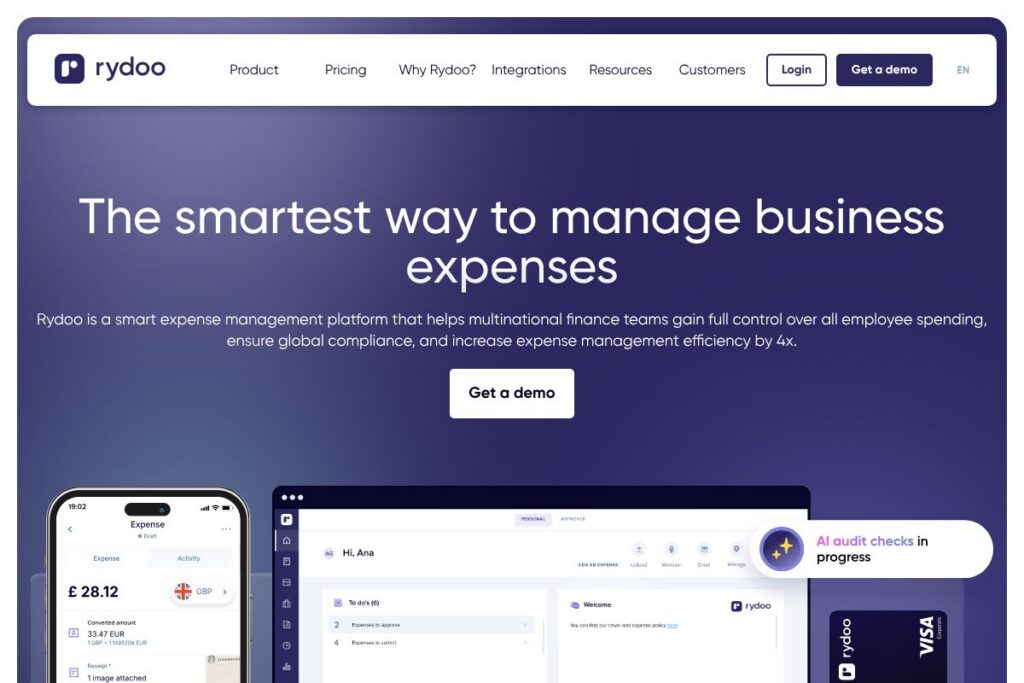

What is Rydoo
Rydoo is an expense management platform that automates expense capture, approval workflows, and reimbursement for businesses of all sizes. It centralizes receipts, enforces expense policies, and connects employee spending to finance systems so teams reduce manual work and speed up close cycles.
Compared with SAP Concur, Rydoo focuses on rapid deployment and a simpler user experience for expense capture and approvals rather than a full travel and invoice suite. Against Expensify, Rydoo emphasizes enterprise-grade controls, multi-country compliance, and integrations with ERP systems. Compared to Zoho Expense, Rydoo scales more directly for multinational finance teams that need granular policy enforcement and currency handling.
Rydoo does particularly well at automating receipt capture and approvals while keeping global compliance and multi-currency support straightforward. This combination makes it well suited to multinational finance teams and companies that need fast reimbursement cycles without rebuilding integration layers.
How Rydoo Works
Expense capture begins on the mobile app or web interface where employees snap receipts, import card feeds, or forward invoices. Rydoo extracts key fields with OCR, matches expenses to corporate card transactions where available, and applies policy checks to flag exceptions before approval.
Approvals follow configurable workflows that route items to managers or finance based on amount, employee role, or country rules. Back-office teams reconcile and export validated expense data to accounting and ERP systems through prebuilt connectors or APIs, shortening reimbursement cycles and reducing manual reconciliation.
What does Rydoo do?
Rydoo bundles mobile-first receipt capture, policy enforcement, real-time approvals, corporate card reconciliation, and analytics into a single expense management workflow. The platform supports multi-currency processing, per-diem rules, VAT handling, and local compliance for global operations, and Rydoo continues to expand its connector library for finance and travel systems.
Let’s talk Rydoo’s Features
Receipt capture and OCR
The mobile app lets users photograph receipts and import invoices; OCR extracts merchant, date, amount, and VAT to populate expense fields automatically. This reduces manual entry and accelerates submission while improving data consistency for finance teams.
Policy engine and compliance
Configurable rules let admins enforce spending limits, allowed categories, and country-specific VAT or per-diem policies at submission time. Automatic policy checks reduce exceptions and speed approvals by surfacing only the items that need manual review.
Real-time approvals and mobile workflows
Managers can approve or request more information directly from the mobile app or web dashboard, while notifications keep processes moving. The ability to attach receipts, add comments, and route items conditionally keeps turnaround times short and employees reimbursed faster.
Corporate card reconciliation and payment feeds
Rydoo links corporate card feeds and matches transactions to submitted receipts to automate reconciliation and reduce unmatched items. Matched expenses flow to finance systems with explanatory metadata, cutting down on month-end cleanup.
Integrations and data export
The platform provides connectors to accounting, ERP, HR, and travel systems so expense data synchronizes with the broader finance stack. For a catalog of supported systems see Rydoo’s integrations page to confirm connectivity for your environment.
Reporting and analytics
Built-in reports and dashboards summarize spend by department, project, or policy exception to help finance teams spot trends and control costs. Exportable datasets allow custom analysis and integration into broader BI workflows.
With these capabilities Rydoo aims to reduce manual processing, speed reimbursement, and keep multi-country compliance under centralized control. The biggest benefit is end-to-end automation from receipt capture to export, which frees finance teams to focus on exceptions and analysis.
Rydoo pricing
Rydoo uses a business-oriented pricing model that is typically tailored to company size, deployment scope, and integration needs rather than fixed public price tiers. For specific plans, seat-based or enterprise quotes, and bundling with AR or travel modules, see Rydoo’s website to request a custom quote or demo.
What is Rydoo Used For?
Rydoo is commonly used to automate employee expense capture and reimbursement processes so finance teams reduce manual entry, improve accuracy, and speed up approvals. It is especially useful for organizations with frequent cross-border expenses, multiple currencies, and local VAT or per-diem rules.
Ideal users include multinational finance teams, companies that issue corporate cards, and organizations that want to consolidate expense data into ERP or accounting systems. Rydoo is also used by firms looking to improve employee experience by shortening reimbursement cycles and reducing paperwork.
Pros and cons of Rydoo
Pros
- Fast expense capture: Mobile OCR and card feeds reduce manual data entry and speed submissions for employees.
- Global compliance focus: Strong multi-currency, VAT handling, and per-diem support help multinational teams comply with local rules.
- Integration-ready: Prebuilt connectors and export options simplify synchronization with ERP, accounting, HR, and travel systems.
- Customer success support: Dedicated onboarding and multilingual support shorten time-to-value during rollout.
Cons
- Custom pricing model: Enterprise-oriented pricing can make initial cost comparisons harder for small businesses that prefer transparent per-user plans.
- Feature overlap with travel tools: Organizations seeking a combined travel booking and expense solution may need additional travel tooling alongside Rydoo.
- Implementation scope for complex ERPs: Deep integration into large ERP landscapes can require professional services and additional configuration.
Does Rydoo Offer a Free Trial?
Rydoo offers demos and tailored trial options for prospective customers. Interested teams can request a demo or trial through Rydoo’s website to evaluate the mobile capture, approval workflows, and integrations with sample data, and sales can outline pilot terms for a limited rollout.
Rydoo API and Integrations
Rydoo provides integrations with over 35 finance, ERP, HR, and travel tools and supports syncing expense data, card feeds, and reconciliation metadata. For a full list of supported systems consult Rydoo’s integrations page to confirm compatibility with your finance stack.
For automation and custom integrations Rydoo exposes developer endpoints and API capabilities to push or pull expense data; see Rydoo’s developer resources or contact their support team for access to API documentation and onboarding guidance.
10 Rydoo alternatives
Paid alternatives to Rydoo
- SAP Concur – Comprehensive travel and expense suite that targets large enterprises with deep travel booking and invoice capabilities.
- Expensify – User-friendly expense capture and receipt scanning with clear per-user plans, suited for small to mid-size teams.
- Certify – Expense management with travel integration and reporting features focused on midsize enterprises.
- Zoho Expense – Cost-effective expense solution integrated into the Zoho ecosystem with multi-currency support.
- Brex – Combines corporate card issuance with expense management and spend controls for startups and scaling companies.
- Airbase – Broader spend management platform that covers bills, corporate cards, and expense reporting for finance teams.
Open source alternatives to Rydoo
- Odoo – Open source ERP with an expense module that can be self-hosted and customized to match internal workflows.
- ERPNext – Full open source ERP including expense claims and reimbursement features suitable for teams that want self-hosted control.
- Dolibarr – Modular open source ERP/CRM that includes expense tracking and simple reimbursement features for small organisations.
Frequently asked questions about Rydoo
What is Rydoo used for?
Rydoo is used to automate expense capture, approvals, and reimbursements across organizations. It centralizes receipts, enforces expense policies, and exports validated data to finance systems.
Does Rydoo integrate with accounting and ERP systems?
Yes, Rydoo integrates with many accounting, ERP, HR, and travel systems. You can view supported connectors on Rydoo’s integrations page and confirm specific endpoints for your stack.
Can Rydoo handle multi-currency and VAT rules?
Yes, Rydoo supports multi-currency processing and local VAT handling. The platform includes per-diem and country-specific rules to help multinational teams remain compliant.
Is there API access for Rydoo?
Yes, Rydoo provides API access for automation and custom integrations. Contact Rydoo or consult their developer resources to obtain API documentation and integration guidance.
How does Rydoo speed up reimbursements?
Rydoo speeds reimbursements by automating receipt capture, matching card transactions, and enabling real-time approvals. Reduced manual reconciliation and automated exports to accounting systems shorten reimbursement and close cycles.
Final verdict: Rydoo
Rydoo is a focused expense management platform that emphasizes fast receipt capture, policy-driven approvals, and multi-country compliance. It is particularly well suited to multinational finance teams that need centralized control and integrations with ERP or accounting systems while keeping employee-facing workflows simple.
Compared with a competitor like Expensify, Rydoo leans more toward enterprise controls and integration depth while Expensify often offers more transparent, self-serve pricing for smaller teams. In practice Rydoo suits organizations that prioritize global compliance and tight ERP synchronization, while teams seeking a low-friction, per-user billed option may prefer a competitor with public pricing.