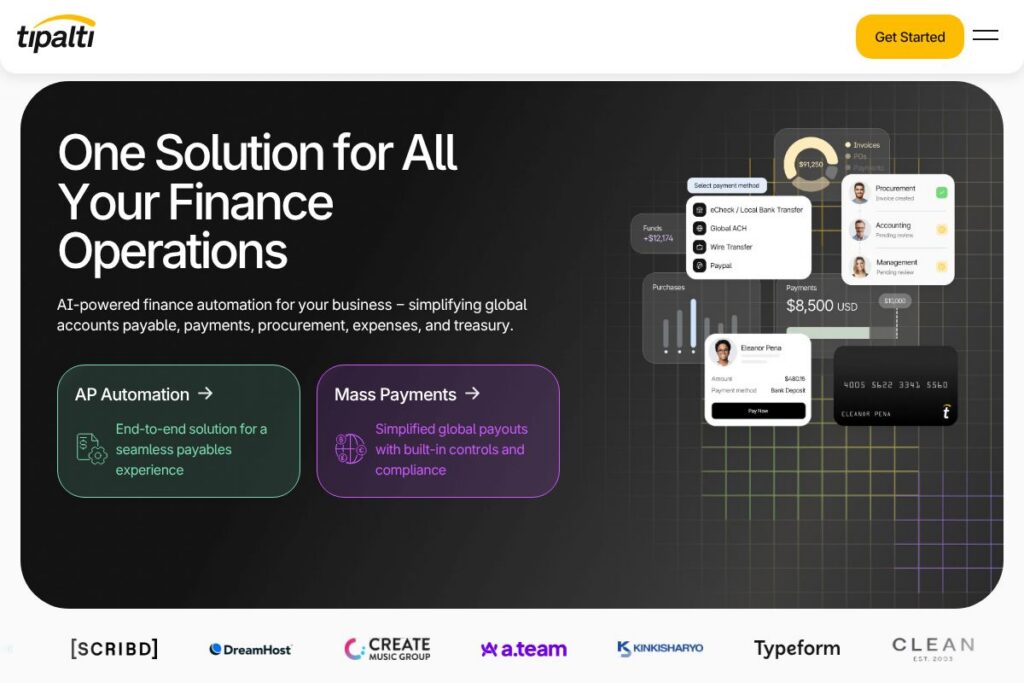

Tipalti: An Overview
Tipalti is a unified finance operations suite designed to automate accounts payable, mass payments, procurement, expense management, and treasury workflows. It combines supplier onboarding, invoice processing, multi-currency payment execution, tax compliance, and reconciliation in a single system that is built for businesses with global suppliers and multiple entities.
Compared with other players in the payables space, Tipalti focuses on global scale and automation. Bill.com tends to target small to midmarket US-centric workflows and simpler vendor payments, while Coupa and SAP Concur are broader procure-to-pay and expense ecosystems aimed at large enterprises with deep procurement needs. Tipalti sits between these approaches by offering enterprise-grade controls and global payout rails while keeping the operational model focused on AP automation and multi-entity finance operations.
All of this makes Tipalti well suited to companies that need end-to-end payables automation and global payment coverage. It is particularly applicable for businesses that pay large networks of suppliers, publishers, affiliates, or contractors across many currencies and countries and require tighter compliance and reconciliation capabilities.
How Tipalti Works
Tipalti centralizes payables operations around a few core flows: supplier onboarding, invoice capture and PO matching, approvals, and payment execution. Suppliers use a self-service portal to register and submit tax forms; Tipalti validates identity and tax documents, then funnels invoices into an automated approval path with configurable rules.
Payments are executed through Tipalti’s global rails with support for many currencies and payment methods; the system handles FX, tax withholding, and payment protections, then posts settled transactions back to connected ERPs. Finance teams typically connect Tipalti to their ERP or accounting system using pre-built connectors or the platform API to keep ledgers and bank reconciliation aligned.
Practical workflows include automated mass payouts for content creators and affiliates, paying international supplier networks with PO matching for manufacturing procurement, and consolidating multi-entity payables into a single operational view to enforce controls and shorten payment cycles.
Tipalti features
Tipalti combines AI-assisted automation, global payment rails, supplier self-service, and compliance tools to reduce manual AP work and improve control. The platform emphasizes cross-border payments, multi-entity management, and integrations with ERPs and business systems to deliver one connected finance stack.
Here are some key features worth highlighting:
AI-driven invoice processing
AI extracts invoice data, matches invoices to POs and contracts, and classifies exceptions for routing, reducing manual data entry and speeding approvals. This lowers touch points in high-volume payables environments and helps teams scale without hiring proportionally more staff.
Global mass payments
Tipalti supports cross-border payments to a large set of countries, currencies, and payout methods to simplify international payouts for suppliers, publishers, and affiliates. The platform handles FX conversions, local payment rails, and batch processing to reduce fees and operational complexity.
Supplier onboarding and self-service portal
A branded supplier portal allows suppliers and contractors to register, upload tax documents, and manage payment preferences without manual intervention. That streamlines KYC, tax form collection, and reduces onboarding time for large supplier populations.
Tax, compliance, and payment protections
Built-in tax form collection, withholding, and multi-jurisdictional compliance routines help finance teams enforce regulatory requirements across regions. Payment protections and fraud controls are included to reduce exposure on large cross-border payouts.
Procurement and PO matching
PO creation, three-way invoice matching, and exception management help enforce procurement controls and ensure invoices reconcile to committed spend. These controls are useful for manufacturing, retail, and other procurement-heavy industries.
Expense management
Employee and corporate card expense capture integrates with AP workflows so reimbursements, card reconciliation, and policy enforcement are handled alongside supplier payables. That produces consistent controls and a single ledger view of spend.
Multi-entity and multi-brand support
Manage payables across subsidiaries, legal entities, and brands from one system with central controls and entity-level reporting. This reduces duplicate processes and provides consolidated visibility for treasury and finance leaders.
Integrations and API
Pre-built connectors and a developer API allow Tipalti to sync with ERPs, accounting systems, HRIS, SSO providers, performance marketing platforms, and collaboration tools. That integration framework supports end-to-end automation and single-source financial records.
Real-time cash flow and treasury tools
Dashboarding and reporting show payment schedules, cash positions, and projected outflows to help teams manage liquidity and prioritize payments. These tools make it easier to optimize working capital across multiple bank accounts and entities.
Reporting and audit trail
Comprehensive audit logs, role-based access controls, and exportable reports support internal audits and external compliance requirements. The auditability of every approval and payment makes reconciliation and regulatory reporting more straightforward.
Overall, Tipalti’s biggest benefit is consolidating end-to-end payables and payments operations while keeping global compliance and reconciliation tightly integrated. That single-system approach reduces manual handoffs and improves the speed and reliability of supplier payments.
Tipalti pricing
Tipalti uses an enterprise SaaS pricing model with custom plans tailored to business size, global payment volume, and required modules; there are no publicly listed per-user subscription prices. Pricing typically reflects the scope of services selected, such as global payment coverage, the number of entities, and integration or implementation needs.
For an accurate quote and details about plan options, contact Tipalti’s sales team or request a demo through Tipalti’s contact page. You can also review Tipalti’s general product and solution descriptions on Tipalti’s website to match capabilities to your organization’s needs.
What is Tipalti Used For?
Tipalti is commonly used to automate accounts payable processes for companies that operate internationally or that have large payee populations, such as publishers, ad networks, marketplaces, and manufacturing suppliers. It is especially useful where manual AP processes create bottlenecks, compliance risks, or costly payment errors.
Finance teams also use Tipalti to consolidate payables from multiple entities into a single workflow, to handle complex tax and withholding requirements across jurisdictions, and to improve visibility into cash flow and payment timing. Procurement and operations teams benefit from PO matching and automated approvals that reduce delays and exceptions.
When to choose Tipalti typically depends on global payment needs, the volume of suppliers or contractors, and the requirement for enterprise-grade controls and auditability. Organizations that need a single platform to manage payables, payments, procurement, and expenses will see the most value.
Pros and cons of Tipalti
Pros
- Global payment coverage: Tipalti supports cross-border payments to many countries and currencies, simplifying international payouts and FX handling. This reduces the need to manage multiple local payment processors.
- End-to-end automation: Automated onboarding, invoice capture, PO matching, approvals, and reconciliation cut manual work and shorten payment cycles. Teams see fewer exceptions and faster supplier payments.
- Compliance and controls: Built-in tax collection, withholding, fraud protections, and audit trails help enforce multi-jurisdictional compliance. This is helpful for regulated industries and multi-entity corporations.
- Strong integrations: Pre-built connectors and an API enable synchronization with ERPs, HRIS, and payment systems, reducing reconciliation gaps and duplicate data entry.
Cons
- Enterprise orientation: Pricing and implementation are tailored to midmarket and enterprise customers, which may be more than smaller businesses need. Smaller companies with simple US-only payables may find lighter tools more cost-effective.
- Implementation complexity: Configuring cross-entity rules, workflows, and integrations requires planning and implementation effort. Organizations should budget for professional services or internal project time.
- Limited public pricing transparency: Without public pricing tiers, procurement teams must engage sales to obtain quotes, which can lengthen vendor evaluation cycles.
Does Tipalti Offer a Free Trial?
Tipalti does not offer a public free plan, but it provides demos and evaluation trials for qualified customers. Prospective customers can request a demo or discuss a trial with Tipalti’s sales team via Tipalti’s contact page to assess fit before committing to a custom plan.
Tipalti API and Integrations
Tipalti provides APIs and a broad set of pre-built integrations for ERPs, accounting systems, HRIS platforms, SSO providers, performance marketing tools, and communication apps like Slack. The integration directory covers common stacks so finance teams can connect Tipalti to upstream systems and automate data flows.
Developers can consult Tipalti’s developer API documentation for endpoints related to suppliers, invoices, payments, and reconciliation to build custom connectors or embed Tipalti functions into internal systems. For integration options, see Tipalti’s integrations resources.
10 Tipalti alternatives
Paid alternatives to Tipalti
- Bill.com – Focuses on AP automation for SMBs and midmarket firms with simpler US-centric payment options and clear subscription tiers for smaller teams.
- Coupa – A comprehensive procure-to-pay platform that emphasizes strategic sourcing, procurement controls, and supplier management for large enterprises.
- SAP Concur – Known for expense management and travel spend, Concur integrates expense workflows with corporate AP for organizations with extensive travel and T&E needs.
- AvidXchange – Specializes in accounts payable automation with strong payment processing and supplier onboarding for middle-market companies.
- Airbase – Combines spend management, corporate cards, bill pay, and approvals in one platform aimed at scaling companies that want integrated expense and AP control.
- Stampli – Emphasizes invoice collaboration and AI-driven exception resolution to speed invoice approvals and improve audit readiness.
- Melio – Targets small businesses with a user-friendly payables platform and straightforward payment options for domestic payments.
Open source alternatives to Tipalti
- Odoo – An open-source ERP with accounting and purchase modules that can be configured for AP workflows and supplier management.
- ERPNext – A full-featured open-source ERP that includes purchase, supplier, and payment workflows suitable for small to midmarket teams that can self-host.
- Dolibarr – A lightweight open-source business suite with invoicing and supplier modules that can be extended for basic AP needs.
- Tryton – A modular open-source ERP that includes purchasing and accounting modules for teams willing to customize an AP solution.
Frequently asked questions about Tipalti
What does Tipalti do for accounts payable?
Tipalti automates the entire accounts payable lifecycle from supplier onboarding to payment execution. It handles invoice capture, PO matching, approvals, global payment rails, and reconciliation to reduce manual processing and improve controls.
Does Tipalti integrate with ERPs and accounting systems?
Yes, Tipalti offers pre-built integrations and API access for ERPs and accounting platforms. These integrations keep the general ledger synchronized and reduce duplicate data entry between finance systems.
How does Tipalti handle tax compliance?
Tipalti provides built-in tax form collection, withholding, and multi-jurisdictional compliance features. The platform automates tax document collection from suppliers and applies withholding rules where required.
Can Tipalti pay international suppliers?
Yes, Tipalti supports global payments to many countries and currencies via multiple payment methods. This includes local rails and FX handling to simplify cross-border payouts and reduce payment friction.
How much does Tipalti cost?
Tipalti uses enterprise pricing tailored to each customer’s scale and feature needs. To get pricing details and a quote, contact Tipalti’s sales team or request a demo on Tipalti’s contact page.
Final verdict: Tipalti
Tipalti excels at automating high-volume, global payables operations by combining supplier onboarding, tax compliance, multi-currency payments, and reconciliation into a single platform. Its strengths are in reducing manual AP work, enforcing controls across entities, and handling the complexity of international payouts.
Compared with Bill.com, which publishes simpler plans and targets smaller, primarily domestic workflows, Tipalti delivers broader global payment rails and enterprise controls at custom pricing. Organizations with international suppliers, multiple entities, or large creator and affiliate networks will find Tipalti’s focus on scale and compliance a strong fit, while smaller businesses with straightforward US payables may prefer a more lightweight, price-transparent solution like Bill.com.