
Benchling: An Overview
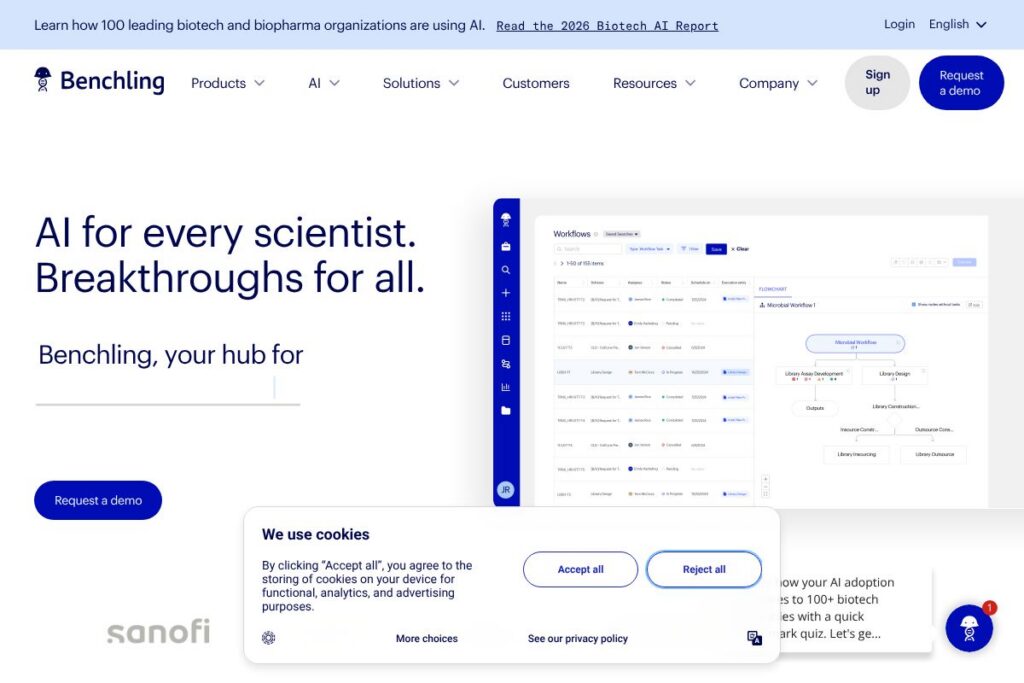
Benchling is a cloud-native platform built specifically for biotechnology research and development, combining an electronic lab notebook, sample and registry management, workflow automation, and analytics into a single data model. It focuses on biology-first needs so teams can capture experimental context, link records to molecular designs and samples, and preserve provenance across discovery, pre-clinical, and process development.
Benchling competes with general ELN and LIMS vendors but differentiates through an integrated biological data model and instrument connectivity. Compared with Dotmatics, which emphasizes cheminformatics and analytics for chemical workflows, Benchling is tailored to sequence- and sample-centric biology workflows. Compared with Labguru, which offers lab management and inventory, Benchling puts more emphasis on structured biomolecular registries and computational tooling to support sequence design and tracking.
All of this makes Benchling particularly strong for molecular biology, cell therapy, biologics process development, and cross-disciplinary R&D teams that need a single source of truth for experiments, reagents, and derived data. It is suited to organizations scaling lab operations that require audit trails, collaboration features, and integrations with instruments and data systems.
How Benchling Works
Benchling organizes scientific work around a unified data model that links experiments, samples, and biomolecular constructs. Users author protocols and experimental notes in the ELN, attach data files and instrument outputs, and connect those records to registered entities such as plasmids, cell lines, antibodies, and reagents.
Workflows can be automated with templates and rules to reduce repetitive tasks such as sample registration, labeling, and notifications. Teams access shared registries and dashboards to track sample lineage and experimental outcomes, while permissioning and audit logs help meet compliance needs. Benchling also exposes APIs and integrations so instrument data and external analysis pipelines can feed directly into the platform.
What does Benchling do?
Benchling is designed to digitize lab processes, reduce manual data entry, and support reproducible science. Core capabilities include a collaborative electronic lab notebook, structured registries for molecules and samples, workflow automation, instrument and file integration, and analytics for operational visibility. The platform has been enhanced with AI tools aimed at reducing repetitive tasks and helping scientists draft and summarize experimental notes.
Let’s talk Benchling’s Features
Electronic Lab Notebook (ELN)
The ELN provides a cloud-native interface for planning, recording, and sharing experiments with rich text, images, sequence viewers, and attached data files. It supports real-time collaboration, versioning, and audit logs so teams can co-author experiments and preserve provenance across study lifecycles.
Molecular and Sample Registries
Structured registries let teams register and track biomolecules, cell lines, animals, reagents, and batches with metadata, relationships, and lineage. This makes it easier to find samples, enforce naming conventions, and trace experimental dependencies back to source materials.
Workflow Automation and Protocols
Automated workflows and protocol templates reduce repetitive tasks by standardizing procedure steps, routing approvals, and auto-creating records such as sample entries or inventory updates. Rules and triggers enable notifications and downstream processing when predefined conditions are met.
Inventory and Sample Tracking
Inventory management links physical samples to digital records and physical locations, supporting barcode labels, freezer maps, and chain-of-custody tracking. This helps labs reduce sample loss, simplify audits, and speed up sample retrieval.
Sequence Design and Molecular Tools
Built-in molecular editors and sequence viewers support plasmid and construct design, annotation, and in-context visualization. Those tools integrate directly with registries and experimental records so designs are tracked alongside experimental outcomes.
Data Integration and Instrument Capture
Benchling can ingest instrument outputs and connect with lab software, data lakes, and cloud storage so raw files and derived results are linked to experiments. Integrations reduce manual uploads and enable downstream analytics across datasets.
Analytics, Reporting, and Insights
Dashboards and reporting tools aggregate operational and experimental metrics, helping teams monitor throughput, reagent usage, and experiment success rates. Custom analytics use the unified data model to answer cross-study questions without manual data reconciliation.
AI-assisted Productivity Tools
AI features assist with drafting experiment notes, summarizing results, and automating routine data curation tasks to reduce manual effort. These tools are designed to integrate into existing workflows so scientists retain control while benefiting from automation.
With these capabilities, Benchling helps organizations capture reproducible experimental records, scale lab operations, and connect wet lab activity to computational workflows for faster iteration.
Benchling pricing
Benchling uses an enterprise SaaS pricing model with custom plans tailored to organization size, required modules, integrations, and support levels. Pricing is typically structured around seat counts, module selection, and deployment requirements for production and compliance use.
Benchling does not publish standardized public pricing; for current costs and to discuss deployment options, contact the team via the Benchling contact page to request a tailored quote or demo.
What is Benchling Used For?
Benchling is used to digitize laboratory records, register and track samples, and run standardized workflows across discovery, in vivo studies, bioprocess development, and quality operations. Teams use it to reduce manual data entry, establish sample lineage, and provide a single source of truth for experiments and reagents.
It is particularly valuable for research groups working with sequences and biological samples, such as molecular biology labs, cell and gene therapy groups, biologics process teams, and translational research organizations that need to scale collaboration and ensure reproducibility.
Pros and Cons of Benchling
Pros
- Biology-first data model: The platform models biomolecules, cell lines, animals, and reagents natively, making relationships and provenance easier to manage across experiments.
- Integrated ELN and registries: Linking experimental records to structured registries reduces duplication and simplifies sample tracking and traceability.
- Automation and instrument connectivity: Workflow automation and instrument integrations cut down manual steps and accelerate data capture for high-throughput environments.
- Collaboration and compliance features: Real-time collaboration, permissioning, version history, and audit logs support cross-team work and regulatory workflows.
Cons
- Enterprise-focused pricing: The vendor pricing model is tailored to organizations, which can be a higher initial investment for small labs or academic groups seeking lightweight solutions.
- Customization learning curve: Configuring registries, workflows, and integrations to fit complex or novel R&D processes requires planning and operational investment.
- Module complexity for small teams: Some advanced features and modules add complexity that may be unnecessary for single-user or very small labs.
Does Benchling Offer a Free Trial?
Benchling offers demos and enterprise trial options rather than a publicly advertised free plan. Prospective customers can request a demo or pilot through sales to evaluate platform capabilities; academic or small-lab arrangements may be available through direct discussions with the Benchling team.
Benchling API and Integrations
Benchling provides developer APIs and integration capabilities to automate record creation, push and pull experimental data, and connect with analysis pipelines. The Benchling API documentation describes endpoints for entities such as sequences, samples, and notebook entries and includes examples for common workflows.
Key integrations include single sign-on providers, cloud storage and S3 buckets, LIMS and ERP connectors, instrument data ingestion, and common collaboration tools. For details on supported integrations and partner connectors, see the Benchling integration options.
10 Benchling alternatives
Paid alternatives to Benchling
- Dotmatics – A scientific informatics platform with strengths in cheminformatics, data visualization, and analytics for chemical and biological R&D.
- Labguru – An ELN and lab management suite focused on inventory, protocol management, and basic LIMS features for mid-sized labs.
- PerkinElmer Signals – An R&D informatics platform with experiment management, analytics, and instrument connectivity suitable for enterprise labs.
- Thermo Fisher SampleManager – A comprehensive LIMS and ELN solution aimed at regulated environments and large-scale laboratory operations.
- RSpace – An electronic lab notebook with integrated data management and collaboration for academic and industrial labs.
- Colabra – A research notebook and collaboration platform designed to link hypotheses, experiments, and results in a lightweight interface.
Open source alternatives to Benchling
- eLabFTW – An open-source electronic lab notebook with sample tracking and basic inventory management for labs preferring self-hosting.
- openBIS – A data management system for life sciences that supports experiment and dataset organization with customizable schemas.
- LabKey – An open-source platform for managing, integrating, and sharing biomedical research data with pipeline and dashboard capabilities.
Frequently asked questions about Benchling
What is Benchling used for?
Benchling is used to manage laboratory data, register samples, and run standardized research workflows. Teams use it to centralize experimental records, link constructs and samples, and enable reproducible science across projects.
Does Benchling offer an API for automation?
Yes, Benchling provides a developer API for programmatic access to records and data. The Benchling API documentation explains available endpoints and integration patterns for common use cases.
Can Benchling integrate with lab instruments and storage?
Yes, Benchling supports instrument data capture and cloud storage integrations. Connections reduce manual uploads and allow experiment records to include raw and processed data linked to registry entities.
How does Benchling handle compliance and audit trails?
Benchling includes version history, permission controls, and audit logs to support compliance workflows. These features help with traceability, review cycles, and regulated study requirements.
Is Benchling suitable for small academic labs?
Benchling can be used by academic and small labs, but pricing and module selections are typically tailored per customer. Many groups begin with demos or pilot programs to confirm fit and scope before wider deployment.
Final verdict: Benchling
Benchling excels at providing a biology-first, unified platform for R&D teams that need to connect molecular designs, samples, and experimental records into a single source of truth. Its ELN, structured registries, automation, and integrations are well suited to teams working on molecular biology, cell therapies, and biologics process development where sample lineage and reproducibility are critical.
Compared with Dotmatics, which is strong in cheminformatics and analytics, Benchling is more focused on sequence and sample-centric biology workflows and on linking wet-lab operations to computational science. Pricing for both platforms is enterprise-focused and typically custom quoted; Benchling emphasizes module-based scaling and operational integration while Dotmatics often structures licensing around analytical modules and user roles.
For organizations that need a platform purpose-built for modern biology workflows and that plan to scale lab operations, Benchling provides a comprehensive set of tools to reduce manual work and improve data continuity. To discuss deployment options or obtain a tailored quote, contact Benchling through the Benchling contact page.